

Key Takeaway
- Win-loss analysis unlocks why deals are won or lost—critical for enterprise sales teams managing complex, multi-stakeholder deals
- Organizations using structured win-loss analysis see 15-30% improvement in win rates
- Revenue Grid automates data collection and analysis for real-time insights across Salesforce, email, and calendar systems
- Success requires clear objectives, unbiased data collection, and systematic action on findings
- Start your win-loss analysis journey with a free Revenue Grid demo
Do you really know why your team wins or loses a deal? What makes existing customers buy from you? What do they think about your offerings? For enterprise sales teams facing long deal cycles, organizations in regulated industries like finance and healthcare, and distributed sales forces managing complex, multi-stakeholder deals, understanding the true drivers of wins and losses is even more critical. If you haven’t had answers to these questions, then you may not have a sales win-loss analysis in place.
In this article, we’ll walk you through the basics of a sales win-loss analysis and how you can implement it to improve your sales revenue.
What Is Win-Loss Analysis?
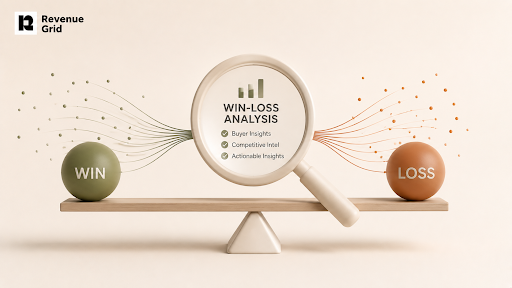
A sale win-loss analysis is a comprehensive review of factors affecting customers’ buying decisions, sales performance, and sales efficiency. It provides you with strategic insights that can help you fill in the gaps between products and sales enablement, improve sales reps’ productivity, and win more deals.
Win-loss analysis has evolved from simple post-mortem reviews to sophisticated, data-driven processes that integrate qualitative buyer feedback with quantitative performance metrics. In the current competitive landscape, organizations use win-loss analysis to understand buyer behavior, competitive positioning, and internal process effectiveness.
A win-loss analysis also involves finding a win-loss ratio over a specific period of time. The typical win-loss ratio formula is:
Won opportunities/lost opportunities
Who Benefits Most from Win-Loss Analysis?
- Enterprise sales teams with complex deal cycles
- Tech/SaaS companies with competitive markets
- Regulated industries (finance, healthcare, government)
- Distributed/global sales forces
- Organizations managing multi-stakeholder buying processes
- Companies experiencing declining win rates or longer sales cycles
Who Is Win-Loss Analysis Essential For?
After reading the proposal, a customer signed up for a contract with your business — it’s a win. If they didn’t, it’s a loss. But it’s one thing to close a deal; understanding what motivated that customer to buy and using those insights to win more clients is another.
According to the book Win/Loss Analysis: How to Capture and Keep the Business You Want by Ellen Naylor, a win-loss analysis when done right, can increase a business’s win rates by 15 to 30%. Typically, it helps you:
- Understand why existing customers buy from you. From that, your sales reps can tailor your messages to connect with them deeper and maintain a long-lasting relationship with them.
- Find out why customers choose you over your competitors. Is it because of your high-quality products or because of your excellent customer service? Having this insight will help you determine your unique value propositions.
- Identify the gaps between sales and marketing, including communications and workflows.
- Provide sales leaders and managers with better insights into how a business is performing overall. They can then use that information to develop success frameworks to improve the business across the board.
Common Objectives and Strategies for Win-Loss Analysis
Before conducting win-loss analysis, organizations must establish clear objectives and strategies to ensure actionable outcomes. Setting specific goals helps align stakeholders and defines success metrics.
Typical Objectives Include:
- Improving Sales Process: Identify bottlenecks, ineffective stages, or missing steps in the sales methodology
- Understanding Buyer Decisions: Uncover the real factors influencing purchase decisions beyond stated requirements
- Competitive Intelligence: Learn how prospects evaluate alternatives and what differentiates winning proposals
- Product Development: Gather feedback on feature gaps, pricing concerns, or market positioning
- Sales Enablement: Identify training needs, messaging improvements, or tool requirements
Strategic Approaches:
- Stakeholder Alignment: Ensure sales, marketing, product, and executive teams agree on priorities and success metrics
- Systematic Methodology: Develop consistent processes for data collection, analysis, and action planning
- Continuous Improvement: Establish regular review cycles and feedback loops to refine the analysis process
- Cross-Functional Integration: Connect win-loss insights to broader business strategies and decision-making
Data Needed for Win-Loss Analysis
To conduct a win-loss analysis, you need data. Effective win-loss analysis requires both qualitative and quantitative data sources to provide a complete picture of deal outcomes. Here are some sources of data you should collect:
Quantitative Data Sources:
- Data from your CRM, sales tools, and revenue platforms
- Deal progression metrics (time in stages, conversion rates, deal velocity)
- Competitive win/loss rates by competitor, product, or market segment
- Revenue impact and deal size analysis
- Data from other departments like marketing, supply chain, and finance
- Industry data and market data — it’s useful to collect these types of data so you can know how well you’re doing compared with your competitors and industry benchmark.
Qualitative Data Sources:
- Data from your sales team collected through surveys and interviews
- Data from your customers and buyers collected through surveys and interviews
- Buyer interview feedback on decision criteria, evaluation process, and vendor comparisons
- Sales team insights on deal dynamics, stakeholder relationships, and competitive positioning
- Customer success team feedback on post-purchase experience and expansion opportunities
Step-by-Step Guide to Conducting a Win-Loss Analysis
Step 1: Gather Data
As said earlier, you can collect customer and internal data from your sales and marketing tech stack. You may also want to survey your sales team and buyers to capture critical insights into recently closed or lost deals.
Another way to collect data is to interview stakeholders personally. This will bring you broader and possibly more accurate data as the interviewees can provide clearer answers than they could in a survey. Focus on deals closed within the last 3-6 months while memories are fresh, and segment data by deal size, industry, or sales rep to identify patterns. Sales automation software can help to gather data from various communication channels automatically and present it in the form of sales management dashboard for further analysis.
Salesforce Management Dashboard by Revenue Grid
Team Analytics for tracking sales team performance
Real-time sales pipeline management
Step 2: Analyze Data
Once you’ve collected enough data, you can start analyzing it. When doing that, get your sales reps and other relevant stakeholders involved. This way, you can gain different insights from different people in different roles that can benefit your analysis.
As you review the data from multiple sources, you’ll start seeing trends and patterns in customers’ purchasing behaviors. You may also notice problems to be addressed, obstacles preventing your sales team from moving deals, or new opportunities to pursue. Use tagging and categorization to identify recurring themes, and validate findings across multiple data sources to ensure accuracy.
Step 3: Take Action
The last step is to prepare a win-loss analysis report and act on what you’ve learned from the analysis. Organize meetings or workshops to communicate actionable insights with your organization. In doing that, think of what information each team wants to know.
For example, sales reps often prefer deal-specific information. They want to know how to acquire more leads, where the opportunities are, and ways to improve their negotiation. Meanwhile, the marketing team is often more interested in channel effectiveness, creatives, and messaging.
Best Practices for Win-Loss Interviews
Conducting effective interviews is crucial for gathering actionable qualitative insights. The quality of your interviews directly impacts the value of your win-loss analysis.
Interview Candidate Selection:
- Primary Decision Makers: Focus on individuals with budget authority and final decision-making power
- Key Influencers: Include technical evaluators, end users, and other stakeholders who influenced the decision
- Recent Deals: Prioritize deals closed within 3-6 months for accurate recall
- Representative Mix: Balance wins and losses across different deal sizes, industries, and sales reps
Interview Best Practices:
- Third-Party Interviewer: Use neutral interviewers to reduce bias and increase honest feedback
- Structured Questions: Prepare open-ended questions that explore decision criteria, evaluation process, and vendor comparisons
- Response Rate Optimization: Offer incentives, keep interviews brief (15-20 minutes), and provide flexible scheduling
- Documentation: Record interviews (with permission) and take detailed notes for analysis
Key Interview Questions:
- What were your primary objectives for this purchase?
- How did you evaluate different vendors?
- What factors ultimately influenced your decision?
- What could the losing vendor have done differently?
- How satisfied are you with your chosen solution?
How to Analyze and Present Win-Loss Findings
Transforming raw data into actionable business insights requires systematic analysis and effective presentation to different stakeholder groups.
Analysis Methods:
- Theme Identification: Use qualitative coding to identify recurring patterns in interview feedback
- Quantitative Correlation: Connect qualitative themes with quantitative metrics (win rates, deal sizes, sales cycles)
- Competitive Analysis: Map competitive strengths and weaknesses across different deal scenarios
- Segmentation Analysis: Break down findings by industry, deal size, sales rep, or geographic region
Presentation Strategies:
- Executive Summary: Lead with key findings and recommended actions for leadership
- Audience-Specific Reports: Tailor insights for sales, marketing, product, and executive teams
- Visual Storytelling: Use charts, graphs, and infographics to communicate complex data
- Action-Oriented Recommendations: Provide specific, measurable next steps for each finding
Report Components:
- Methodology and data sources
- Key findings and themes
- Competitive landscape analysis
- Recommended actions by department
- Success metrics and tracking plan
Win-Loss Analysis Metrics and KPIs
The following table outlines key metrics and KPIs essential for measuring and benchmarking win-loss analysis outcomes:
| Metric | Formula | Purpose | Benchmark |
| Win Rate | Won Deals / Total Qualified Opportunities | Overall sales effectiveness | 20-30% (varies by industry) |
| Win-Loss Ratio | Won Deals / Lost Deals | Competitive positioning | 1:3 to 1:4 ratio |
| Average Deal Size | Total Won Revenue / Number of Won Deals | Deal quality and targeting | Industry-specific |
| Sales Cycle Length | Average Days from Opportunity to Close | Process efficiency | 30-180 days (varies by complexity) |
| Competitive Win Rate | Wins vs. Specific Competitor / Total Competitive Deals | Competitive strength | Track trends over time |
These metrics provide a comprehensive view of sales performance and help organizations benchmark their win-loss analysis outcomes against industry standards and internal goals.
Interpreting Win-Loss Metrics:
- Win Rate Trends: Look for patterns by quarter, sales rep, product line, or market segment
- Deal Velocity: Analyze how win-loss insights impact sales cycle length over time
- Revenue Impact: Calculate the financial value of improvements driven by win-loss analysis
- Competitive Intelligence: Track competitive win rates to identify market positioning changes
Stages of Win-Loss Analysis Maturity
Organizations typically progress through distinct stages of win-loss analysis maturity. Understanding these stages helps teams benchmark their current practices and plan improvements.
| Stage | Characteristics | Challenges | Benefits |
| Ad Hoc | Informal, sporadic reviews after major losses | Inconsistent process, limited insights | Basic awareness of win/loss factors |
| Basic | Regular internal reviews, basic CRM tracking | Internal bias, limited buyer feedback | Systematic data collection, trend identification |
| Advanced | Third-party interviews, structured analysis | Resource intensive, complex coordination | Unbiased insights, actionable recommendations |
| Optimized | Automated data collection, predictive analytics | Technology complexity, change management | Real-time insights, proactive improvements |
This maturity framework helps organizations assess their current capabilities and develop a roadmap for advancing their win-loss analysis practices to drive better business outcomes.
Opportunities to Automate and Streamline Win-Loss Analysis
Using surveys and interviews to collect data is a common practice, but the problem is you have to spend a lot of time preparing a list of questions, setting appointments, sending the surveys, collecting answers, and more. That’s why it’s time to take advantage of platforms like Revenue Grid to simplify and automate your win-loss research.
Why Revenue Grid?
- AI-driven win-loss analysis unique in the industry
- Seamless Salesforce, Outlook, and Gmail integration – no manual data entry
- Enterprise-grade security and compliance (SOC 2, GDPR)
- Award-winning customer support with 24/7 response
Only Revenue Grid offers a fully automated, real-time view of your sales pipeline—no more blind spots.
Revenue Grid makes it easier for you to consolidate real-time data from Salesforce, email clients, and calendars of all who are involved in sales activities. Revenue Inbox Add-in also automatically collects and stores transcripts of meetings conducted in Zoom and GoToMeeting, so you don’t need to switch between these platforms to look for information.
With Revenue Grid, you can visually analyze sales progress per opportunity and gain a detailed picture of closed deals, lost deals, changes, trends — all in one place. It also provides you with a win-loss analysis dashboard, showing information like:
- How an opportunity is moving forward. Is it on track or at risk and needs more attention?
- How conversations are going with a particular opportunity. How many meetings, calls, and emails have been delivered?
- When the last touch was with an opportunity. Was the conversation positive or negative?
How do you interpret win-loss ratio?
Win-loss ratio is calculated by dividing the number of won deals by the number of lost deals. A ratio of 1:3 means you win one deal for every three you lose. Industry benchmarks vary, but ratios between 1:3 and 1:4 are common for B2B sales. Focus on trends over time rather than absolute numbers, and segment by deal size, competitor, or sales rep for deeper insights.
What are the key metrics for win-loss analysis?
Essential metrics include win rate (percentage of qualified opportunities won), win-loss ratio, average deal size, sales cycle length, and competitive win rates. Advanced metrics include deal velocity, pipeline conversion rates, and revenue impact. Track these metrics over time and segment by relevant categories to identify patterns and improvement opportunities.
How often should you conduct a win-loss analysis?
Conduct win-loss analysis on an ongoing basis with formal reviews quarterly or semi-annually. Interview buyers within 3-6 months of deal closure while memories are fresh. For high-velocity sales environments, monthly reviews may be appropriate. The key is consistency and ensuring you have sufficient data volume for meaningful insights.
What is the difference between qualitative and quantitative win-loss data?
Quantitative data includes measurable metrics like win rates, deal sizes, and sales cycle length from your CRM and sales tools. Qualitative data comes from interviews and surveys, providing context about buyer motivations, competitive perceptions, and decision-making processes. Both types are essential for comprehensive win-loss analysis.
Who should conduct win-loss interviews?
Third-party interviewers typically get more honest feedback than internal sales teams. Consider using neutral parties like customer success teams, external consultants, or dedicated win-loss analysis specialists. The interviewer should be skilled in asking open-ended questions and avoiding leading or biased inquiries.
How do you improve response rates for win-loss interviews?
Keep interviews brief (15-20 minutes), offer flexible scheduling, provide incentives when appropriate, and clearly communicate the value to participants. Use multiple outreach channels, follow up persistently but respectfully, and consider offering to share aggregated insights as a benefit for participation.