
Almost everyone in high-stakes industries like wealth management agrees the technology is going to reshape how the work gets done. Belief is not the problem. But belief has not translated evenly. A handful of firms are getting real results from AI while most are stuck running pilot programs that never get implemented.
From the outside, the divide looks like an appetite for risk.
Some firms are bold, some are cautious, and the bold ones get ahead. That conclusion is comfortable because it turns the problem into a matter of nerves, and that feels like something a leadership team can fix in a single meeting. But it’s not that.
The divide is not about budget either. AI is no longer something only the largest or best-funded firms can reach. The tools have become close to a commodity, available to a solo practice and an enterprise firm on roughly the same terms.
So the real divide sits a layer down, in something far less visible than risk tolerance or spend. It is the thing that decides whether any of this works at all, and it is the reason two firms can buy the same technology and get results a world apart.
The Real Divide in AI Adoption Is Trust
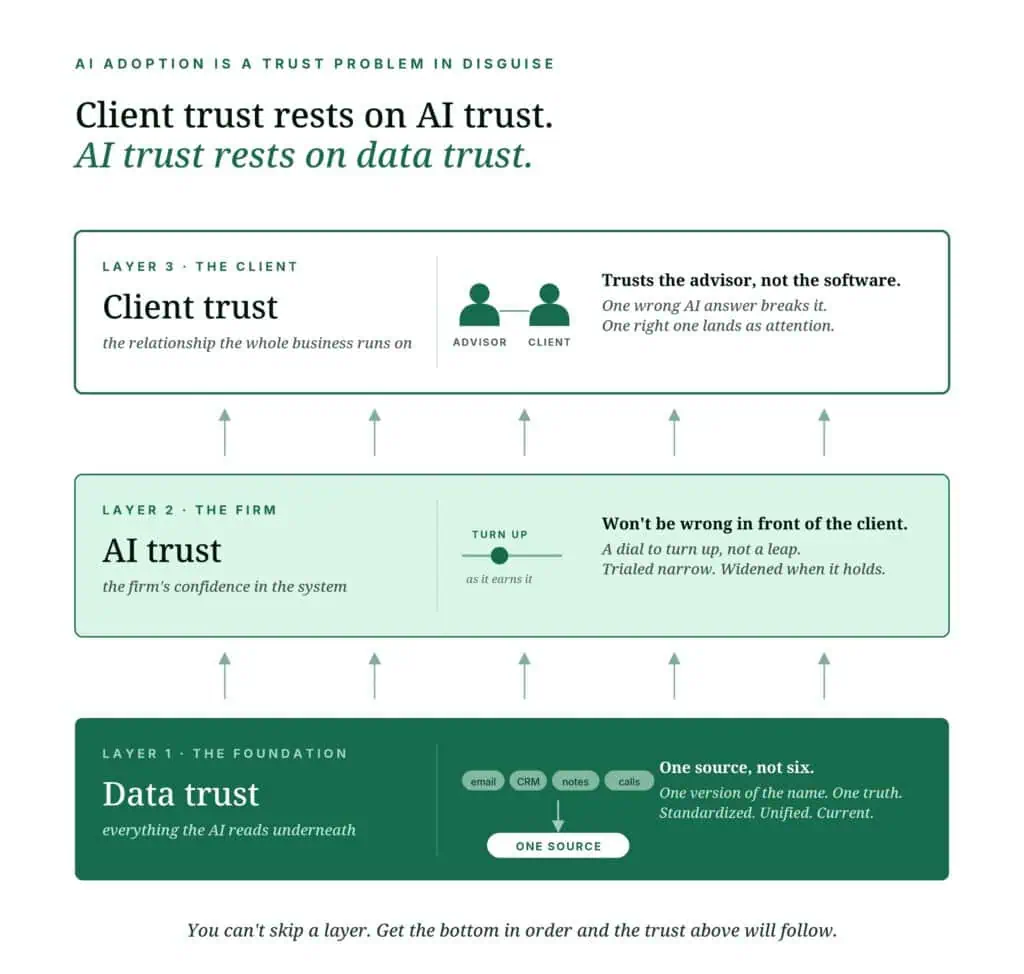
Think about what actually happens when an advisor sits down with a client. The client isn’t trusting the firm’s software. They don’t know what system pulled their file up and they wouldn’t care if you told them. They trust the person who’s talking to them, or emailing them. That’s the relationship the whole business runs on, and it’s the thing a firm should protect above everything else.
Which is exactly why a firm won’t let AI anywhere near that conversation until it’s sure the AI won’t be wrong in front of the client. If the system states a number wrong, or hallucinates you lose the client’s confidence.
 That bar sounds impossibly high, but trust has cleared bars like it before. Tim Welsh, founder of Nexus Strategy, explained it using an everyday example that stuck with me:
“Our moms told us never to get into a stranger’s car. And guess what we all do now, without thinking twice? We get into a stranger’s car. It became a norm. We have even taken it to another level when we are ready to get into a car with no driver in it. The same thing will happen here. AI will become a norm, and one day we’ll look back and wonder what we were ever worried about.”
The threshold for what people will trust isn’t fixed. It moves as the scaffolding around a new thing proves itself, and the same shift is coming here.
So before any of this reaches a client, the firm has to trust the AI itself. Which raises the question the rest of this comes down to. How do you get there?
Trust the Data Before You Trust the AI
An AI is only as good as what you feed it. So trusting the AI really means trusting the information underneath it. And that’s where most firms have a problem they haven’t examined closely.
The first surprise is that what sits in the CRM is only one type of data (structured). It has contacts, logged orders and stage movements, a few automated sequences. It records that a client exists and when the firm interacted with them. None of it describes the relationship. You cannot pull a signal about how a client is really doing out of a dropdown menu.
The data that would tell you something real about the relationship lives elsewhere, in emails, meeting notes, accounting systems, or someone’s spreadsheet. Tim describes a typical firm’s setup as a “Frankenstack” or “tech pile.”
Meeting tools don’t solve this. A summary tool works off the transcript in front of it. It can tell you what was said in the room, but it doesn’t know what led there. It misses the email exchange that set up the meeting, the decision made two calls ago, the thing the client mentioned last year.
You can’t get meaningful signals about what’s actually going on with a client from just CRM data, and a meeting summary.
The best advisor’s real CRM is their own memory, and the sentiment and emotional stakes (the “what do we do about estate sale for college fund” conversation) have no field, no vector, nowhere to slot into a traditional database. That’s the context a CRM structurally can’t hold.
Which is why pointing AI at an incomplete CRM disappoints.
How to Build AI Systems You Can Actually Trust
If the context lives outside the CRM, the answer is not to add more fields. It’s to do two things, in order:
• Get the underlying data into a state you can trust.
• Then let AI read the messy sources the CRM was never built to hold.
Get the data house in order
The relevant information is scattered across email, planning software, the CRM, trading, rebalancing, and risk systems, and it doesn’t agree with itself.
Something as basic as a client’s name might be stored inconsistently, first-name-last in one place and last-name-first in another. Before AI can do anything useful, that data has to be standardized and pulled together so every system feeds one source instead of six.
And that consolidation has to happen on a foundation the firm can actually stand behind. This isn’t a “trust us with your data” ask — it’s built to the standards regulated environments require: SOC 2 Type II and ISO 27001 certified, GDPR-compliant, with the firm retaining full ownership and control over retention and where data lives. A firm doesn’t have to choose between getting its data in order and staying audit-ready.
This is the layer Revenue Grid helps to build.
It captures activity automatically from email, calendar, and meetings and writes it back to a single system of record, so the data feeding your AI is complete and consistent instead of scattered across six tools.
And because every recommendation traces back to that one governed source, a firm can always see what the AI drew on and why, which is what makes client-facing AI something a firm can adopt with confidence rather than caution.
Let AI read what the CRM couldn’t
Once the data is in order, the second move is what changes the client experience. AI reaches into the unstructured sources and pulls context forward.
The same meeting tool that only knew the transcript becomes something different once it can also see the email that set up the call and the decision made two calls ago. The summary stops being a record of one conversation and starts being a record of the relationship.
Done together, these two moves add up to build a relationship intelligence layer that sits above the CRM. It pulls the scattered data into one place, and turns it into signals an advisor can act on. For example, it leads to a system of proactive surfacing. The system nudges and advises that they haven’t spoken to a client in three months, or that a client mentioned selling a vacation house two years ago with no follow-up since.
The Low-Risk Way to Start With AI
None of this has to happen in one leap so that you can lower the risk.
Tim said it well on this:
“You don’t have to go full Monty and adopt the whole thing. You can say, this one piece where we’re doing these reports, let’s see if we can speed that up, and drop some AI on top of it. The goal is to be incremental versus revolutionary. It’s especially true of the wealth management industry where a massive burst of progress will always get the hard no.”
The sequence I’d recommend has two steps:
1. Build the workflows and capture the data first, without AI.
2. Switch AI on with a control you can turn down or off if it makes you nervous.
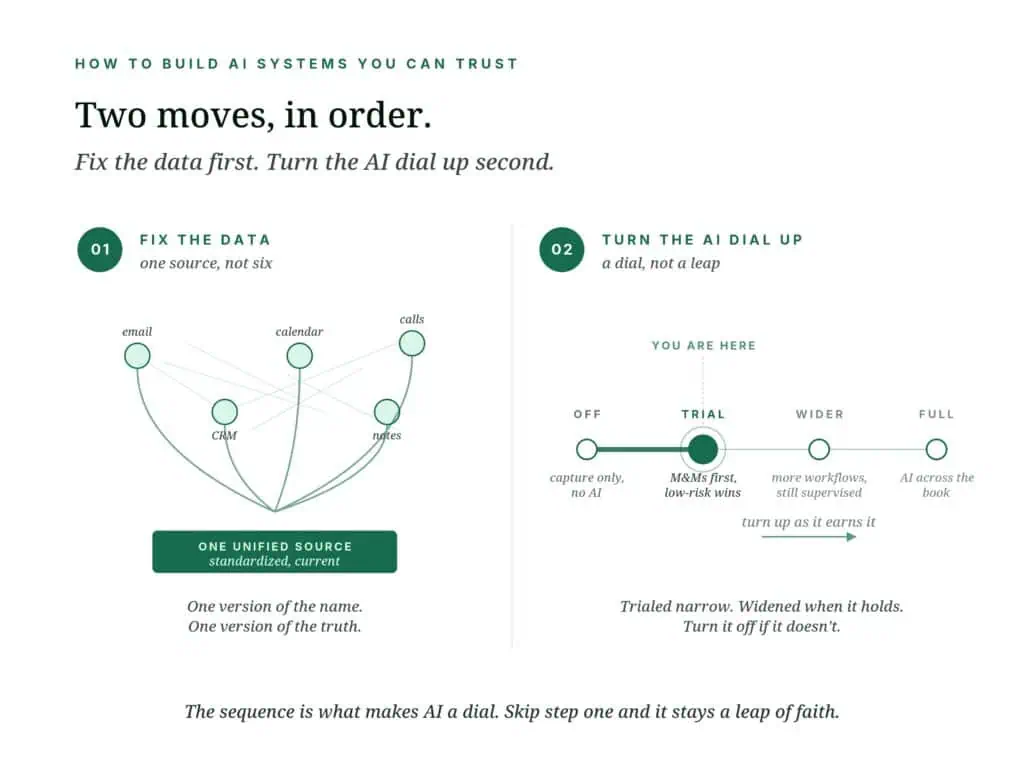
That means AI becomes a dial rather than a plunge. You can trial it with a small part of the business, and turn it off if you’re a little spooked out by it. Doing the groundwork first is what makes the next step feel manageable.
And if the data project feels like a mountain, you don’t have to start there. Tim’s advice is to begin with the “M&Ms,” aka marketing and meetings. They’re siloed, low-risk, and they produce visible wins while the harder cross-system work happens in the background.
Revenue Grid’s meeting assistant is built for exactly this kind of low-risk start. It preps you before the call by pulling the relevant history into one memo, captures the conversation, and writes the follow-ups back to your record automatically. You get a visible win in the first week without touching the harder cross-system work, and every meeting quietly adds to the same record the next one draws on.
The Best Advisors Remember at Scale, With the Help of AI
The best advisors have always been the ones who remembered the thing a client mentioned once in passing, who noticed when a client’s tone shifted, who reached out at the right moment about a life event that had nothing to do with a portfolio. That kind of attentiveness was never a piece of technology. It was human attention, and one person could only hold so much of it. Beyond a few relationships, the details start to slip, and the client feels it.
What changes now is that the limit moves. The advisor still makes the judgment calls and still holds the relationship. What the system does is remember more of the details and surface them at the right time, so the care an advisor could once extend to their top handful of clients can reach the whole book.
That is the whole point, and it is what this work, done in the right order, makes possible at a scale no advisor could reach alone.