

Your AI is only as good as the data underneath it, and most of that data sits scattered and incomplete. So how do you actually get it ready before AI reads it?
When the AI assistant on top of your CRM keeps suggesting next steps that are generic or wrong, the explanation usually lands in one of two places. You think either the AI is not ready yet, so you wait for a better model, or your reps are using it wrong, so you spend more time on training them.
Both explanations point at the wrong thing.
What made your AI tools underwhelming was the data it read because AI is only as good as the data underneath it. So the fix sounds simple. Give it better, and more data.
And you’d reasonably think you already have, because you’ve spent years filling that CRM, asking reps to log every field and stage and update along the way. All of that record-keeping should be exactly what AI needs to work from.
Why a Full CRM Still Isn’t a Full Picture
The CRM was built as a system of record. Its purpose was to store structured data that you can filter and report on.
Take an example of two deals that both go cold. In the CRM they look the same. Same stage, and same slipped close date. But one went quiet after a buyer who haggled on every line and never quite committed. The other went quiet after a strong champion, a warm referral, full alignment across the room, and zero pushback on price.
But the CRM lacks context of why, and how. And so does AI on top of it. So AI assistants will flag both as equal priority. But in reality, the second one is worth more than the first, and it’s the one someone should be chasing today.
For years, this lack of stored context did not create a problem because humans were using the tools. And as long as they had the full context nothing broke. They could fill the gaps from memory, or their notes.
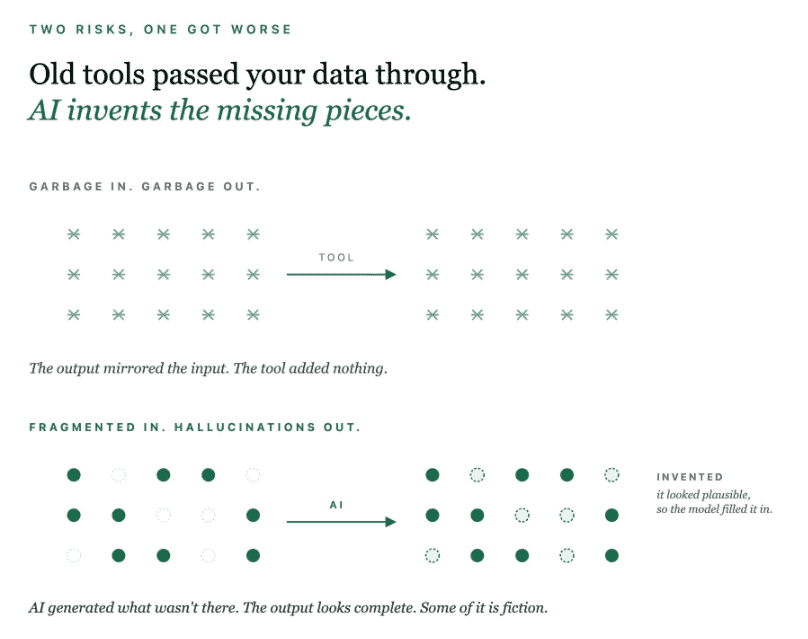
However, AI does not register that anything is absent. It reads what is in front of it, takes each field literally, and where the picture is incomplete it fills the space with whatever looks plausible. It makes something up and hands it to you as fact. The invented answer is often wrong.
Garbage in, garbage out was the risk when humans ran the system. With AI, it’s even riskier. Fragmented in, hallucinations out.
So what does AI actually need to be useful to your reps?
Three Things AI Needs to Get This Right
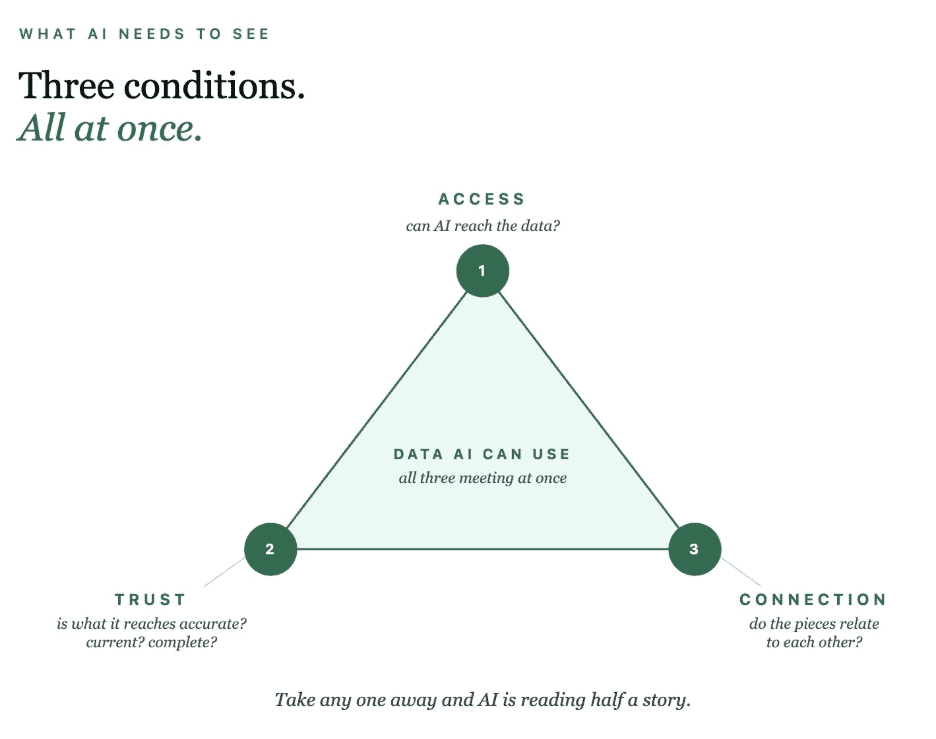
AI runs on what it can see. And what it can see depends on three things working at once:
- Access. Can it reach the data, or is half of it locked in systems it never touches?
- Trust. Is what it reaches accurate, current, and complete, or stitched together from stale fields?
- Connection. Do the pieces relate to each other, or sit in separate boxes with no thread between them?
These sound like things you’ve handled. You bought the tools, you cleaned the data, you somehow connected the systems (for example, your calendar is connected to your recording tool). But look closely at each one and the same gap shows up every time.
Access is still not fully solved.
The AI assistant sitting on top of your CRM only sees the CRM. The emails, the chats, the meeting notes, the calendars, the call transcripts, all of it sits in other tools the assistant was never plugged into. So most of the context that explains an account is simply out of reach.
Trust is shakier than it looks, but it’s the most fixable. A CRM is only as accurate as the reps filling it in, and reps are busy. Fields get skipped, updated a week late, or filled with whatever keeps the deal looking healthy in the pipeline review. So the record the AI inherits is part fact, part guess, part six months out of date.
This is what activity capture is for, and it’s where Revenue Grid started, automatically logging the emails, meetings, and calls into the CRM as they happen. The record stops reflecting what someone remembered to type and starts reflecting what actually occurred.
Connection is the one nobody owns at all.
Say you fix access and trust. The AI can now reach everything, and what it reaches is accurate. It still gets the calls, the emails, and the notes as separate piles with nothing tying them together. Each piece is an island, and AI can’t reason across islands.
Put the three together and you can see that AI readiness starts with data readiness.
Data Readiness Means Connecting, Not Collecting
Don’t confuse data readiness with collecting more data. You already have more than you could ever read. The job now is connecting what you already have, bringing the calls, the emails, the notes, and the history alongside the CRM record, so the structured field and the story behind it finally sit together.

That connected view has a name. Relationship intelligence.
The connection puts the pieces in one place. The intelligence reads them together and tells you what they mean for the account, the full picture of where the relationship stands and why. The what and the why in one place, rather than split across systems that never compare notes. It’s built so that anything reading it sees the whole relationship instead of a slice, whether that reader is a person or an AI.
Don’t Starve Your AI on Half a Story
The models are getting better, and they are getting better fast. Before long they will take in as much context as you can give them, read it in seconds, and keep improving from there. But if the full story of an account is not sitting somewhere the model can reach, no number of tokens and no upgrade will invent it.
This is the part most teams have backwards. They are waiting for the models to get good enough, and the models are almost there. The data underneath them is the part that isn’t. The work now is to build that part, a layer the model can stand on, where the calls, the emails, the notes, and the records are joined into one complete picture of each relationship.
When that picture is whole, the AI stops guessing, and your reps stop checking its every answer against their own memory. They act on what it says.
It is best to start building a layer your AI can use now because the amount of context you create keeps growing. Every year there are more tools capturing it. Meetings transcribe themselves, those transcripts become summaries, and the summaries become draft proposals. Joining it as it is created is manageable. Going back to reassemble years of it is not.
Everyone will soon run the same AI models, and have the tools to build client relationships at scale. The only thing that will differ is what each one is given to read. Will you give your AI assistant your whole context or will it still be scattered across tools where it was collected?