


What is an AI Sales Agent?
An AI sales agent is software that reads your sales data, works out what is going on with a lead or a deal, and then either suggests the next move or carries it out for you. It pulls from your CRM, your email and calendar, call notes, and past meetings to help with everyday sales work like qualifying leads, writing follow-ups, prepping for calls, spotting deals that are going cold, and keeping records up to date.
What sets it apart from a plain automation rule is that it does more than fire when a field changes. It reads a wider set of signals, weighs what they mean for one specific deal, and acts with a bit of judgment.
Agents that assist and agents that act
The real difference between agents is how much they do without a person signing off. Some only suggest. Others act.
- A semi-autonomous agent suggests and waits. It drafts the follow-up, flags a deal that has gone quiet, or recommends the next step, then a rep checks it and approves before anything goes out. For example, it writes a reply to an inbound lead and leaves it in the rep’s inbox to send.
- An autonomous agent acts on its own, inside rules you set. For example, the moment a web form comes in, it scores the lead, assigns it to the right rep, and logs the activity, without any humans in the loop.
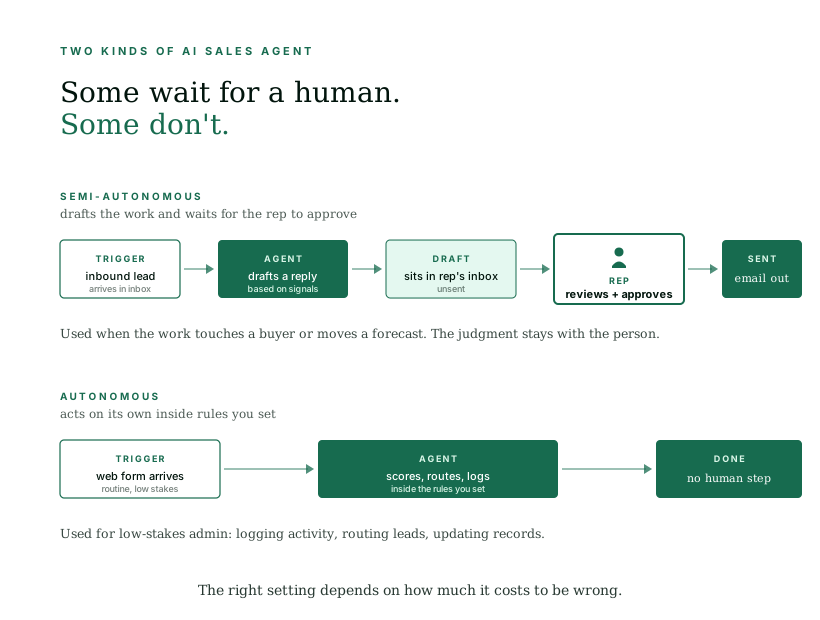
Sales teams often let the agent act on its own for low-stakes admin like logging activity or routing leads, and they keep a person approving anything a customer will see or anything that changes a forecast number.
Whether an agent is any good comes down to the data it can read. For most sales teams that data lives in the CRM. If your reps’ emails, meetings, calls, and next steps never make it into the CRM, the agent cannot see them, and its suggestions come out half-formed.
This is exactly the foundation Revenue Grid AI Sales Assistants are built to support. They help Salesforce-centric teams capture the complete activity record that reliable AI recommendations depend on, so the agent works from what actually happened instead of a partial picture.
AI Sales Agent vs AI Sales Assistant vs Sales Automation
Different automation, and AI tools for sales have overlapping labels so buyers get confused fast. The fastest way to cut through it is to ask what a tool’s primary job is, because most of these products can do a little bit of everything but are built around one thing. The table below sorts the common categories by their main role:
Different automation, and AI tools for sales have overlapping labels so buyers get confused fast. The fastest way to cut through it is to ask what a tool’s primary job is, because most of these products can do a little bit of everything but are built around one thing. The table below sorts the common categories by their main role:
| Category | Primary role | Example function |
| AI sales agent | Takes autonomous or semi-autonomous action | Qualifies a lead, recommends next steps, triggers a follow-up |
| AI sales assistant | Helps reps complete work faster | Drafts emails, summarizes meetings, suggests CRM updates |
| AI sales copilot | Answers and assists in the flow of work | Surfaces context and answers questions while a rep works |
| Chatbot | Handles scripted conversations | Routes inbound questions, books a meeting |
| Sales engagement platform | Manages outreach workflows | Runs sequences, tracks replies, schedules follow-ups |
| Relationship intelligence | Tracks who is involved in a deal and how engaged each person is, using real email, meeting, and call activity | Surfaces a buying committee with one quiet decision-maker, flags an account nobody has touched in weeks |
| Conversation intelligence | Analyzes calls and meetings | Summarizes calls, tracks topics, supports coaching |
| Salesforce activity capture | Creates a complete activity record | Logs emails, meetings, and tasks into Salesforce |
| Workflow automation | Fires rules on triggers | Updates a field, assigns a task when a stage changes |
Types of AI Sales Agents
AI sales agents are built to do one job well rather than run the whole sales process. When teams look for the best AI tools for sales, the simplest way to make sense of them is by where they help in your day, from getting new leads in the door to closing big, complicated deals. Here are the main groups, each with an example of what it does:
Agents that find and sort new leads
These work right at the start, before a real deal exists. They reach out to prospects, handle the first questions, and decide which leads are worth a rep’s time:
- An SDR agent sends and answers first-touch outreach at volume.
- A prospecting agent researches accounts and builds a target list.
- A qualification agent scores new leads and sends the good ones to the right rep.
Agents that take admin off your reps
These give your reps their time back by doing the busywork that wraps around selling. A follow-up agent drafts the next email and nudges the rep when it is time to send. A meeting-prep agent pulls the account history together before a call. And a logging agent records the email and the meeting in the CRM, so the rep never has to.
Agents that help managers coach
A coaching agent watches how reps are actually working and shows managers where they can help. It might notice that a rep’s follow-up has slipped on a few open deals and suggest that as the next thing to cover in a one-on-one. The manager spends less time digging through deals and more time on the conversation that moves the needle.
Agents that watch the pipeline and forecast
These work above the single deal, across the whole pipeline. A forecasting agent checks what reps are committing to against the real activity on each deal, so a confident call on a quiet account gets a second look. A deal-inspection agent points out opportunities that jumped a stage without much engagement behind them.
Human + AI Sales Operating Model
The human-AI model in sales isn’t about replacing roles. It’s about assigning each piece of work to whoever does it best: repetitive, signal-based, data-heavy tasks to the agent, and judgment, relationships, and strategy to people.
- The agent does the steady, repeatable jobs. It logs activity, writes summaries, sends reminders, watches for warning signs, and suggests a next step.
- Reps do the parts that need a person in the room, like building trust, running discovery, handling the hard conversations, and closing the deal. Managers decide where their coaching time goes and how to play each deal.
RevOps designs how the whole thing runs and keeps the data honest. Leaders use what the agent surfaces to run forecast reviews and make the call on the number.
The agent does the steady, repeatable jobs. It logs activity, writes summaries, sends reminders, watches for warning signs, and suggests a next step. Reps take the parts that need a person in the room, like building trust, running discovery, handling the hard conversations, and closing the deal. Managers decide where their coaching time goes and how to play each deal. RevOps designs how the whole thing runs and keeps the data honest. Leaders use what the agent surfaces to run forecast reviews and make the call on the number.
The table below makes the split concrete across a few everyday tasks:
| Responsibility | AI sales agent | Sales rep | Manager | RevOps |
| Activity logging | Supports or automates | Reviews accuracy | Monitors compliance | Defines rules |
| Follow-up reminders | Recommends | Personalizes and sends | Coaches on gaps | Tracks adherence |
| Deal risk detection | Flags signals | Explains context | Prioritizes intervention | Tunes criteria |
| Forecast inspection | Surfaces evidence | Updates deal reality | Reviews commit quality | Governs the process |
AI Sales Agent Readiness Checklist for Salesforce Teams
Before you deploy anything, it is worth checking whether your Salesforce environment is ready for an agent to act on. Most readiness problems come down to data and process rather than technology. Run through the checklist below with your RevOps and Sales Ops leads:
Data readiness
✓ Email and calendar activity is captured in Salesforce automatically.
✓ Meetings, calls, tasks, and next steps are logged consistently across reps.
✓ Contacts and buying-committee members are mapped to opportunities.
Process readiness
✓ Opportunity stages are clearly defined and used the same way by everyone.
✓ A next step is required before a deal can progress to a stage.
✓ Sales methodology fields are complete on active opportunities.
✓ Sales sequences line up with your actual sales process.
Governance readiness
✓ Managers can see deal risk signals across the team.
✓ RevOps can inspect activity by rep, team, segment, and opportunity.
✓ There are clear human approval rules for any AI-generated communication.
✓ Salesforce permissions and field-level security are configured.
✓ Compliance requirements are documented.
Adoption readiness
✓ There is a rollout plan for reps and managers, beyond an install date.
✓ Reps and managers know what the agent will and will not do, and who to go to when it gets something wrong.
✓ Someone owns adoption and tracks whether reps are actually using the agent, beyond whether it is switched on.
If this checklist surfaces gaps in activity capture, relationship visibility, or pipeline inspection, that is the work to do before scaling an agent. Revenue Grid helps create the data foundation those gaps point to, and you can request a demo to see how it closes them in a Salesforce environment.
How to Implement an AI Sales Agent in a Salesforce Environment
Implementation goes better when you treat it as a process change with a technology component rather than a software install. Enterprise sales teams need governance, change management, and clear ownership for this to stick, and RevOps should own the process design and the measurement. A workable sequence looks like this:
- Define the workflow or use case: Pick one job to start, such as inbound response or stalled-deal detection.
- Audit Salesforce data quality: Find out how complete your activity and opportunity data really is before you build on it.
- Connect email, calendar, and activity sources: A clean Salesforce integration for inbox, calendar, and activity data is the base layer.
- Map roles, permissions, and data access: Decide who and what the agent can see.
- Define guardrails and approval points: Be explicit about what the agent can do alone and what needs sign-off.
- Configure recommendations or actions: Set up the specific guidance or automated steps for your chosen use case.
- Pilot with one team: Test with a group small enough to watch closely.
- Train reps and managers: Show them what the agent does and where their judgment still rules.
- Monitor adoption and performance: Track whether people use it and whether it helps.
- Improve based on outcomes: Tune the rules and expand only once the first use case works.
The teams that succeed give the rollout an owner, a clear use case, and the patience to fix data before scaling. Revenue Grid supports the foundations that make these steps possible, including activity capture, email and calendar integration, pipeline visibility, deal guidance, relationship intelligence, and coaching workflows.
How Revenue Grid Helps Salesforce Teams Build an AI-Ready Revenue Execution Foundation
Every capability an AI sales agent offers depends on the quality of the activity, relationship, and pipeline data underneath it. That is the gap Revenue Grid is built to close, as the Salesforce-native relationship intelligence and execution layer that makes AI sales strategies more reliable.
Revenue Grid is the layer that captures the data, grounds the pipeline, and guides execution, so that whatever agents you deploy have accurate inputs and your team has real visibility. Here is what Revenue Grid offers:
- Activity Capture writes emails, meetings, and sales activities into Salesforce automatically, which cuts manual CRM work and keeps the record complete.
- True Pipeline gives teams real pipeline visibility, deal-stage progression, and stalled-deal detection.
- Sales Forecasting grounds forecast calls in captured activity rather than rep opinion.
- Deal Guidance surfaces per-deal risk and the next-best action.
- Sales Sequences support multichannel outreach that lines up with your process.
- Relationship intelligence shows stakeholder engagement and buying-committee coverage.
- Sales coaching helps managers prioritize based on real activity and deal signals.
- Enterprise readiness keeps access to sales activity and pipeline data governed for security and compliance.
An AI sales agent needs complete, accurate, and actionable Salesforce data to be worth trusting. Revenue Grid helps sales and RevOps teams capture activity, inspect pipeline, understand relationships, guide sellers, and forecast with more confidence. To see how it makes your Salesforce environment ready for an AI sales agent, request a demo.
Book a demo to see Revenue Grid in action!
1. What is an AI sales agent?
An AI sales agent is a software system that uses AI to analyze sales data and then perform or recommend sales actions. It can support prospecting, lead qualification, follow-up, coaching, forecasting, and deal execution by reading CRM records, email and meeting activity, engagement signals, and pipeline context.
Agents can run autonomously inside defined rules or semi-autonomously with a person approving each step, and the right setting depends on your governance and how much risk a given task carries. Most enterprise teams start with semi-autonomous behavior on anything that touches a buyer or a forecast, and reserve fuller autonomy for low-risk, repetitive work.
2. How is an AI sales agent different from an AI sales assistant?
An AI sales assistant usually helps a rep complete tasks faster, such as drafting emails, summarizing meetings, or suggesting CRM updates. An AI sales agent can go further by taking defined actions or orchestrating a workflow, such as qualifying a lead, triggering a follow-up, flagging a deal risk, or recommending the next-best action. The categories overlap in practice, and many products do some of both. The useful distinction is whether the tool mainly assists a person’s work or acts on its own inside the rules you set.
3. What data does an AI sales agent need?
An AI sales agent needs Salesforce data, email and calendar activity, meeting history, call notes, opportunity fields, contact roles, engagement signals, pipeline movement, and sales methodology data.
The more complete that picture, the better its recommendations, and incomplete CRM data is the most common reason an agent gives weak or misleading guidance. If reps are not logging every email, meeting, and next step by hand, the record drifts from reality. Revenue Grid’s Salesforce-native activity capture closes that gap by writing activity into Salesforce automatically, so the agent reads from a full history.
4. Will AI sales agents replace sales reps?
AI sales agents are far more likely to augment reps than replace them, especially in complex B2B sales. An agent can handle repetitive work, surface signals, recommend actions, and keep follow-up consistent, which gives reps more time for the parts of selling that need a person. Reps still own discovery, building trust, negotiation, executive alignment, and the strategic judgment a deal turns on. The realistic outcome is a more disciplined revenue motion where the agent handles the routine and the seller handles the relationship.