

For most organizations, CRM has become the most expensive system for recording activity rather than improving execution.
When Salesforce launched in 1999, the value proposition was straightforward: stop managing the forecast in disconnected spreadsheets, require consistent activity capture, and create a single view of pipeline that leadership, finance, and the board could trust.
The model worked because information flowed upward and value flowed with it. Frontline managers gained visibility, finance gained something auditable, and executives gained a roll-up they could use to make operating decisions.
The category succeeded because it solved a real leadership problem. CRM became the system of record, and for that purpose it has remained highly effective for more than two decades.
But over time, the interests of the people buying CRM and the people using it every day began to diverge.
The buyer has typically been sales leadership, RevOps, or the CRO. The user has always been the seller.
As leaders kept asking the platform for more fields, more stages, more reporting precision, and more forecast accountability, sellers absorbed the cost in the form of additional administrative work. The system improved for the people measuring performance, while it became less helpful for the people expected to generate it.
Sellers know the deal does not advance because a field was updated. It advances or stalls because of stakeholder alignment, responsiveness, internal urgency, commercial friction, legal review, and the strength of the relationship across the buying group.
In practice, the CRM is usually the last place those signals appear, if they appear at all. That is why teams end up discovering problems too late: a deal remains in the wrong stage, the close date is not updated, or a buying committee goes quiet while the record still looks healthy. We see versions of this across real sales environments, including missed stage hygiene, close-date drift, and sync-related data quality issues that distort forecast confidence and pipeline inspection.
The result is predictable: pipeline quality degrades and forecast reliability declines while admin burden increases.
That is why both sellers and leaders often arrive at the same conclusion: the CRM feels broken.
In reality, it is not broken.
CRM is performing the role it was originally designed to perform. It is not failing at selling because it was never designed to sell. It was designed to retain a structured record of customer interactions and commercial data.
The issue is that we now expect CRM to solve a broader execution problem it was never architected to handle.
What we are actually asking the CRM to do
Decide. We expect the system to tell sellers what matters most right now: which opportunity deserves attention first, which stakeholder has disengaged, which follow-up is late, and which deal risk is material. In modern sales environments, that is not theoretical. It is the difference between catching a quiet champion before momentum is lost and discovering the issue in a forecast call two weeks too late.
Act. Once the next best action is clear, we expect the system to help execute it. That may mean drafting the follow-up, launching a sequence, preparing a renewal touchpoint, or triggering internal coordination before a legal, security, or procurement bottleneck expands. In real selling motions, these delays are not abstract. They show up in contract cycles, handoff risk, and late-stage stagnation.
Coach. We also expect the system to help improve seller performance. That means identifying missed discovery, weak multi-threading, unaddressed competitive mentions, poor next-step discipline, or low-quality meeting execution. In effect, we want software to scale the kind of inspection and coaching a strong frontline manager would provide if they had the capacity to listen to every call and inspect every deal in context.
At the same time, CRM is still expected to do its original job: capture activity, maintain a clean pipeline, support an auditable forecast, and preserve the integrity of the record. The challenge is that all of these newer expectations depend on signals the CRM alone does not reliably contain, especially the live state of the customer relationship across email, meetings, calendars, internal collaboration, and commercial documents.
The original CRM mandate never disappeared. It has simply been layered beneath three far more complex expectations that require a different operating model and, increasingly, a different class of software.
Why this can’t be fixed from inside the CRM
CRM has evolved substantially since 1999. Automated activity capture reduced manual entry. Sales engagement platforms improved outreach execution. Revenue intelligence surfaced new insights. Conversation intelligence made call review more scalable. Each category addressed a real operational problem.
Those improvements matter, but they still do not resolve the core issue: execution requires interpreted context, prioritization, and timing, not just better storage and reporting.
The CRM is built around clean, structured data.
CRM is fundamentally designed around structured fields such as stage, amount, owner, forecast category, and close date. Each field is optimized to hold a clean answer. But the commercial reality of a deal rarely fits into that structure.
What actually matters is usually distributed across long email threads, rescheduled meetings, notes taken outside the CRM, contract redlines, security questionnaires, and internal collaboration. In our own ecosystem, examples of this show up when stage progression is overstated, deals are automatically misclassified because required fields or close dates were not maintained, or synchronization issues create false signals inside the record. By the time those issues surface, leadership is already managing from stale or incomplete information.
As a result, any analysis or AI built on top of incomplete CRM data inherits the same limitations. The output may be polished, but it is still constrained by what the system can actually see.
The CRM assumes the buying journey is linear
The CRM model also assumes the buying journey is relatively linear. In reality, enterprise or complex, long-cycle buying behavior is not linear at all.
A prospect may engage at an event, revisit the category later through content, reappear through a partner or campaign, and only then become visible in the CRM as a new lead. The system records the entry point it recognizes, not the full context that shaped buyer intent.
That is why teams often run the wrong motion against the right account. The system sees a new lead; the seller is actually dealing with a partially educated buyer whose history sits outside the record.
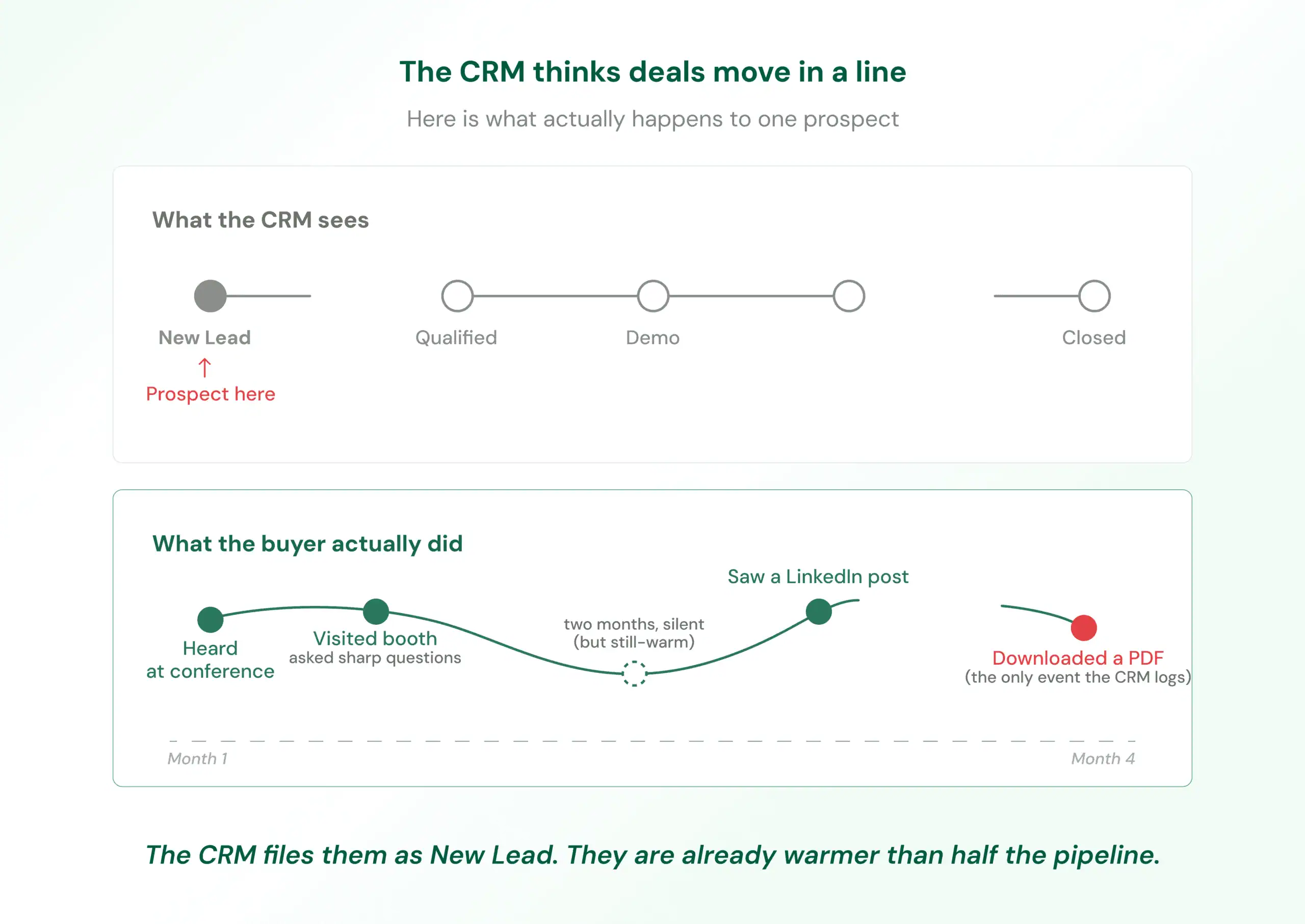
That distinction matters because a system of record cannot, by itself, become a system of execution.
A system of record is optimized for completeness, structure, governance, and durability. A system of execution must be optimized for speed, relevance, and actionability in the flow of work.
What sellers need in the moment is not another static record. They need an informed read on relationship health, stakeholder movement, responsiveness, risk, and readiness to advance. CRM does not natively interpret those signals well enough to drive action.
What execution actually requires
Execution is not primarily a data collection problem. The relevant information already exists across email, calendar, meeting recordings, notes, internal conversations, legal workflows, and customer documents. The real gap is the absence of a system that can interpret those signals together and drive timely action before the window to influence the deal closes.
A true system of execution requires three capabilities that CRM alone does not provide:
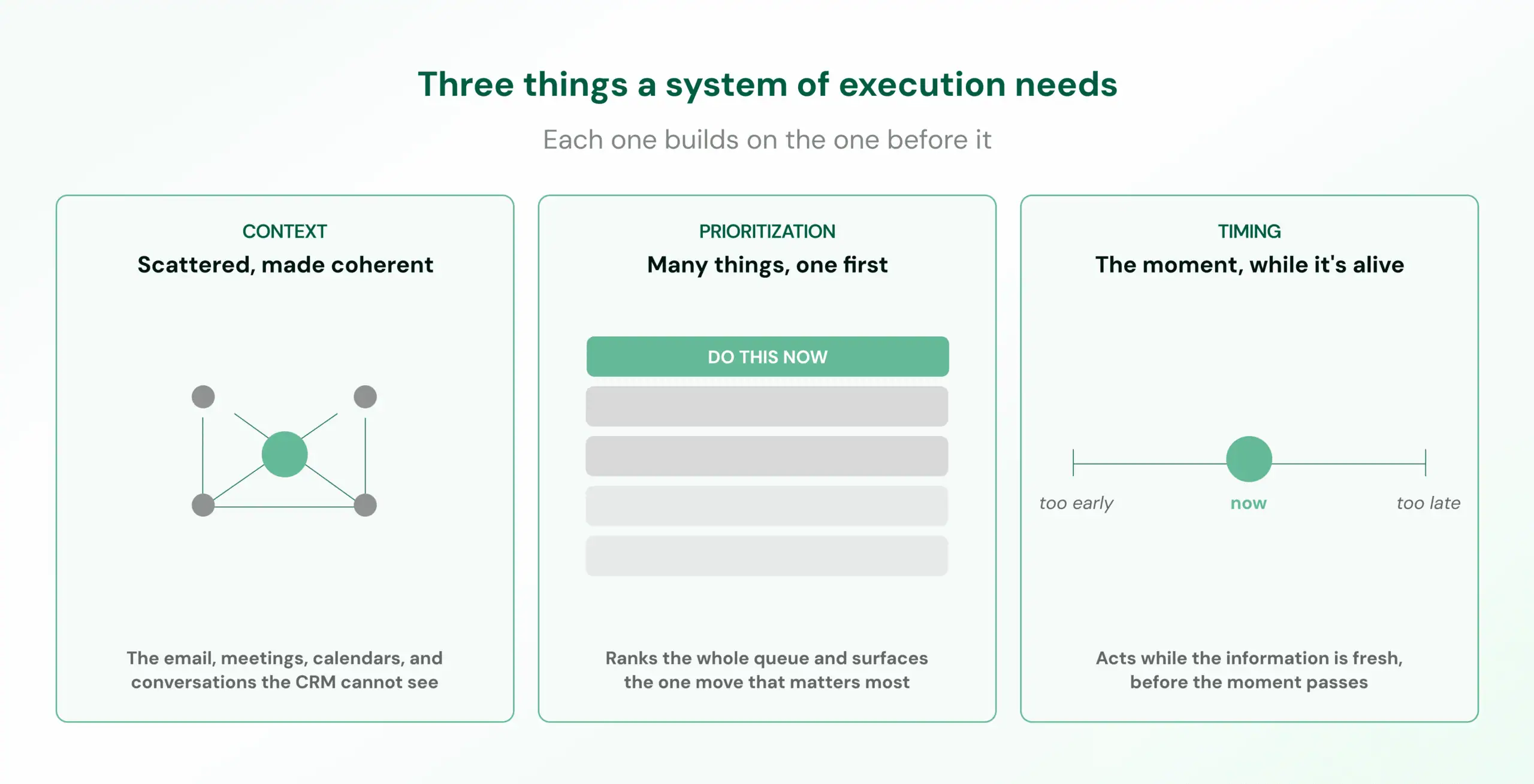
Context
Context is the live state of the relationship. It includes what has been said, committed, delayed, escalated, or quietly abandoned across the entire customer journey. CRM captures part of that picture, but a material share remains outside the record.
Prioritization
Prioritization turns context into action. Sellers manage more variables than any individual can continuously triage well: open pipeline, follow-ups, internal approvals, pricing requests, renewals, champion engagement, procurement delays, and new inbound demand. A system that surfaces everything but ranks nothing does not solve the problem.
Timing
Timing determines whether good insight becomes useful execution. A reminder delivered thirty minutes before a customer call can improve preparation and outcomes. The same reminder delivered after the meeting or at the point of commercial escalation adds little value. In sales, information decays quickly if it is not delivered at the right moment.
CRM does not inherently contextualize, prioritize, or time the next best action. That is why attempts to force execution into the reporting layer typically produce dashboards, alerts, and summaries that are visible but not operationally decisive.
That work belongs to a relationship intelligence layer: a category of software designed to interpret customer engagement in context and turn it into meaningful action.
Why AI on top doesn’t fix this
Adding AI on top of CRM does not automatically solve the execution gap. Salesforce, Microsoft, and other major platforms are making substantial investments in copilots and agents, and those investments are directionally important. But when AI is layered onto a system of record without a sufficiently rich knowledge layer underneath it, the output is usually a better summary of existing records rather than a reliable recommendation on what to do next.
There are three distinct layers between raw activity and a seller’s next action.
The first layer is the data itself: emails, meetings, calls, contracts, CRM updates, and collaboration artifacts accumulating across systems.
The third layer is action: a specific recommendation or workflow delivered to the right person at the right time.
The middle layer is the knowledge layer, and it is the one most organizations still underbuild. This is where disconnected signals are translated into understood facts: who is engaged, what has been agreed, where risk is accumulating, what friction is emerging, and which next step is most likely to move the opportunity forward.
Without that middle layer, AI simply accelerates access to the record. Large language models are very good at interpreting messy human communication, but they can only produce high-value recommendations when they are grounded in consolidated, decision-relevant knowledge rather than fragmented activity logs.
“A customer meeting took place on Tuesday” is data. “The customer agreed to proceed without a POC, which means budget alignment and commercial terms must be addressed this week” is knowledge. CRM stores the first. Sellers need the second.
What the next layer looks like
None of this means CRM goes away. It should continue doing the job it was designed to do. But the next layer has to sit above the record and work with the information the record does not fully understand.
Most of that missing information is relationship data. The real state of a deal lives in interaction patterns and stakeholder behavior: who has gone quiet, who is leaning in, who has introduced legal or security review, who is delaying decisions, and where momentum is building or eroding. Those are the signals sellers need in order to act effectively.
The next generation of sales software will increasingly look like relationship intelligence rather than traditional CRM expansion. In that model, platforms such as Revenue Grid are not trying to replace the record; they are trying to make the record operational by interpreting the signals around it and helping teams take better action.
A strong relationship intelligence platform should behave more like a high-performing operating layer than a passive database. It should read broadly, retain context, surface risk early, and help answer the most practical question in sales: what should this team do next, on which deal, and why? The seller still owns the judgment and the customer conversation. The software should remove the administrative drag and sharpen execution around them.