

Key Takeaway
- Reliable revenue forecasting is essential for planning — it guides cash flow management, hiring decisions, inventory planning, and long-term strategy.
- Revenue forecasting goes beyond sales forecasting by accounting for payment timing, deal lifecycle, churn, and upsell opportunities.
- Using multiple forecasting models (straight-line, moving average, ARR snowball, regression, etc.) gives a more accurate and balanced projection.
- A structured, data-driven forecasting process—including trend analysis, seasonality, rolling updates, and pipeline adjustments—significantly improves accuracy.
- Forecasting tools like Revenue Grid enhance precision with automated insights, risk detection, and predictive analytics that help teams hit revenue targets.
Revenue forecasting is a critical part of any business plan and strategy. A solid forecast can help you take advantage of opportunities in your industry, make smart decisions about investments, and prepare for the future.
But how do you do it? What should be included in your forecast? What forecasting software can help? We’ve put together this guide to help you answer those questions and start forecasting the right way.
Accurate revenue forecasting serves as the foundation for virtually all strategic business decisions. Without a clear picture of future revenue, companies struggle to allocate resources effectively, plan for growth, or respond to market changes. In fact, businesses with reliable forecasting processes are 2.4x more likely to achieve their revenue targets than those without structured approaches.
Throughout this guide, we’ll explore the fundamental concepts of revenue forecasting, examine different forecasting models, provide step-by-step instructions for creating your own forecasts, and show you how Revenue Grid’s intelligence platform can transform your forecasting process.
What is Revenue Forecasting?
Revenue forecasting (also called revenue projection in some cases) is a process of estimating the future revenue of a company. It’s typically based on historical data but can also be influenced by external factors like market conditions and economic trends.
The goal of revenue forecasting is to predict and plan for how much money will be coming in over the next few months or years so that you can decide whether you need to hire more employees or order more inventory, among other things.
At its core, revenue forecasting is a project management process that requires careful planning, execution, and monitoring. It involves analyzing various revenue drivers and creating models that accurately reflect your business’s unique characteristics.
Several foundational elements are critical to effective revenue forecasting:
- Timing considerations – Determining the appropriate time horizon (monthly, quarterly, annual) for your forecast
- Forecasting philosophy – Deciding between conservative, moderate, or aggressive forecasting approaches
- Driver-based modeling – Identifying the key factors that influence your revenue generation
- Stakeholder alignment – Ensuring all departments agree on assumptions and methodologies
- Data quality – Maintaining accurate, consistent historical data as the foundation for projections
Why Revenue Forecasting is Important
There are many reasons why you need to do revenue forecasting. Here are some key points:
- Cash flow management – It helps you predict how much money you’ll need to ensure your company has enough cash flow to keep running smoothly.
- Workforce planning – It enables you to predict when to hire new employees and scale up operations to meet the demand for your products or services.
- Inventory optimization – It helps you avoid sales shortages by showing you how much inventory you need on hand at any given time.
- Growth objective alignment – Revenue forecasts provide a clear target that helps align all departments around common growth goals, ensuring everyone is working toward the same outcomes.
- Customer acquisition strategy – Accurate forecasts help you determine how many new customers you need to acquire and at what cost, allowing for more precise marketing budget allocation.
- Investor relations – Consistent, accurate forecasts build credibility with investors and stakeholders, making it easier to secure additional funding when needed.
Cross-departmental decision support – From marketing campaign timing to product development roadmaps, revenue forecasts inform decisions across the organization.
Revenue Forecasting vs. Sales Forecasting
Sales forecasting and revenue forecasting are two important tools for business owners, sales teams, and marketers. They’re both used to help predict a company’s future, but the two terms have different meanings.
Sale forecasting refers to predicting the number of deals your business will close within a given period. It provides insights into how much you can expect to close over the next month or quarter so that you can plan your staff and resources to meet that projection.
Meanwhile, revenue forecasting takes into account the entire lifecycle of a deal, from start to finish. This means looking at things like the length of the sales cycle, payment terms, and any potential upsells or cross-sells.
| Forecast Type | Primary Focus | Timeframe | Used By | Example |
|---|---|---|---|---|
| Sales Forecast | Number of deals/units to be sold | Short-term (weekly, monthly, quarterly) | Sales teams, sales operations | Predicting 50 new customer contracts will be signed next month |
| Revenue Forecast | Actual money to be received | Medium to long-term (quarterly, annual) | Finance, executive leadership | Projecting $2M in recognized revenue for Q3, accounting for payment terms |
| Financial Forecast | Complete financial picture (revenue, expenses, profit) | Long-term (annual, multi-year) | Finance, investors, board | Projecting full P&L statement for the next fiscal year |
While sales forecasting focuses on the top of the funnel and immediate sales activities, revenue forecasting provides a more comprehensive view of when and how money will actually flow into the business.
Revenue Forecasting Models and Methods
There are many different types of revenue forecasting models. One common model is bottom-up forecasting, where you estimate the sales of each product or service, then add them all up to get an overall estimate. Another is the top-down forecasting model, which starts with the overall market demand and then breaks it down into individual product categories and subcategories.
Apart from these two models, you can also try the following ones:
1. Straight-line model
The straight-line method is a simple forecasting model that estimates future revenues based on past growth. The model assumes that the company’s revenue will grow at a steady rate, and it uses the average of the past two years of growth as a baseline.
For example, if you have $10 million in revenue this year and expect it to grow at 10% per year, your expected revenue for next year would be $11 million ($10 million × (1 + 0.1)).
The straight-line method is easy to use but has some drawbacks. The most obvious problem with this model is that it assumes every year will be exactly like every other one, which isn’t always true. More importantly, you can’t use this method if your company has experienced dramatic growth or a decline in the past few years.
2. Moving Average forecasting model
The moving average method is a revenue forecasting model that uses the average of a series of historical data points.
A moving average is calculated by adding up all of your revenue numbers from one year and dividing them by the number of months in that year (i.e., 12). This gives you an average monthly revenue amount for the year being analyzed. You can then compare that number with current revenue figures to predict what might happen next month or next quarter.
For example, if your current month’s revenue is higher than last year’s average monthly revenue, then you’ll probably see increased sales this month; if your current month’s revenue is lower than last year’s average monthly revenue, then you’ll probably see decreased sales this month.
3. Quota Capacity Model
The quota capacity model is particularly useful for sales-driven organizations. It forecasts revenue based on the number of sales representatives, their individual quotas, and historical attainment rates.
Formula: Projected Revenue = Number of Reps × Average Quota × Historical Attainment Rate
Example: With 10 sales reps, each with a $500,000 annual quota and a historical attainment rate of 85%, your projected annual revenue would be: 10 × $500,000 × 0.85 = $4,250,000
This model works best when you have stable sales team performance and consistent quota setting practices.
4. ARR Snowball Model
For subscription businesses, the ARR (Annual Recurring Revenue) snowball model accounts for new bookings, expansions, contractions, and churn to forecast future revenue.
Formula: Ending ARR = Starting ARR + New ARR + Expansion ARR – Contraction ARR – Churned ARR
Example: Starting with $5M ARR, adding $2M in new bookings, $500K in expansions, with $300K in contractions and $200K in churn, your ending ARR would be: $5M + $2M + $500K – $300K – $200K = $7M
This model is essential for SaaS companies and other subscription-based businesses to track growth accurately.
5. Sales Cycle to New Bookings Model
This model forecasts revenue by analyzing your sales pipeline stages and conversion rates, along with average sales cycle duration.
Formula: Forecasted Bookings = Pipeline Value × Stage-Specific Conversion Rate × Time-to-Close Adjustment
Example: With $10M in opportunities at the proposal stage with a 30% close rate, and 80% expected to close this quarter, your forecast would be: $10M × 0.3 × 0.8 = $2.4M
This approach is particularly effective for businesses with longer, more complex sales cycles.
6. Time Series Analysis
Time series analysis uses statistical methods to identify patterns in historical data, including seasonality, trends, and cyclical patterns.
Formula: Various statistical models including ARIMA (AutoRegressive Integrated Moving Average)
Example: A retail business might use time series analysis to forecast that December sales will be 2.5x their average monthly revenue based on consistent seasonal patterns over the past five years.
This approach works well for businesses with clear seasonal patterns or long operating histories.
7. Regression Analysis
Regression analysis identifies relationships between revenue and various independent variables like marketing spend, economic indicators, or pricing changes.
Formula: Revenue = β₀ + β₁(Variable 1) + β₂(Variable 2) + … + ε
Example: Analysis might show that for every $10,000 increase in marketing spend, revenue increases by $50,000, allowing you to forecast the impact of budget changes.
This model is ideal for understanding which factors most significantly impact your revenue and by how much.
Revenue Forecasting Tools and Software
Today, companies use data to make better decisions about their future business growth and strategies. Using revenue forecasting software like Revenue Grid is a great way to do that because it allows you to see what’s coming down the pipeline, so you can plan accordingly.
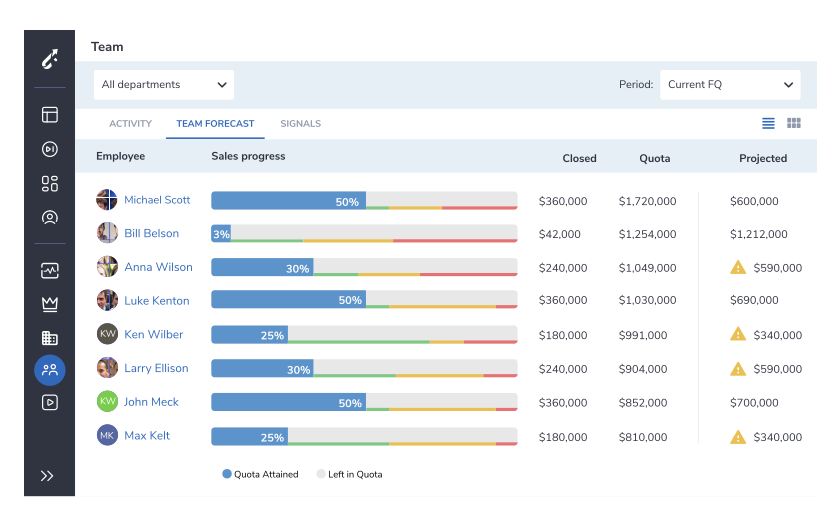
Another benefit of using Revenue Grid is that it allows you to detect risks and opportunities right away. That means you’ll be able to act quickly when something goes wrong or capitalize on an opportunity before anyone else does. Hence, you can avoid costly mistakes and keep your company moving forward.
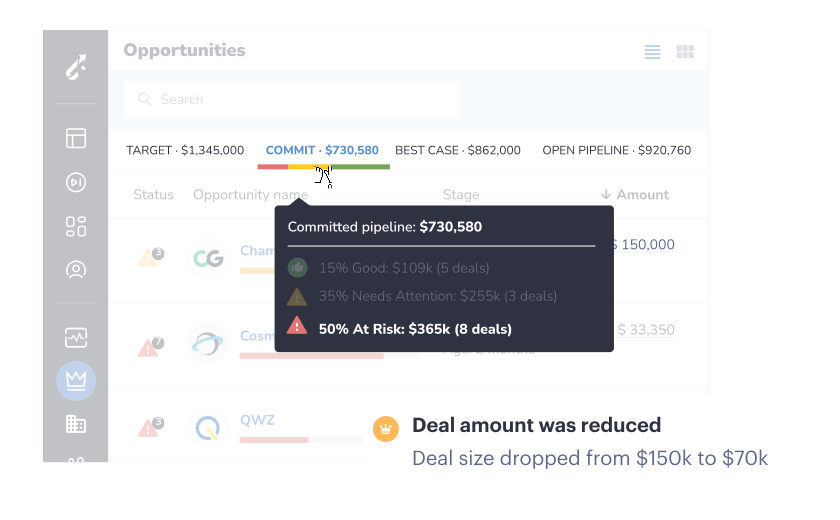
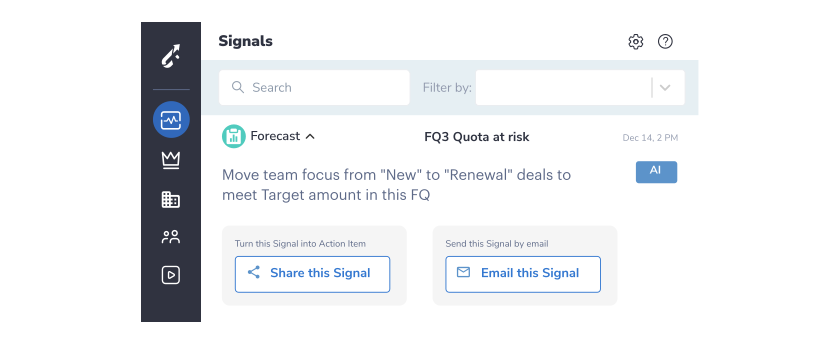
Revenue forecasting software also sends alerts when things aren’t going as planned so that you can address them before they become real problems. It’s a great way to stay on top of things that can help you close more deals, acquire more customers, and boost revenue.
How to Forecast Revenue
Creating a reliable revenue forecast doesn’t have to be complicated. Follow these steps to build your own revenue forecast using Excel or Google Sheets:
Step 1: Gather historical data
Collect at least 12-24 months of historical revenue data, broken down by month. If possible, segment this data by product line, customer type, or geographic region for more detailed analysis.
Example formula: Create a simple table with months in rows and revenue categories in columns
Step 2: Identify seasonality and trends
Calculate year-over-year growth rates and look for monthly or quarterly patterns.
Example formula: Growth Rate = (Current Period Revenue / Previous Period Revenue) – 1
For example, if January 2023 revenue was $100,000 and January 2022 revenue was $80,000, the growth rate would be: ($100,000 / $80,000) – 1 = 0.25 or 25%
Step 3: Choose your forecasting method
For most businesses, a combination of methods works best. Start with a simple growth rate method:
Example formula: Next Period Forecast = Current Period Revenue × (1 + Expected Growth Rate)
If your average monthly growth rate is 3%, and your current month’s revenue is $100,000, your forecast for next month would be: $100,000 × (1 + 0.03) = $103,000
Step 4: Apply seasonality adjustments
Calculate seasonal indices by dividing each month’s revenue by the average monthly revenue for that year.
Example formula: Seasonal Index for Month = Month Revenue / Average Monthly Revenue for Year
If January’s revenue is typically 80% of your average monthly revenue, multiply your trend-based forecast by 0.8 for January predictions.
Step 5: Create a rolling forecast
Update your forecast regularly as new data becomes available.
Example formula: Updated Forecast = (Actual Results × Weight) + (Previous Forecast × (1 – Weight))
Using a weight of 0.7 for actual results, if your forecast was $100,000 but actual results were $95,000, your updated forecast would be: ($95,000 × 0.7) + ($100,000 × 0.3) = $66,500 + $30,000 = $96,500
Step 6: Add pipeline-based adjustments
Incorporate your sales pipeline data by multiplying the value of opportunities by their probability of closing.
Example formula: Pipeline-Adjusted Forecast = Trend Forecast + (Pipeline Value × Close Probability × Historical Close Rate Adjustment)
With a trend forecast of $100,000 and $50,000 in pipeline opportunities at 60% probability, adjusted by a historical close rate factor of 0.8: $100,000 + ($50,000 × 0.6 × 0.8) = $100,000 + $24,000 = $124,000
Step 7: Visualize your forecast
Create line charts comparing historical data with forecasted values to easily spot trends and potential issues.
Use conditional formatting to highlight significant variances between forecasted and actual results.
Step 8: Document assumptions
Keep a record of all assumptions made in your forecast, such as expected growth rates, market conditions, and planned initiatives that may impact revenue.
This documentation is crucial for explaining variances and refining future forecasts.
Best Practices and Common Mistakes in Revenue Forecasting
Even the most sophisticated forecasting models can fail if not implemented properly. Here are key best practices to follow and common mistakes to avoid:
Best Practices
- Use multiple forecasting methods – Combine different approaches (bottom-up, top-down, statistical) to create a more balanced and accurate forecast. This helps mitigate the inherent weaknesses of any single method.
- Involve cross-functional teams – Include input from sales, marketing, customer success, and finance to capture diverse perspectives and ensure all relevant factors are considered.
- Update forecasts regularly – Implement a cadence of weekly or monthly forecast reviews to incorporate new data and adjust projections accordingly.
- Segment your forecast – Break down projections by product line, customer segment, or geographic region to identify specific areas of strength or weakness.
- Track forecast accuracy – Measure the variance between forecasted and actual results to continuously improve your methodology.
- Document assumptions – Clearly record the assumptions underlying your forecast so you can understand why variances occur.
- Implement scenario planning – Create best-case, worst-case, and most likely scenarios to prepare for different potential outcomes.
Common Mistakes
- Relying solely on historical data – Past performance doesn’t always predict future results, especially in rapidly changing markets.
- Ignoring seasonality – Many businesses have predictable seasonal patterns that significantly impact revenue.
- Overconfidence in complex models – Sophisticated models aren’t necessarily more accurate than simpler approaches.
- Failing to account for pipeline quality – Not all opportunities are created equal, and conversion rates vary by stage, source, and sales rep.
- Neglecting external factors – Economic conditions, competitor actions, and regulatory changes can dramatically impact results.
- Setting unrealistic targets – Confusing aspirational goals with realistic forecasts undermines the credibility of the entire process.
- Using inconsistent methodologies – Changing forecasting approaches frequently makes it impossible to track accuracy and improve over time.
How to Forecast Revenue
Step 1: Set goals for yourself and your team members.
Whether it’s a particular number of sales or a specific dollar amount from a customer over a given timeframe (like monthly), having specific targets makes it easier for everyone to contribute to the forecasting process.
Step 2: Review past performance.
What did your revenue look like last year? How much did it change year over year? And what were the biggest changes you saw? If there were any major changes, what caused them?
Step 3: Learn about your current customer base.
Who are they? Where do they come from? What kind of products or services do they buy from you? Are there groups of customers who have similar purchasing habits? If so, how can you better serve them by ensuring their needs are met?
Step 4: Make sure you’ve got all the data you need.
This includes financial data, as well as data about customer behavior and market trends. Use your revenue forecasting software to find it.
Step 5: Gather your team for a brainstorming session.
This is where everyone gets together and thinks about what might happen in the future. Maybe there’s been a shift in regulations that affects your business model, or perhaps an industry trend might make it harder for people to find your products or services. Then think about how those things will affect your revenue—will they increase or decrease it? And by how much?
Revenue forecasts are vital in setting goals, measuring performance, and informing strategic decision-making. It’s impossible to make well-informed strategic decisions without understanding what you can achieve in the future.
How to perform revenue forecasting with Revenue Grid
Revenue Intelligence from Revenue Grid is a brilliant way to not only track forecasts and manage your pipeline in Salesforce, but also to quickly get insights on which deals need intervention. It does this by offering a set of analytics and predictive capabilities to answer important questions. Will you hit your revenue targets? Where are there risks in your pipeline? What can you do to close forecast gaps?
Revenue Intelligence enables your company to:
- Forecast sales with precision
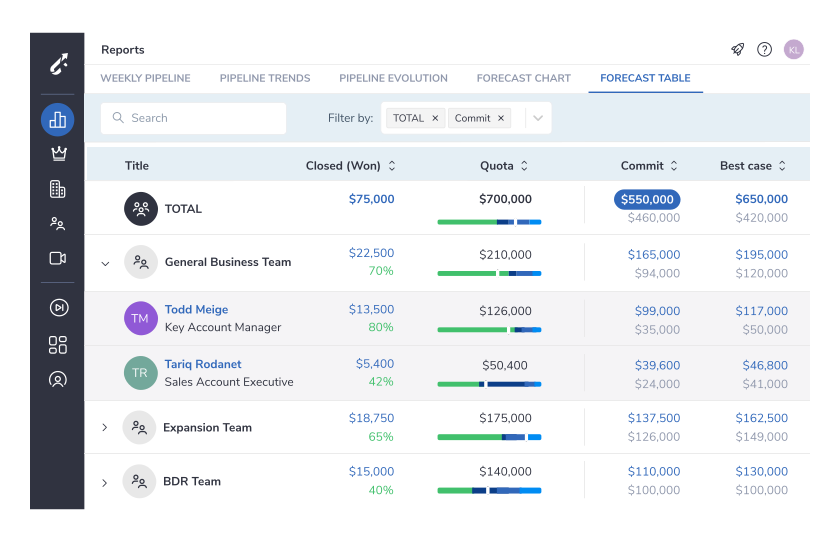
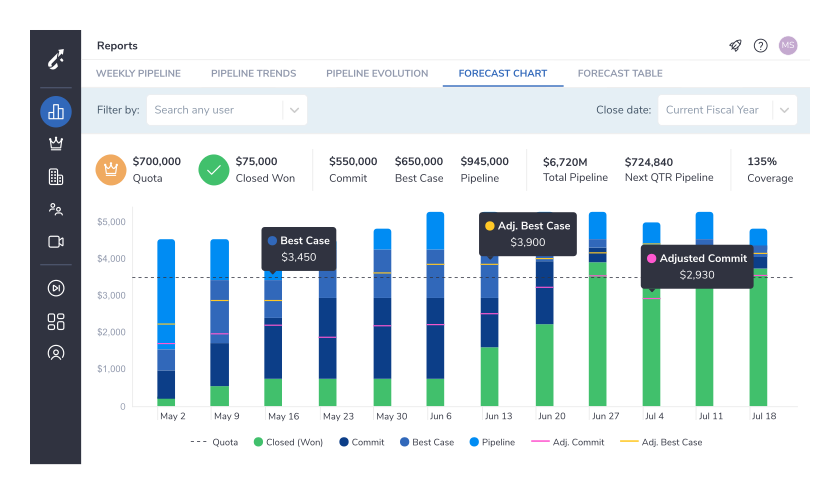
- Understand where to focus and communicate efficiently with your team about where to pivot for quick success.
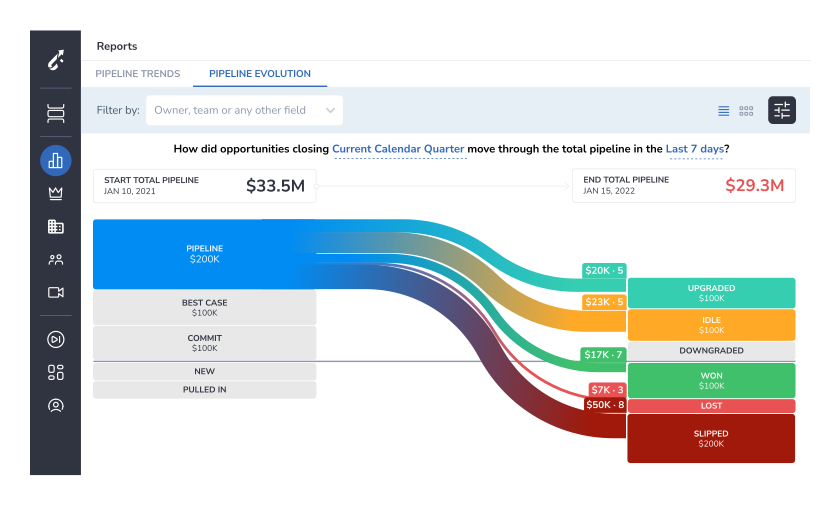
- See the pipeline growth during the selected period with pipeline evolution reports and adjust your revenue projections when needed
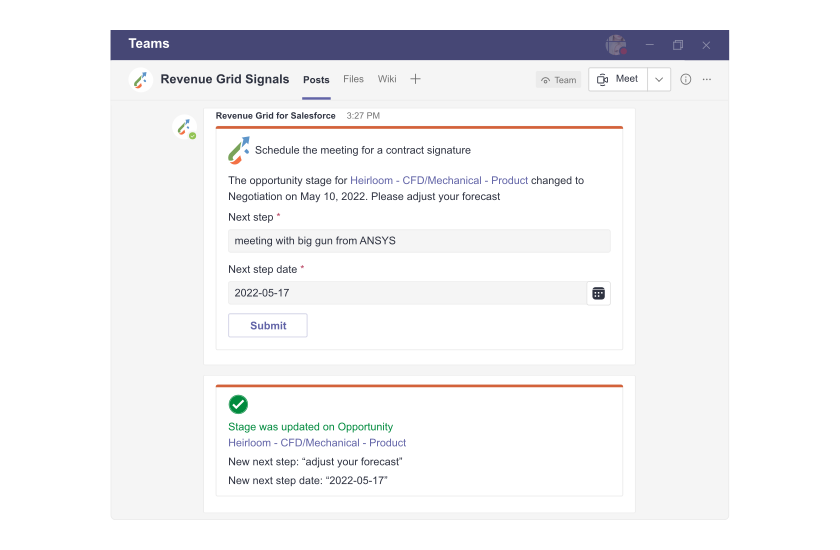
- Guide your team at each stage of sales forecasting process with Revenue Signals
 Using our revenue intelligence capabilities, Revenue Grid will predict your revenue outcome with 96% accuracy.
How do you forecast revenue in Excel?
To forecast revenue in Excel, start by organizing your historical revenue data by month or quarter in columns. Use the FORECAST function (=FORECAST(x, known_y’s, known_x’s)) for simple linear projections, or the more advanced FORECAST.ETS function for time series forecasting that accounts for seasonality. For example, =FORECAST.ETS(A1, B2:B25, A2:A25, 1, 0.3) would forecast the next period’s revenue based on historical data in ranges B2:B25 and A2:A25, with seasonality detected automatically. You can also use Excel’s built-in Forecast Sheet feature (Data tab > Forecast > Forecast Sheet) for visual forecasting with confidence intervals.
How do you forecast in Google Sheets?
In Google Sheets, revenue forecasting is similar to Excel but with slightly different functions. Use the FORECAST function (=FORECAST(x, data_y, data_x)) for basic linear projections. For more advanced forecasting, use the TREND function (=TREND(known_y’s, known_x’s, new_x’s)) to predict future values based on linear regression. Google Sheets also offers the GROWTH function for exponential growth modeling. To visualize your forecast, create a scatter chart with your historical data, then add a trendline by right-clicking the data series and selecting “Add trendline.” You can display the trendline equation and R-squared value to evaluate the forecast’s reliability.
What are the three types of forecasting?
The three primary types of forecasting are:
- Qualitative forecasting: Based on expert judgment, market research, and intuition rather than numerical data. Examples include the Delphi method, market research, and scenario planning. Best used when historical data is limited or during major market disruptions.
- Time series forecasting: Analyzes historical data patterns to predict future values. Methods include moving averages, exponential smoothing, and ARIMA models. This approach works well when you have substantial historical data and stable patterns.
Causal/econometric forecasting: Identifies relationships between the variable being forecast and other influencing factors. Regression analysis and econometric modeling fall into this category. This method is powerful when you need to understand how specific variables impact your revenue.
What is the difference between sales and revenue forecast?
Sales forecasts focus on the number of units or deals expected to be sold in a given period, primarily serving the sales department’s planning needs. Revenue forecasts, however, translate those sales into actual monetary terms and account for when the money will be received, considering factors like payment terms, revenue recognition rules, and the timing of cash flow. While sales forecasts typically operate on shorter timeframes (weekly or monthly) and focus on sales activity metrics, revenue forecasts take a broader view, incorporating all revenue streams (not just new sales) and often extending to quarterly or annual projections. Finance teams and executive leadership typically rely more heavily on revenue forecasts for budgeting and strategic planning.
What is top-line forecasting?
Top-line forecasting refers to projecting a company’s gross revenue or total income before any expenses, deductions, or costs are subtracted. It focuses exclusively on the “top line” of the income statement—the total amount of money generated from sales of products or services. This type of forecasting is crucial for growth planning, market expansion strategies, and evaluating the effectiveness of sales and marketing initiatives. Unlike bottom-line forecasting (which predicts net profit after all expenses), top-line forecasting doesn’t account for operational costs, taxes, or other expenses. Companies typically use top-line forecasting to set sales targets, evaluate market opportunities, and make initial resource allocation decisions before conducting more detailed profitability analyses.