

Wealth management runs on memory across decades, but the details that build trust rarely fit in a CRM. Relationship intelligence is how firms remember what matters and stay close to clients at scale.
Wealth management is a relationship business in a way few other industries are. A household stays with the same firm through marriages, retirements, businesses sold, the children growing up, the grandchildren arriving. The sale is measured in decades. And the firms that win the best clients and keep them are the ones that pay attention over a very long time.
Trust is built slowly through hundreds of small acts of attention, and a single moment of misunderstanding can end a 15-year relationship inside a week. So why do firms with good advisors still lose long-term clients? What does it take to deliver relationship-driven service at firm scale?
The Firm Has to Remember Like One Person
Trust between people runs on memory. Think of a friend who remembers you mentioning an allergy and takes care of it if you visit their home. It makes you feel known.
Wealth management runs on the same wiring. When a client mentions a concern and the advisor cannot connect it to what they raised a few months ago, the client does not file it under “forgetfulness.” They file it under “does not care.” From there trust erodes. The relationship cools down, over months, until the client has moved most of their assets to a different firm.
The other truth is that the client is not actually in a relationship with one advisor. They are in a relationship with the firm. Over a twenty-year arc, the original advisor will retire, the account will be reassigned at least once, and specialists will be pulled in along the way. Each transition is a chance for the firm to forget something the client believes they told it years ago.

From the client’s seat, all of that movement is supposed to be invisible. The firm is one continuous person who has been paying attention the whole time, and the client expects it to behave that way.
The Structural Limits of Memory at Scale
Remembering everything about clients is structurally hard, and it only compounds when the number of clients increases and the time with those clients also increases.
A wealth management firm has multiple business units, often multiple implementations of the same CRM, each with its own workflows and customizations. The household relationship is not a single thread. It branches across a wealth advisor, a trust officer, an investment specialist, sometimes a banker, sometimes an outside estate attorney. Most of these threads never meet anywhere a person can see them at once. It’s all scattered, or lost.
Multiplied across many advisors and many channels for many years, those small losses compound into the difference between a firm that feels like one continuous person to its clients and a firm that feels like a rotating series of strangers.
And even if the firm could capture every conversation perfectly, the most important things to remember would not fit.
What You Need to Remember Isn’t in the CRM
There was a wealth management firm that wanted to host a private wine tasting in Napa for a small group of clients.
Finding people in that location was the easy part because the address is a structured field in CRM. It only took a single query. The harder part of the invitation was figuring out who actually likes wine. The team had written down this information for most of the clients. They had heard it in meetings and written it down in notes and contact comments over years. None of that was a queryable field, so the list could not be built without an advisor sitting down and reading through hundreds of records by hand.
Generalize that out and the pattern is everywhere.
The most valuable things any advisor knows about a client almost never sit in a structured field. Things like family dynamics, preparing for a major expense in the future, or the way one spouse thinks about legacy versus the other, etc. The CRM was built to only hold what fits cleanly into rows, and the things that matter most to a wealth relationship rarely do.
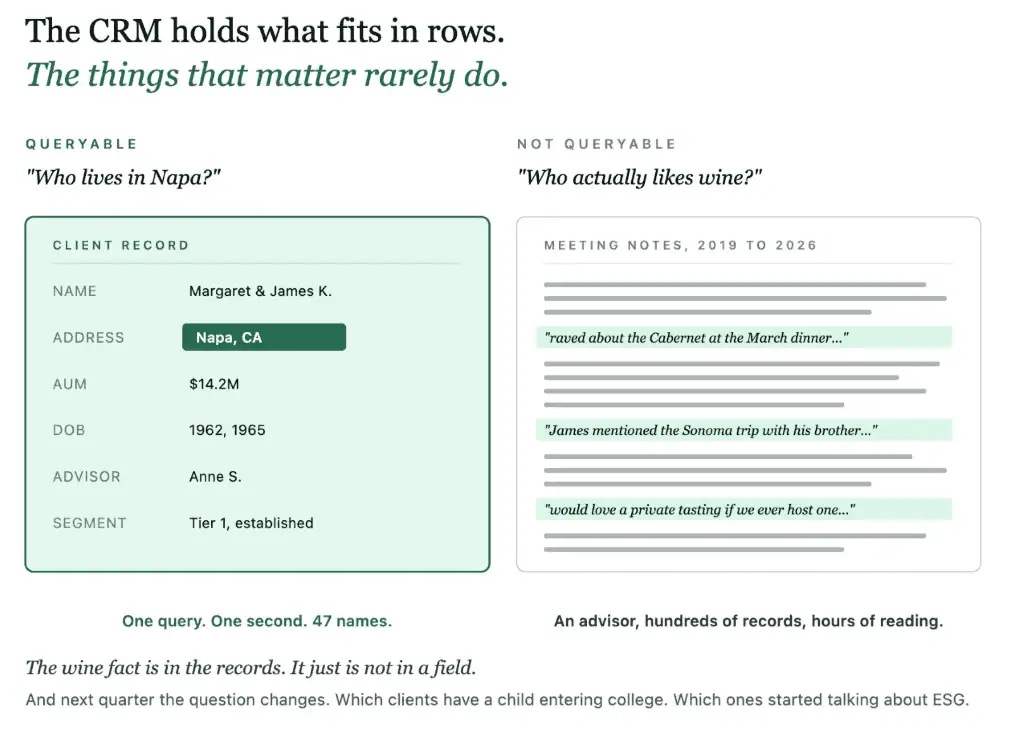
Adding more CRM fields does not solve this either. Technically, you can add a “drinks wine” field, but next quarter the question will be different. Which clients have a child entering college. Which ones recently lost a parent. Which ones have started talking about ESG? The questions arrive faster than the fields can be added.
If the data problem is hard, most firms assume the regulatory layer is going to make it harder. That assumption is the wrong way around.
Compliance Wants What the Client Wants
Most firms read compliance as the constraint slowing them down. It is more useful to read it as the formal written description of what good already looks like.
- • KYC means Know Your Customer. The regulator is asking for a continuous, current, accurate picture of who each client is, what their household looks like, what their goals are over the next three, ten, and twenty years, and what has changed since you last checked.
- • Reg BI (Regulation Best Interest) requires broker-dealers to act in the best interest of their clients when making investment recommendations. To clear that bar, the firm has to actually know the client well enough to know what their best interest is.
- • Fiduciary duty, which applies to registered investment advisers, is a stricter standard still. The adviser must act in the client’s best interest at all times, with full loyalty and care. That obligation only holds up if the firm carries an accurate, current picture of who the client is and what they want.
The client wants to feel known and remembered. The regulator wants the firm to be able to demonstrate that it knows the client well enough to advise them
Compliance, the client, and the competitive pressure of an industry where the next generation will change advisors more readily than the last one ever did, are all asking the firm to know the client well enough to advise them.
If three different forces are asking for the same thing, the question that follows is what kind of tools actually deliver it?
The Two Halves of a System That Remembers
The inside half builds on activity capture, which has been logging every email, meeting, calendar event, and call for years. The newer work sits on top of that record. A system turns those logged conversations into facts the firm holds about each household: the wine preference mentioned in a meeting note three years ago, the concern about a grandchild’s college, the offhand remark about possibly selling the business in five years. All of it becomes retrievable by whichever advisor needs it next. The CRM continues to be the system of record. The new layer is what makes the conversations usable.
The outside half does the same for the world beyond the firm:
- • Public news about the client or their family
- • Life events
- • Changes at companies the client is invested in
- • Articles their adult children have written
- • Movements in their industry that will reshape the next conversation
None of this should depend on an advisor checking eight news sources on a Sunday night.
Both halves run whether the advisor opens any software or not. By Monday morning, the prep work is done. The relevant context surfaces. The suggested next move arrives with the reasoning attached. The advisor reads it, edits if needed, and decides what to send.

The Future of Trust in Wealth Management
It’s not up for debate anymore that AI is about to change what trust looks like in the wealth management industry. Communication is getting faster, outreach is getting cheaper, and personalization is getting easier to fake. Clients are already noticing. As more of what lands in their inbox starts to feel AI-generated, the moments that come from someone who genuinely knows them will matter more than they ever have.
The right message is controlled autopilot, not full autopilot. The judgment stays with the advisor. What changes is the work around the judgment.
The category for software that does this is starting to be called relationship intelligence. The job of a relationship intelligence tool is to read everything the firm is hearing and seeing, turn it into knowledge the firm collectively holds, and prepare the next move.
And Revenue Grid is that relationship intelligence tool.
It helps wealth management firms tap into relationship-aware, longitudinal data that compounds in value the older it gets. All of it is amplified by AI. And the best part is that none of this exists to reduce human interaction. It exists to make every human interaction count for more.