
For decades the linear sales process came with a promise that if you follow the steps in order, you would win enough deals to hit your revenue number. For a long time this promise was true because the buying world was simple.
The promise of the linear sales process
Back then a buyer had few ways to learn about you (a call, a brochure, a trade show), few competitors in the running, and no way to research on their own. So a deal genuinely did move one step at a time, in order, because there were only so many things that could happen and they happened in a predictable sequence.
The linear sequence also gave us a shared language. When a rep said a deal was in negotiation, everyone knew roughly what the rep meant. Forecasts became possible because the stages lined up in order, and order is easy to count.
We even built CRMs to mirror that linear sales process. The stages a deal moves through, the fields you fill at each one, the reports that score how far along you are, all of it assumes a deal advances one step at a time in a set order. The software didn’t just track the straight line, it expected it, and it still does.
The deal is a puzzle now
Now the world doesn’t move in a predictable direction. A buyer talks to your competitor, reads reviews, asks peers, sits in a webinar, and confirms budget internally, all before you even know they exist, and in no fixed order. Reps are following the process, moving every deal along exactly as the CRM lays it out, entering the data they are asked for, and still losing deals they should have won.
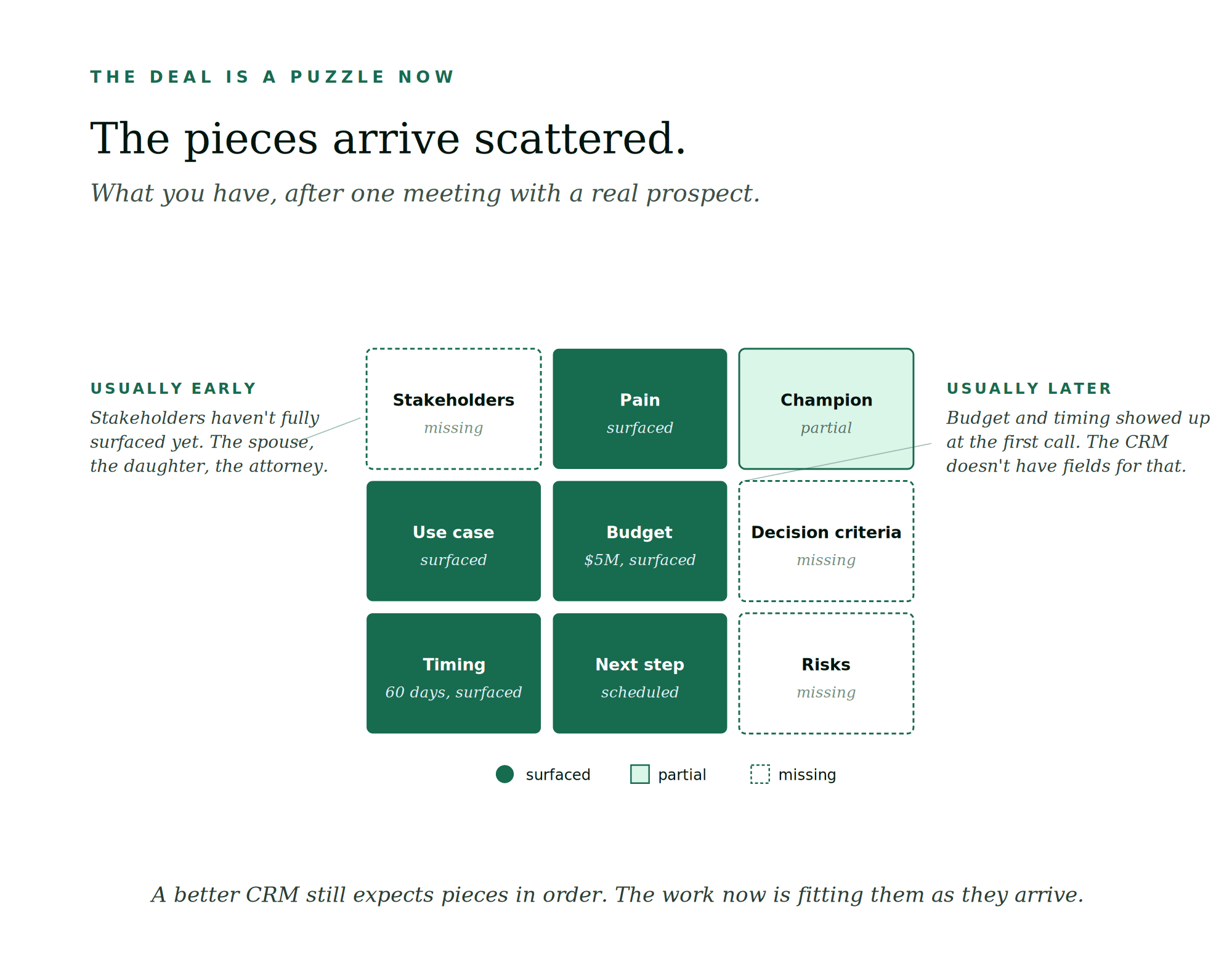
Take an advisor on her first meeting with a prospective client. The system files it as an intro call, but far more came out of it than that label holds. The prospect is ready to move $5 million in assets, and they want it settled before a liquidity event closes in 60 days. That is real money and a hard deadline, both things the process expects much later.
The CRM still reads the relationship as early and weak, because the boxes it wants filled by now sit blank. It doesn’t yet know who else has a say, whether a spouse, an attorney, or the family accountant, what the prospect is really trying to protect, or what the agreed next step is. She is holding pieces that usually arrive late and missing the ones that usually arrive first.
Now run it forward.
Weeks on, close to bringing the client on, the prospect’s adult daughter joins a call and asks to fold the family trust into the plan, something nobody raised before. That is discovery work, the kind of thing the process assumes was settled long ago. The relationship has already moved past that stage, so the system has nowhere to put a piece that showed up out of turn.
The advisor has the pieces that usually come late. She is missing the ones that usually come first. So is it the CRMs fault that it can’t judge the full context? Or is the data incomplete?
It’s none of these. Deals no longer move in a straight line. They come to you as scattered puzzle pieces, and the work now is fitting them together to see the whole picture and decide what to do next.
A better CRM won’t fix it
A real deal does not arrive in order. The pieces show up whenever the buyer happens to reveal them, and the order is close to random. So the natural response to a wrong read is to ask for a better tool. If the CRM scored our rep’s deal as weak when the deal was actually strong, then maybe the answer is a smarter CRM, one that weights the pieces better and fills the blanks with AI.
The obvious fix is to capture everything, so you can see the pieces that you have, and where to fill the gaps. We have mostly solved that part already.
Activity Capture pulls in every email, meeting, and call on its own, which means the budget our rep heard on that first call is saved in the system whether or not she stopped to log it. The same goes for the approver who surfaces weeks later and the problem the buyer finally spells out later still. Every piece gets collected and filed the moment it arrives.
But a CRM’s job is to remember.
It records what happened and keeps it filed in order. So when you make a CRM “better,” you are making it remember better: more fields to fill, cleaner data, stricter process, and lately an AI layer that reads the records and writes faster summaries of them.
You can sharpen a filing system until it files perfectly, and it is still a filing system.
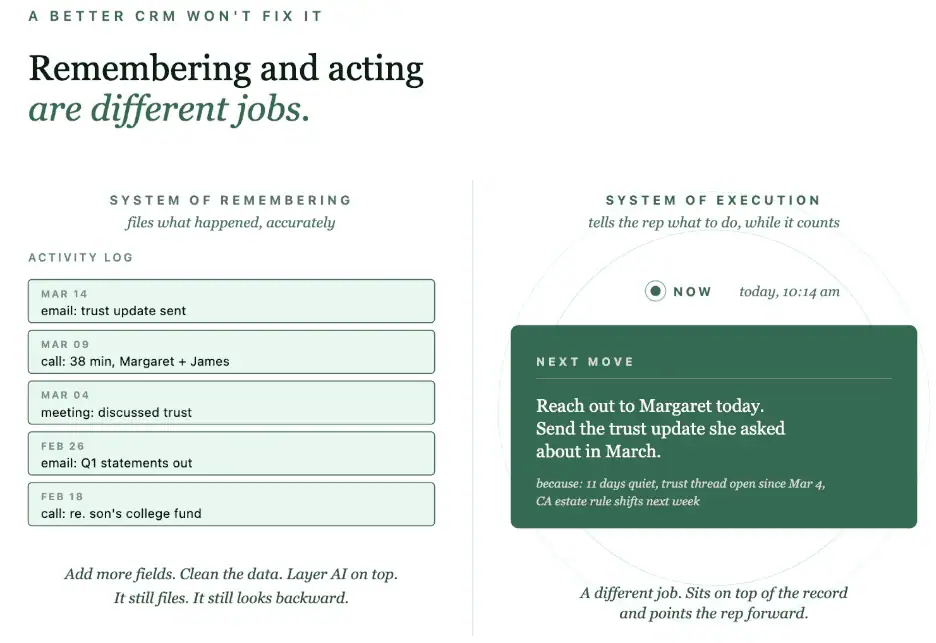
But the advisor’s real problem in the above example was not that she remembered too little. Her problem was that the pieces arrived out of order, and she needed something to fit them into a picture and tell her the next move while it still mattered. That is execution, and it is a different job from remembering.
How to get a system of execution running for your reps?
You don’t have to change the way you sell, or ditch your CRM. To build a system of execution you need three things:
- Context is where the deal actually stands right now. Who you’ve talked to, what they agreed to, what went quiet. Most of it lives in email and calls the CRM never sees.
- Prioritization is being told which deal to work first. A rep has dozens open at once. This ranks them, so the day goes to the one that matters most.
- Timing is the right nudge while it still counts. A warning that a buyer went quiet helps today. The same warning next week is just a note on a deal you already lost.
A CRM does none of these on its own. That is why bolting execution onto the reporting layer just gets you more dashboards and alerts, the kind you can see but can’t act on.
What you need is a relationship intelligence layer (like Revenue Grid) that sits on top of the CRM you already run. Connect your email, calendar, meetings, and calls, and from there it reads everything and tells the rep what to do next.
Here’s how it’ll work in four steps:
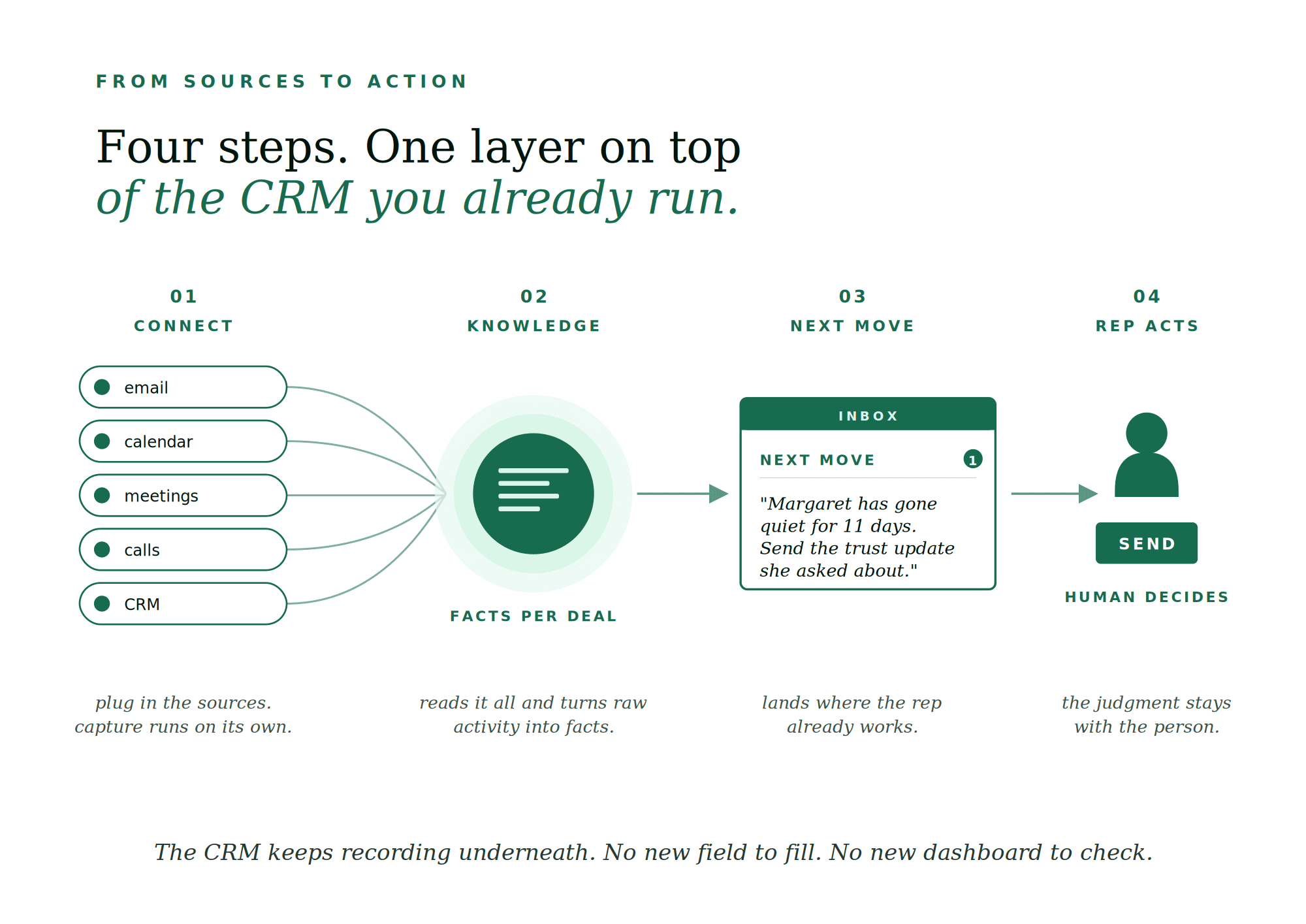
- Connect your sources. You plug in email, calendar, meetings, calls, and the CRM. From that point capture runs on its own. Every interaction flows into one place without a rep logging anything.
- Let the platform build the knowledge layer. It reads across all those sources and turns the raw activity into facts about the deal: who the stakeholders are, who has gone quiet, what was agreed, where risk is building. This interpretation is the thing you are actually buying. You are not configuring it field by field.
- Take the next action where the rep already works. The platform does not hand you another dashboard to go check. It puts the next step in the rep’s inbox or in front of a call. This deal, this person, this move, now.
- The rep acts and owns the call. The CRM keeps recording underneath, exactly as before. The software removes the admin and sharpens the read. The judgment stays with the rep.
The straight line isn’t coming back
The buying world will keep getting more tangled, not less. Deals will keep showing up as scattered pieces, out of order, faster than anyone can sort by hand. The real question is no longer whether your reps can follow the steps. It is whether they can see the whole picture in time to act on it.
That is what a system of execution is for. The CRM keeps the record, the platform on top reads the pieces and hands the rep the next move, and the rep keeps the part that was always theirs, the judgment and the relationship itself. The straight line is gone. What replaces it is a rep who finally sees the whole board.