
Why the ceiling on AI in wealth management is set by whether a firm can explain it, own it, and undo it, not by how accurate it is.
91% of financial advisors now use generative AI in some form. But only 29% will let it near a financial plan.
Both numbers come from a survey of 300 advisors at enterprise wealth management firms, and the gap between them is the most telling fact about AI in this industry right now.
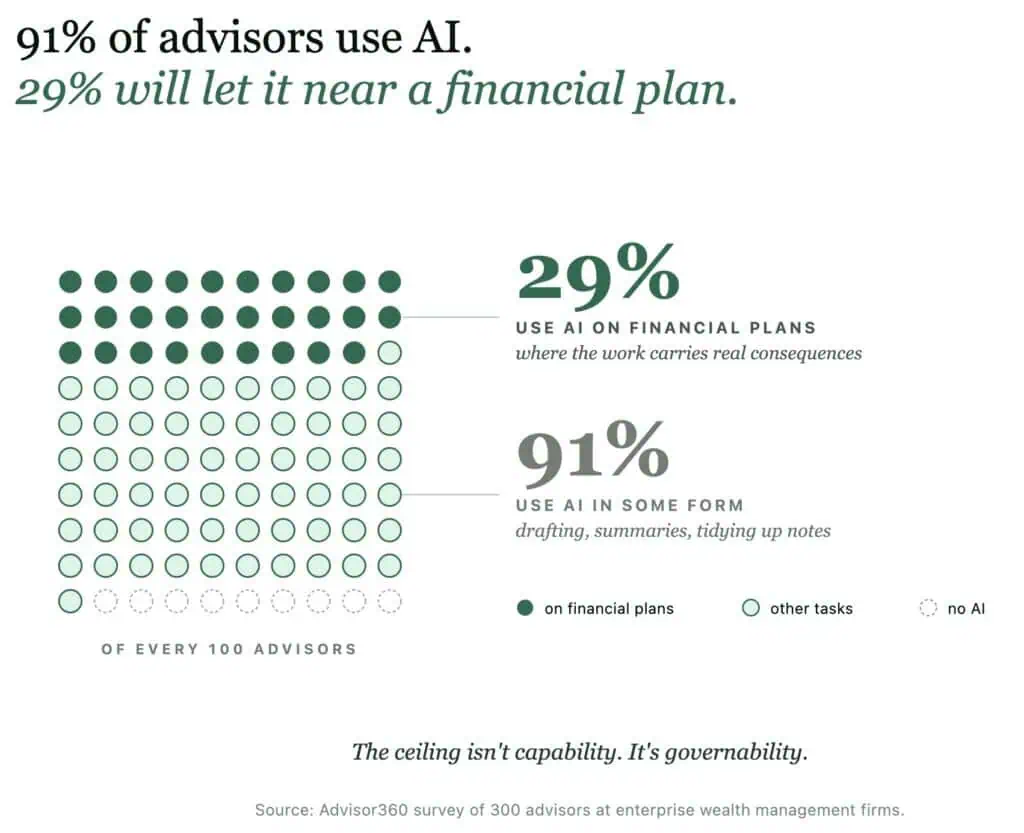
The tools cleared the capability bar a while ago. They draft the meeting summary, pull the research, and tidy up the notes. Then they stop, right at the point where the work starts to carry real consequences for a client.
EY, working with 50 wealth managers and 50 asset managers, found that 95% had scaled generative AI across multiple use cases while 29% reported substantial business impact, and that 86% ran into regulatory and compliance complexity along the way.
The thing holding AI at the door isn’t capability but governability. Governability is what sets the ceiling on how much AI a firm can actually put in front of a client.
A system is governable when:
- • It can explain itself. The firm can say why the system reached a given output, in terms a person can follow and a regulator will accept, rather than pointing at a result and calling it correct.
- • Someone owns it. There is a named person who answers for the decision, not a process or a vendor. Accountability sits with a human who carries the consequences if the call is wrong.
- • It can be caught and undone. The firm can flag a bad output and reverse it before the client feels the damage, which means a review step early enough to matter and a way back once something has gone through.
However, governability carries a cost, in review steps and slower launches, so it’s worth being clear about what you’re buying.
The cost of being wrong is asymmetric and often irreversible
When people judge an AI system, they reach for one number to see it’s performance: What is the percentage of the time when it’s right vs. wrong?
If it’s wrong only 5% of the time, it sounds reassuring. But that only tells you how often it’s wrong. It doesn’t tell you how bad the wrong choices are.
But it hides the thing that actually matters, which is what the other five percent costs. Two systems can both score ninety-five percent. One is wrong on small, easily fixed calls. The other is wrong on a client’s entire retirement. The number looks the same. The outcome does not.
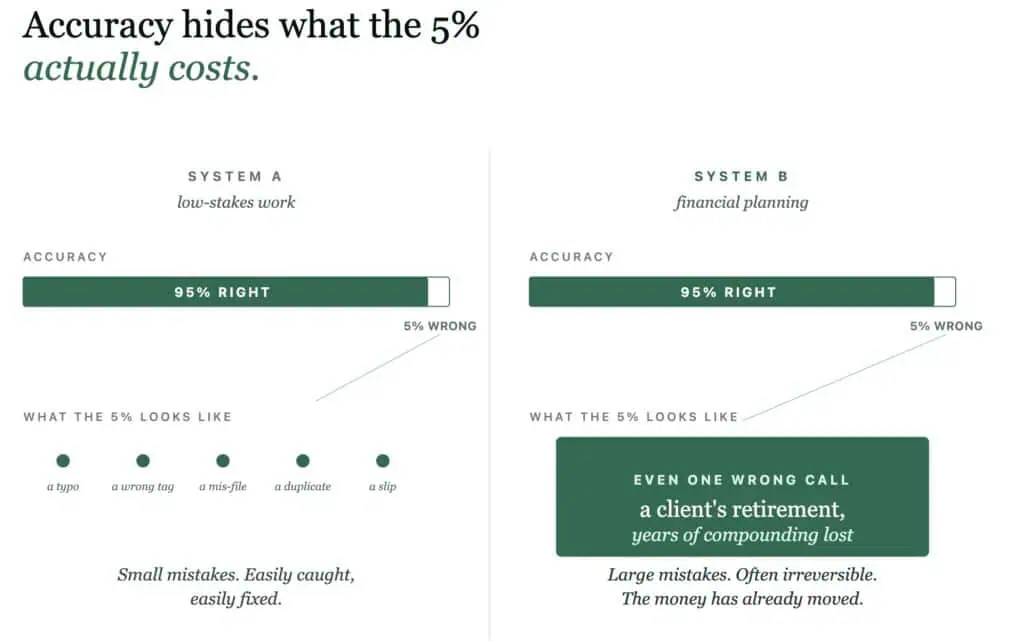
An accuracy score treats every mistake as equal. In this business they are not. A wrong call on a minor rebalancing is an inconvenience. A wrong call on someone’s life savings can set their retirement back by years.
There’s a second problem, and it’s worse.
Most of these decisions can’t be taken back. Once a trade goes through or a client acts on a recommendation, the money has already moved. There’s no catching the mistake at that point. It’s already done, and the chance to reverse it is gone.
This is why an accuracy score can fool you. It tells you how often the system gets it right. It says nothing about the damage done when it gets it wrong, and in wealth management that damage is the part that counts.
Trust is what clients are paying for
A client can get information anywhere. What they can’t get from a machine is someone who answers for it.
A model can read every report and run the numbers faster and more accurately than any person. But when it makes a call, it has nothing at stake. It doesn’t lose its license if the call is wrong. It doesn’t lose its reputation, or a night’s sleep, or the client. It produces an answer and marks the task as done.
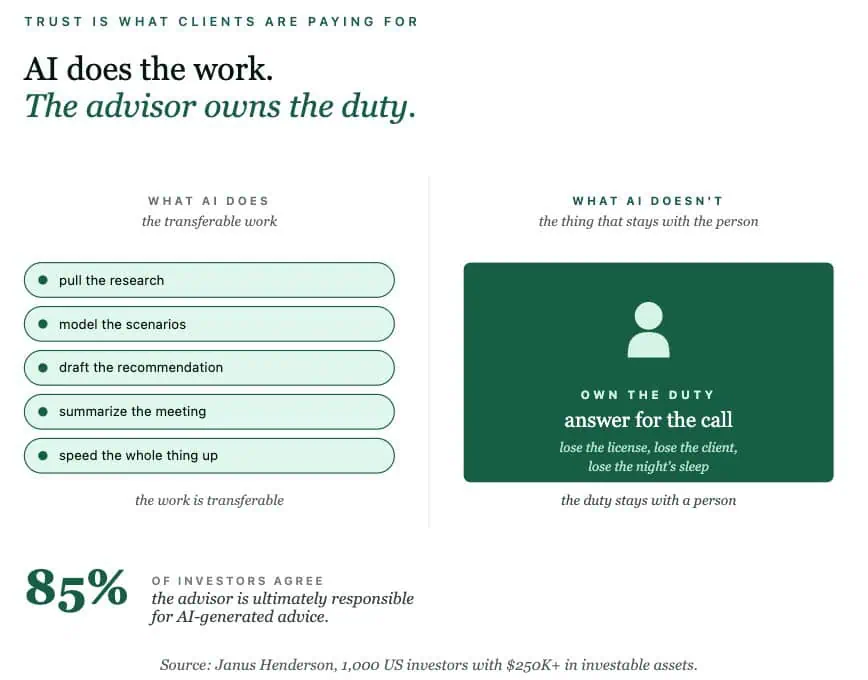
Janus Henderson surveyed 1,000 US investors holding at least $250,000 in investable assets and found that 85% agree their financial advisor is ultimately responsible for AI-generated advice and materials received from that advisor. Clients have already worked out where accountability sits, and they have put it on the person rather than the tool.surveyed 1,000 US investors holding at least $250,000 in investable assets and found that 85% agree their financial advisor is ultimately responsible for AI-generated advice and materials received from that advisor. Clients have already worked out where accountability sits, and they have put it on the person rather than the tool.
When a client hands over their portfolio, they’re anxious about their investments, their retirement, their plans. Part of what they’re paying for is to hand that worry to someone else, a professional who takes it on and says, in effect, “I’ve got this, and I’ll do the best I can for you.”
And the client knows the advisor has something at stake too. If the call goes bad, the advisor answers for it, in reputation, in the relationship, in their standing. That shared exposure is what makes the reassurance mean anything.
Brian Green, chief product officer at Merit Financial Advisors, says, “AI can surface insights and speed things up, but when a recommendation affects someone’s retirement, family or sense of security, a human must own the decision.”
In fact, an advisor owes clients a fiduciary duty, a legal obligation to put the client’s interest first. AI can do a great deal of the work underneath that duty. It can pull research, model scenarios, draft the recommendation. What it cannot do is take the duty on. The duty belongs to a person and stays there, no matter how much of the work the machine does.
So the better AI gets, the more this matters, not less. As the machine takes over the analysis, the human’s job narrows to the thing the machine cannot do, which is to be accountable for the result.
Regulators ask how, not how well
When a regulator looks at a decision, they don’t ask how accurate the system was.
They ask:
- • Were there controls in place?
- • Was the recommendation reviewed?
- • Could someone challenge the decision?
- • Was there a clear record of who was responsible?
- • Did the firm follow its own policies?
Being right isn’t enough. Firms also need to show they reached the decision in a controlled and accountable way.
And regulators have said fairly clearly what they expect to see written down. In its 2026 report, FINRA gave AI its own dedicated section for the first time, after barely mentioning it the year before. The message was that AI is now something firms have to supervise, not just buy. That means keeping records of what the AI was asked and what it answered, noting which version of the model was used, and having a person review its output before it goes anywhere.
When the SEC brought its first two AI cases in 2024, part of what it went after was exactly this: the firms had no policies in place to catch the false claims they were making. The missing safeguard was itself the violation.
However, a policy only governs what reaches a system. A firm can write an excellent AI use policy and still fail the question that decides a review: what did the system actually see? When the substance of a client relationship – the concern raised on a call, the objection buried in an email thread, the reason a meeting got moved – never reaches a system, AI systems work from a partial record and produces a recommendation that looks exactly as confident as one built on the full picture. Nobody can tell the difference afterward, including the reviewer. Explainability is decided at capture time, long before anyone asks the question.
The fix is unglamorous. Interactions have to be captured as they happen – email, meeting notes, calendar history – with firm-level control over what gets recorded, how it’s stored, and where it lives. A relationship record built that way can carry the reasoning a regulator or a client will eventually ask about, because the reasoning went into the file before anyone needed it. Retrofitting that record is not an option; the conversation is gone. This is the layer Revenue Grid sits in, and it’s why compliance-readiness belongs in the architecture rather than the policy document.
Governance is what creates room to deploy
Capture solves what a firm can show. What it doesn’t answer is whether any of this slows the work down – and that’s the question a budget meeting actually asks.
Morgan Stanley suggests it doesn’t. Jeff McMillan, who led firmwide AI there, has described a model in which nothing reaches production until a second group of reviewers – who don’t report to him and aren’t paid by him – independently validate it. That sounds like friction. It’s also why the firm got AI into the hands of thousands of advisors instead of leaving it in a pilot.
Governance built in advance becomes deployment capacity later. Firms that treat it as the last step before launch find that it was the first, and that retrofitting it costs more than building it would have.
Governability has to be built
Accuracy will keep improving on its own; every model release moves it. Governability doesn’t work that way – no vendor ships it, and it can’t be added once the recommendations are already going out. It’s the part a firm has to decide to build, at the point where the client relationship is first captured.