


Key Takeaway
- Most teams leave Outreach.io because pricing opacity, weak Salesforce data capture, and contract rigidity stack up, not because sequencing broke.
- The strongest alternatives split into two camps: tools that do sequencing better or cheaper, and platforms that solve the CRM data gap Outreach was never built for.
- Revenue Grid captures every touchpoint into Salesforce natively, turning that data into pipeline visibility and AI-driven deal guidance, starting at $30/user/mo.
The first quarter on Outreach.io usually feels like progress. Sequences run on schedule, reps stop forgetting follow-ups, and the analytics dashboards finally make pipeline conversations look organized. The shine fades around month nine. Forecasts keep missing. Reps quietly admit they only use a fraction of the platform. The CFO asks why a tool that costs $120 per user per month still leaves the Salesforce activity history full of gaps.
That’s the pattern showing up across G2, Capterra, and Reddit threads in 2026. Teams aren’t abandoning Outreach.io because it broke. They’re walking away because it stopped solving the problems that actually move revenue.
This article covers 11 Outreach.io alternatives, with every pricing figure verified directly from the vendor’s site in April 2026. Each tool gets honest treatment based on how it actually performs in real workflows, not what its sales team promises. By the end you’ll have a shortlist matched to the way your team actually sells.
Why Sales Teams Are Leaving Outreach.io
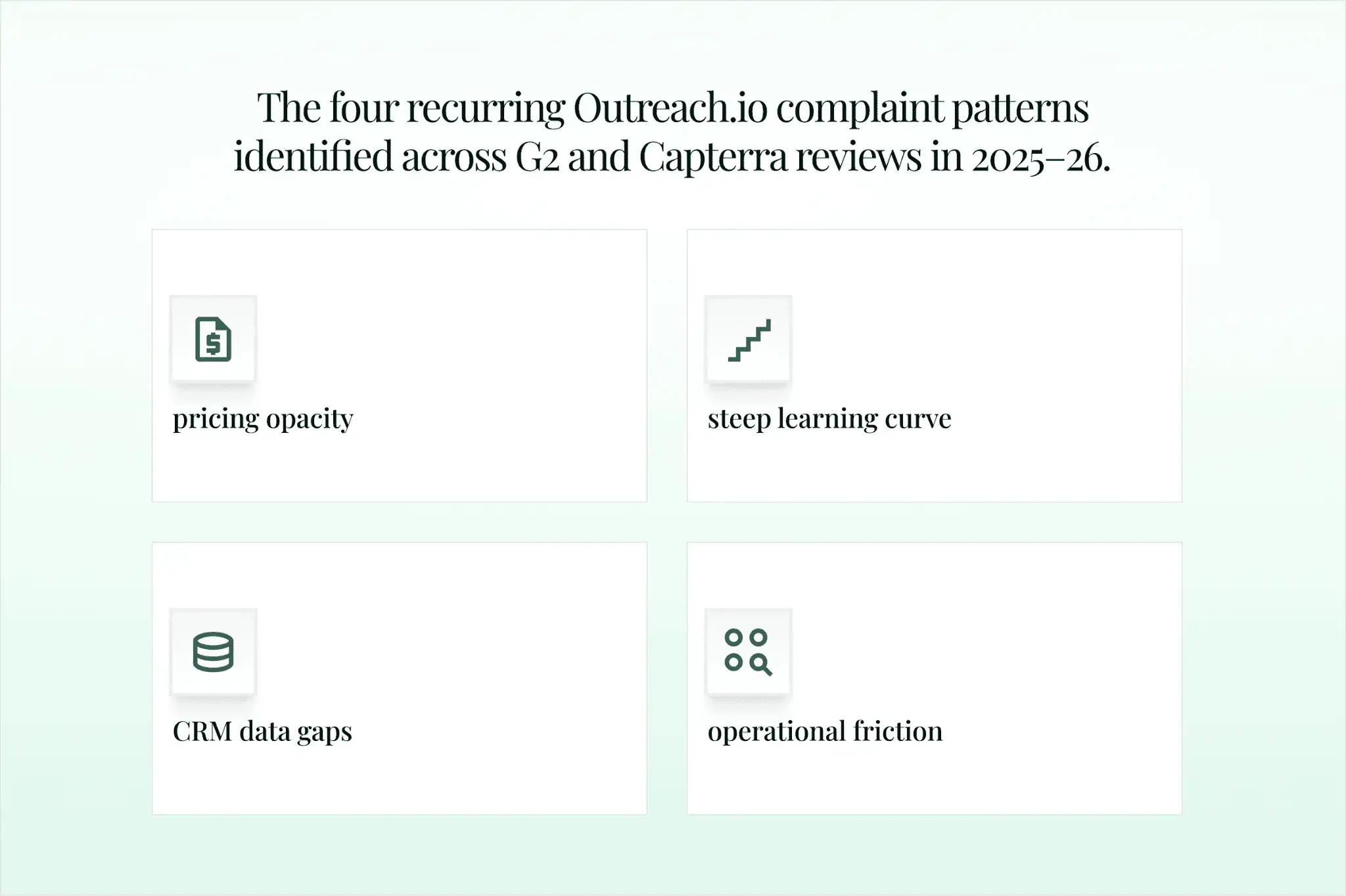
The first quarter on Outreach.io usually feels like progress. Sequences run on schedule, reps stop forgetting follow-ups, analytics look organized. The shine fades around month nine. Reading G2 and Capterra reviews from the last 18 months, four patterns surface repeatedly.
Pricing opacity. Outreach still doesn’t publish pricing. Vendr data shows $100–$160/user/mo with annual prepayment. A 20-person SDR team commits $24,000–$38,400/year before onboarding fees and most don’t know that until they’re three meetings deep with a sales rep.
Complexity. New reps need 2–4 weeks of ramp time. G2 reviewers report day-to-day usage covers only 30–40% of what the platform can do. The rest sits idle, paid for and untouched.
CRM data gaps. Outreach captures activity that happens inside Outreach. Cross-threaded replies, side conversations with sales engineers, meetings rescheduled outside the platform — every interaction that doesn’t pass through a sequence step risks never reaching Salesforce. That data gap is the root cause behind missed forecasts and the uneasy feeling that the CRM doesn’t reflect reality.
Operational friction. Slow support on lower tiers. Sales methodology workarounds. Auto-renewal clauses that catch teams off guard with 30–60 day cancellation windows.
None of this is unique to Outreach.io. The combination raises the obvious question. If these issues keep stacking, what should a better outreach alternative actually look like?
What Makes a Superior Outreach.io Alternative
Once you start evaluating Outreach.io alternatives, the criteria shift quickly from feature lists to operational reality. The platforms worth a real shortlist tend to excel in three areas.
1. CRM data capture and integration depth
This is the first non-negotiable. RevOps leaders call it the deciding factor because forecasting, pipeline reviews, and rep performance all depend on how closely the platform behaves like part of Salesforce. When it doesn’t, the same problems repeat. Sync delays distort weekly forecasts. Storage fills up with thousands of auto-generated activity records. Flows and reports break because activities sit in non-standard objects. Platforms built to mirror Salesforce’s data model avoid this entirely, which is why teams that have been burned by sync issues tend to put native activity capture above every other criterion. Reliable data quality, however, only exposes the next question: do reps actually adopt the tool that captures it?
2. Multi-channel sequencing and rep workflow
Email is table stakes. The real questions are around phone, LinkedIn, SMS, and WhatsApp coverage, and whether the sequence builder supports conditional logic or stays linear. Beyond features, the workflow has to fit how reps already work. The pattern across G2 and Reddit is consistent. High-adoption tools live where reps already spend their time. They require minimal retraining. They show value in the first week. Tools that demand reps adopt new behavior tend to lose that battle within the first quarter, regardless of how good the sequence builder looks in a demo.
3. Pricing transparency and total cost of ownership
The per-seat sticker price is the smallest part of the equation. Implementation fees, onboarding time, admin overhead, AI credit consumption, and dialer add-ons compound quickly. A $79 per-user platform with $5,000 in annual add-ons costs more than a $99 platform that includes everything. Tools that publish their pricing openly tend to be the ones confident in their value. Tools that hide pricing behind a sales call usually have negotiation-dependent contracts that vary wildly between similar buyers.
Very few platforms deliver on all three. Once you filter for Salesforce-depth, true workflow fit, and pricing honesty, the shortlist tightens fast. Here’s what’s actually on it.
Top 11 Outreach.io Alternatives
Teams evaluating Outreach.io alternatives usually compare the same handful of platforms. Each solves a different part of the problem, and understanding the differences upfront saves weeks of vendor calls.
| Tool | What it does best | Starting price | Key differentiator | CRM integration |
| Salesloft | Closest feature parity to Outreach | ~$125/user/mo (custom) | Strong analytics + Drift CI | Salesforce, HubSpot, Dynamics |
| Apollo.io | Prospecting + engagement in one | $49/user/mo (annual) | 275M+ contact database built in | Salesforce, HubSpot |
| Revenue Grid | Salesforce-native data capture & forecasting | $30/user/mo | 100% activity capture, no sync layer | Native Salesforce, Outlook, Gmail |
| HubSpot Sales Hub | Teams already on HubSpot | $20/user/mo Starter | Tight HubSpot ecosystem | HubSpot-native, Salesforce sync |
| Gong | Conversation intelligence + deal insights | ~$1,300+/user/yr (custom) | Best-in-class AI call analysis | Salesforce, HubSpot |
| Clari | Revenue forecasting + pipeline analytics | ~$68/user/mo Essentials | AI-driven forecast accuracy | Salesforce (API), HubSpot |
| Groove (a Clari company) | Salesforce-native engagement | ~$50–$150/user/mo (custom) | Data lives inside Salesforce | Salesforce-native only |
| Cirrus Insight | Salesforce inbox integration | $17/user/mo Starter (published) | Affordable activity capture | Salesforce + Outlook/Gmail |
| ZoomInfo Sales | Enterprise data + engagement | ~$15K+/year custom | Best-in-class B2B database | Salesforce, Dynamics, HubSpot |
| Outplay | Multichannel at lower price | ~$79/user/mo | Multi-channel parity at SMB cost | Salesforce, HubSpot, Pipedrive |
| Mixmax | Gmail-first lightweight teams | $29/user/mo | Lives inside Gmail | Salesforce (Suite tier), Gmail |
The high-level differences are useful for a first cut. The deeper differences only show up in how each platform behaves once a real team is using it. Each section below walks through what that experience actually looks like, starting with the platform most teams evaluate first.
1. Salesloft
Cost: Custom pricing, typically $125 to $180 per user per month based on Vendr 2026 transaction data.
Ease of use: Stronger out of the box than Outreach for new reps. Still requires dedicated admin support.
Total cost of ownership: Comparable to Outreach.io. Conversations and Rhythm AI add-ons drive total contract value higher.
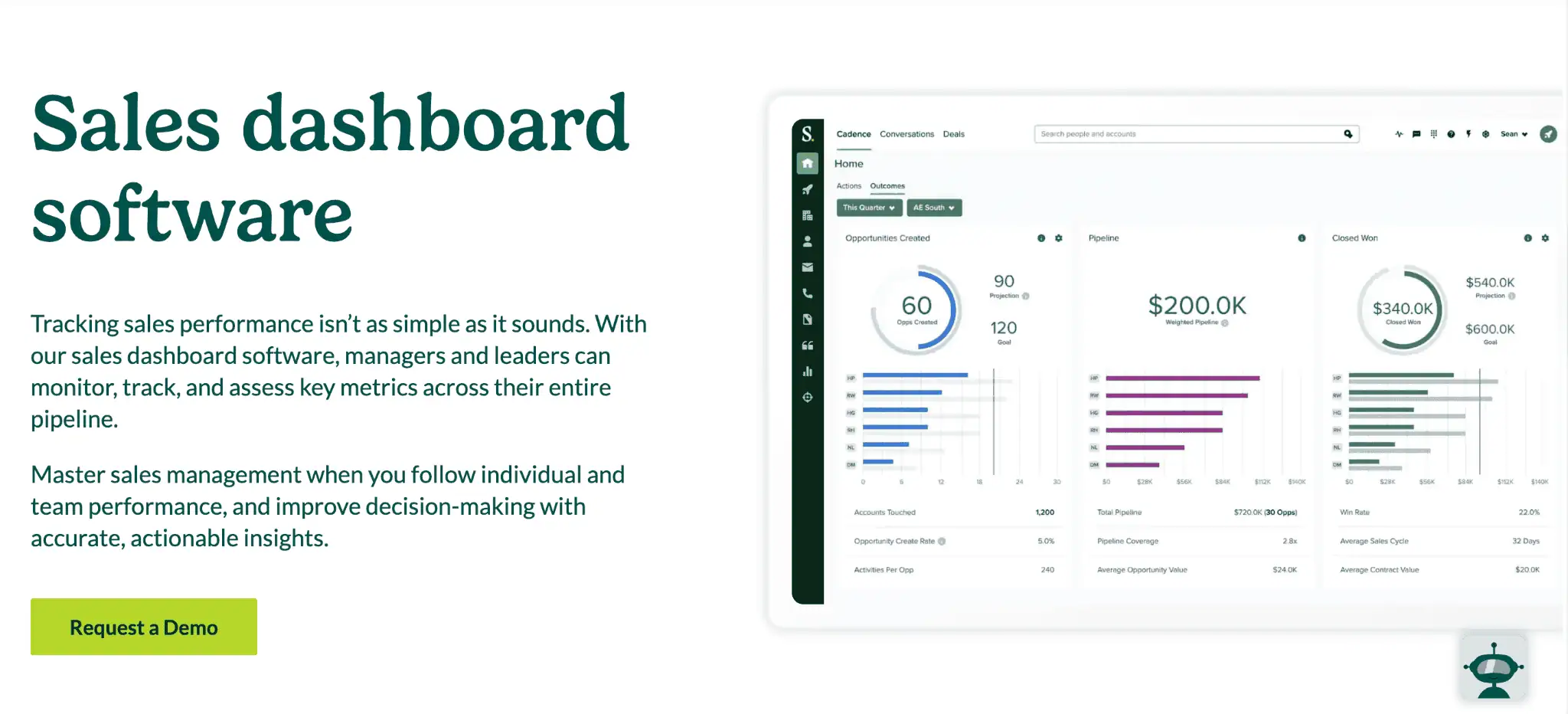
Salesloft’s cadence builder interface, the feature most teams compare directly against Outreach.io’s sequence editor.
Salesloft is the platform most teams evaluate first when leaving Outreach. The two compete head-to-head on cadence automation, analytics, and Salesforce integration depth, and the conversation usually starts with which UI reps prefer rather than which features each platform supports. Reviewers consistently describe Salesloft as marginally easier to adopt, and the Drift conversation intelligence baked in after the 2024 acquisition gives it a real edge in coaching workflows where Outreach typically requires the Kaia add-on.
That edge fades when pricing comes up. Vendr data shows Salesloft contracts land in roughly the same $125 to $180 per-user range as Outreach.io, which means budget-conscious teams aren’t actually getting much relief by switching. The platform has also been through two back-to-back ownership changes since 2024. Vista Equity Partners acquired Salesloft in August 2024, and Clari completed its merger with Salesloft on December 3, 2025, creating a combined entity that now operates two sales engagement platforms (Salesloft and Groove) and two conversation intelligence systems under one roof. Existing contracts are reportedly unaffected in the short term. The long-term product rationalization creates legitimate roadmap questions for multi-year buyers.
For teams that genuinely need enterprise-grade sequencing and want a friendlier UI without changing categories, Salesloft remains the safest like-for-like swap. The trade-off is honest. You’re moving sideways on cost and roadmap risk in exchange for a smoother adoption curve.
| Feature | Salesloft | Outreach.io |
| Multi-channel sequencing | Yes | Yes |
| Conversation intelligence | Drift-powered | Kaia (add-on) |
| Salesforce integration | API-based | API-based |
| Pricing transparency | No | No |
| Implementation time | 4 to 6 weeks | 4 to 8 weeks |
| Total cost of ownership | High | High |
2. Apollo.io
Cost: Free plan available. Basic $49, Professional $79, Organization $119 per user per month (annual billing). Monthly billing adds roughly 20%.
Ease of use: Clean UI, straightforward setup, useful free tier for evaluation.
Total cost of ownership: Genuinely lower than Outreach for teams that don’t need a separate enterprise data vendor.
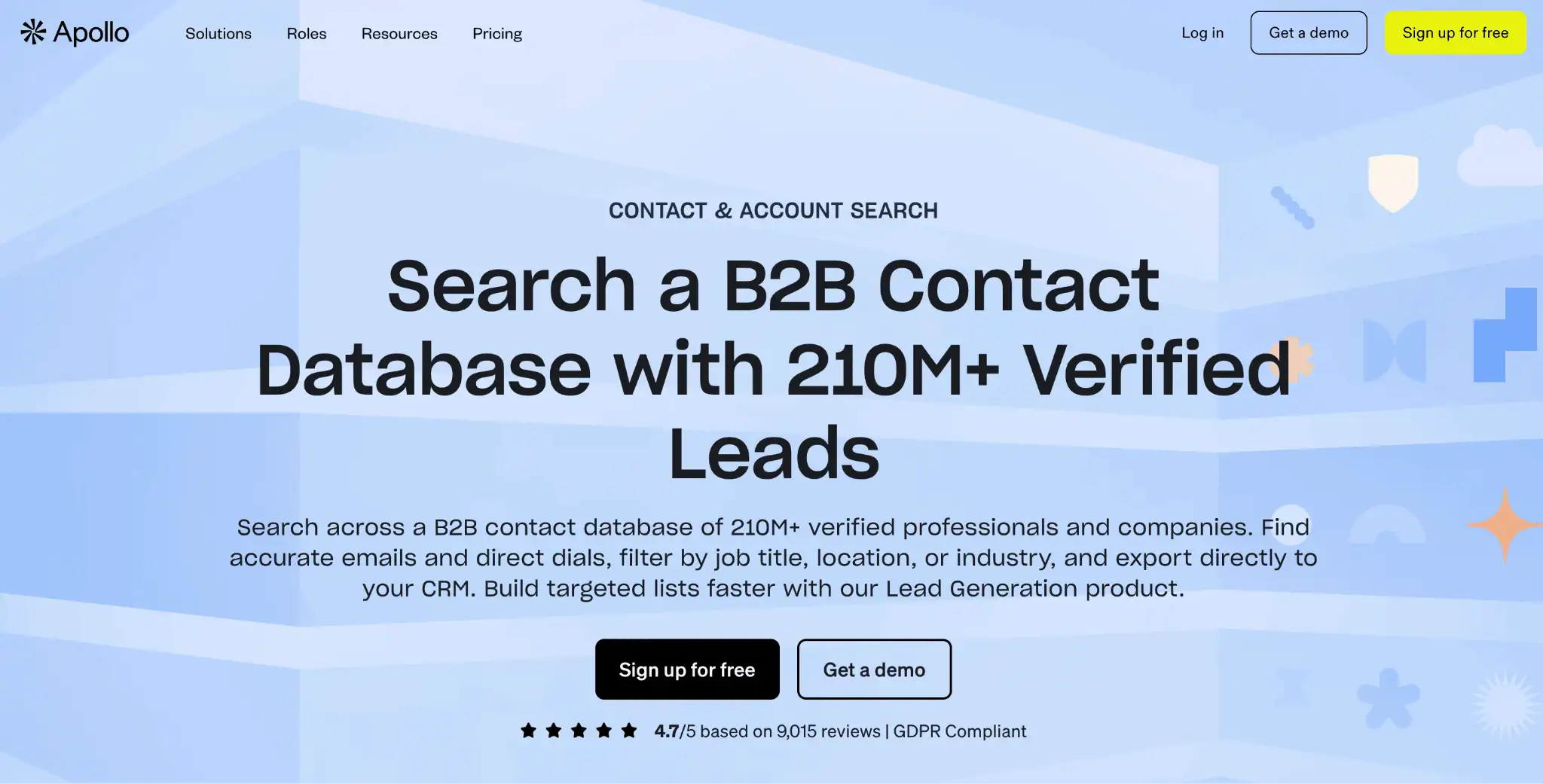
Apollo contact database search interface
Apollo.io collapsed two product categories into one, and that single decision is what makes it the most common cost-driven alternative to Outreach. Where most teams pay separately for a data provider and a sequencing tool, Apollo bundles a 275-million-contact database with email and phone outreach. For SMB and mid-market budgets, that consolidation is the largest cost lever in the market. Pricing is published, transparent, and roughly a third of typical Outreach.io rates. The free tier is genuinely useful for evaluation, which almost no other platform on this list offers.
The trade-offs show up once teams scale. Engagement features sit a clear tier below the enterprise platforms, particularly around conversation intelligence and analytics depth. Data accuracy varies meaningfully by region. G2 reviewers consistently mention email bounce rates of 15 to 25 percent, especially for contacts outside North America, and the credit system drives real costs higher than the sticker price suggests. Mobile reveals consume five to eight credits each versus one credit for an email, so phone-heavy teams burn through allowances quickly and then pay $0.20 per overage credit. A 25-user team with active phone prospecting often sees actual annual spend at two or three times the advertised rate.
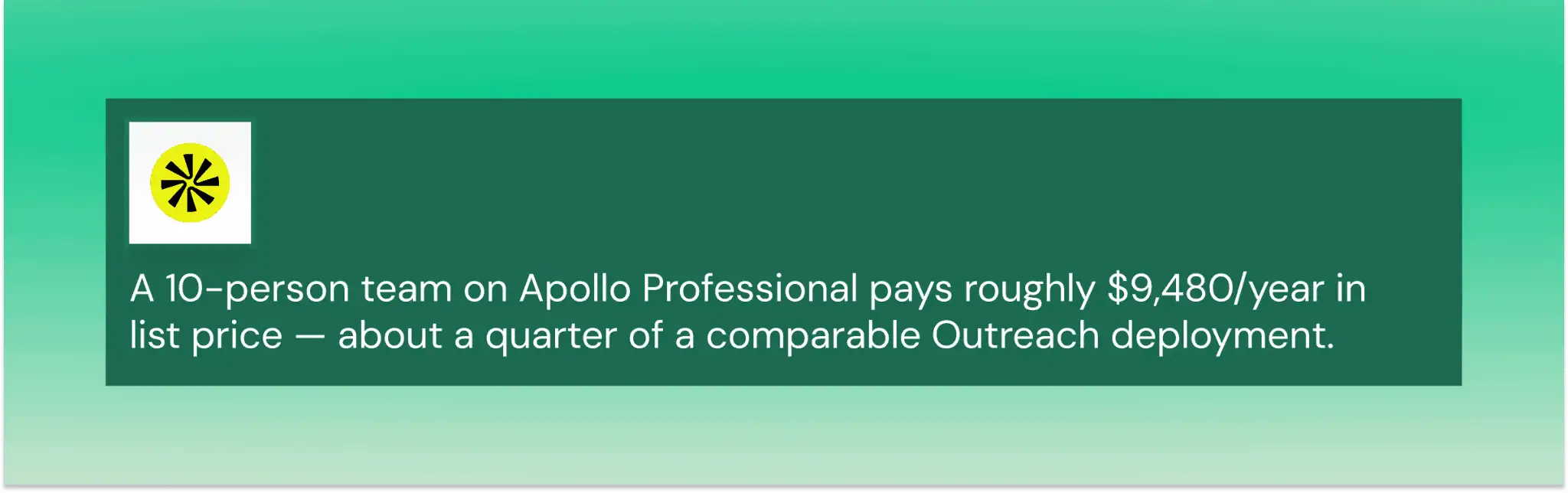
For teams whose priority is reducing tooling spend without losing core sequencing capability, Apollo is usually the strongest argument on the list. Teams running enterprise-grade outbound at scale will eventually outgrow it.
| Feature | Apollo.io | Outreach.io |
| Built-in contact database | Yes (275M+) | No |
| Pricing transparency | Yes (published) | No |
| Sequencing depth | Moderate | Best-in-class |
| Free plan | Yes (usable) | No |
| Conversation intelligence | Basic | Yes (Kaia) |
| Total cost of ownership | Low | High |
Apollo solves the cost problem at the entry tier. Once teams move past the budget question and start asking about Salesforce data quality and forecast accuracy, the conversation shifts to a different category of tool entirely.
3. Revenue Grid
Cost: Activity Capture 360 at $30/user/month, Knowledge Capture at $49/user/month, Revenue Grid Ultimate at $149/user/month. Published transparently.
Ease of use: Lives inside Salesforce, Outlook, and Gmail. Reps don’t adopt a new tool because the tool meets them where they already work.
Total cost of ownership: Lower than enterprise competitors. No API sync layer to maintain, no surprise Salesforce storage costs, no engineering oversight required.
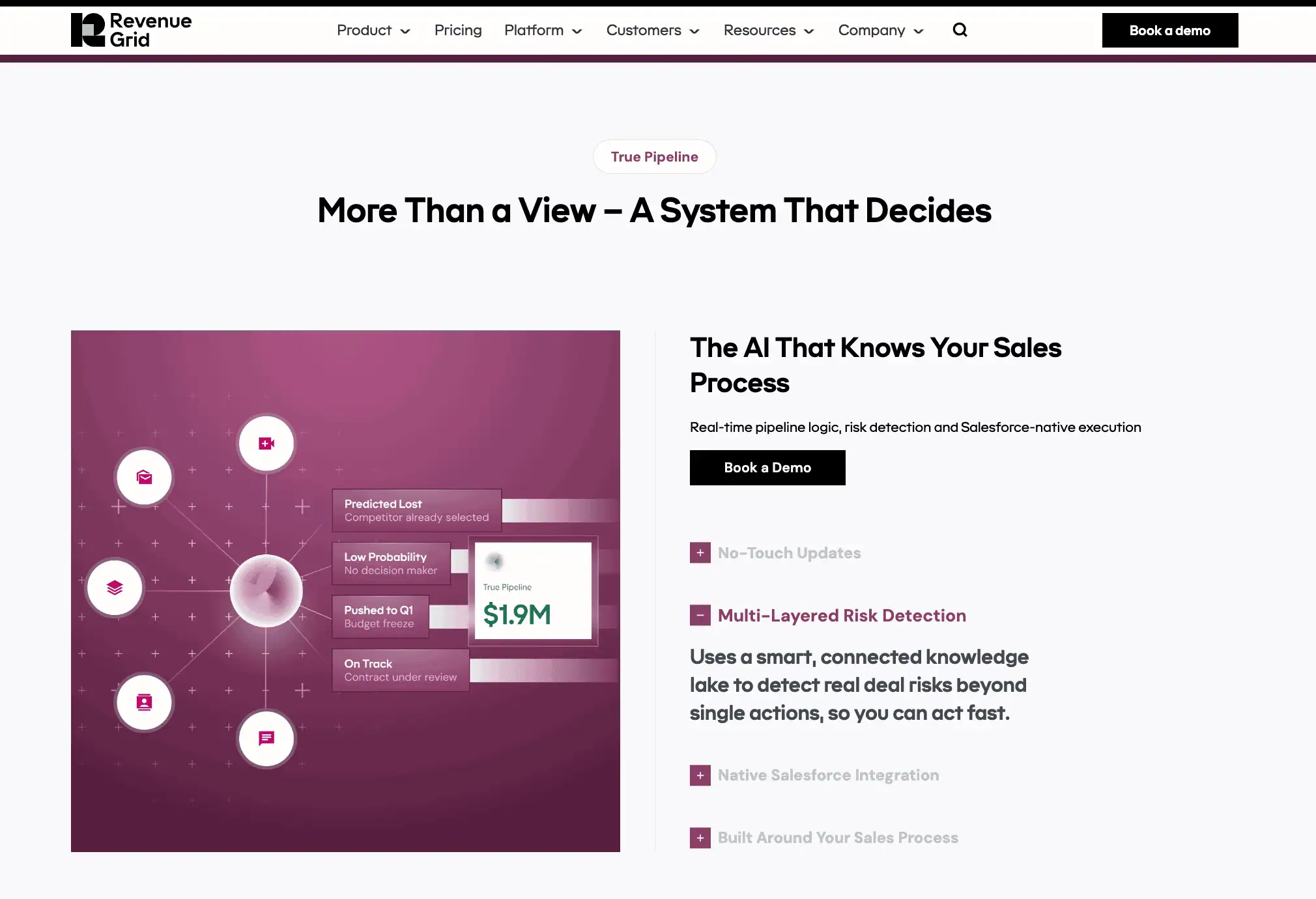
Revenue Grid’s True Pipeline dashboard gives sales leaders real-time visibility into deal movement, stakeholder engagement, and risk signals, all native to Salesforce.
Revenue Grid belongs to a different category than the rest of this list, and that’s the point. It isn’t trying to be a better version of Outreach.io. It’s solving the underlying problem Outreach was never designed to address, which is the gap between what reps actually do and what Salesforce eventually shows. Gartner introduced the Revenue Action Platform category in 2024 specifically to describe this class of tool.
The shift becomes clear in the first month of use. Because the platform is fully native to Salesforce rather than connected through an API sync layer, every customer interaction lands in the CRM in real time, mapped to the right opportunity, contact, and account. Email replies that happen outside a sequence still get captured. Meeting notes and recordings sit on the opportunity record. Files shared in Slack or Teams attach to the right deal. Pipeline reviews stop being archeology because True Pipeline reflects what’s actually happening rather than what reps remembered to log. Forecasting shifts from rep self-reporting to data-backed projection, which is usually the moment leadership notices the difference.
For RevOps teams in regulated industries, the security posture matters as much as the features. Revenue Grid carries SOC 2 Type II, ISO 27001, GDPR, HIPAA, CCPA, and PCI DSS certifications. That’s the bar enterprise buyers in financial services, healthcare, and pharma actually have to clear before procurement signs, and most engagement-first platforms don’t carry the same depth of compliance coverage.
The honest trade-off is that Revenue Grid isn’t built primarily for high-volume cold email. The Engage module covers outbound sequencing, but the platform’s center of gravity sits in data capture, pipeline intelligence, and forecasting. Teams whose only requirement is sending more emails faster should look at Apollo or Instantly first. The deepest value also requires Salesforce. Teams running HubSpot or no CRM at all won’t see the same return, which is why the platform’s strongest fit is the segment of the market where Salesforce is the system of record and forecast accuracy is a board-level metric.
| Feature | Revenue Grid | Outreach.io |
| Salesforce integration | Fully native | API-based |
| Activity capture | 100% automated, no storage bloat | Sequence-only |
| Pipeline visibility | True Pipeline, real-time | Basic |
| Forecasting | Integrated | Add-on |
| Deal guidance | In-record alerts | Limited |
| Pricing transparency | Published | No |
| Implementation | Hours to days | 4 to 8 weeks |
| Security certifications | SOC 2 II, ISO 27001, HIPAA, GDPR | SOC 2 |
See how Revenue Grid captures every customer interaction into Salesforce automatically.
Book a demo with Revenue Grid
Revenue Grid solves the data problem that drives most Outreach.io renewals into question. Teams whose CRM is something other than Salesforce face a different set of trade-offs, and that’s where the next tool tends to enter the conversation.
4. HubSpot Sales Hub
Cost: Free tier; Starter $20/user/mo; Professional $100/user/mo (plus $1,500 onboarding); Enterprise $150/user/mo (plus $3,500 onboarding).
Ease of use: Among the most intuitive in the category, especially for HubSpot-native teams.
Total cost of ownership: Reasonable at Starter and Pro tiers. Rises sharply at Enterprise once Marketing Hub and contact-based pricing kick in.
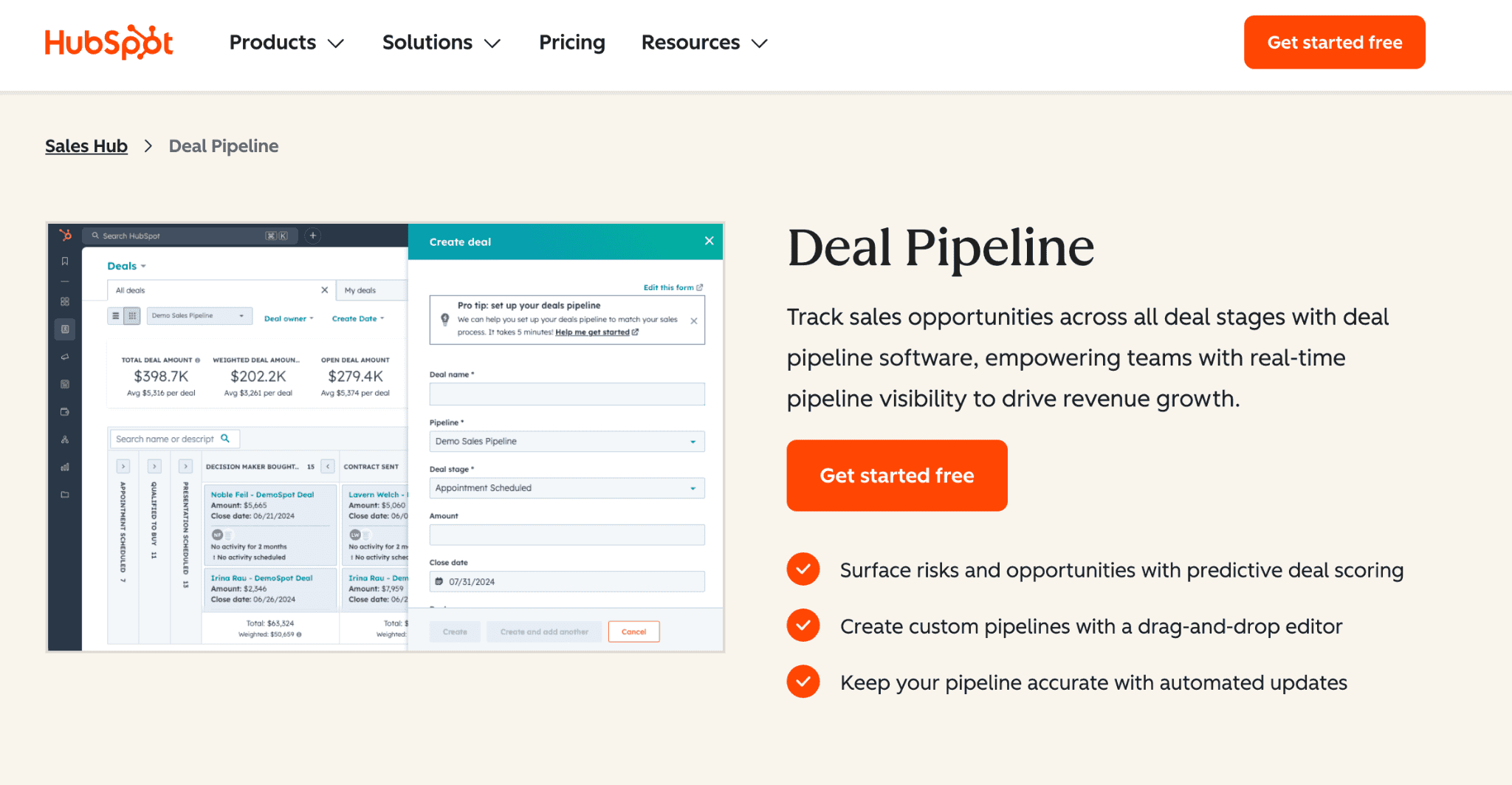
HubSpot Sales Hub’s deal pipeline view, tightly integrated with HubSpot Marketing and Service Hubs for a unified customer journey.
HubSpot Sales Hub wins for one specific scenario, and recognizing it early saves a lot of evaluation time. The team is already running HubSpot for marketing, and adding sequences eliminates a vendor without new integrations to maintain. The unified view from marketing touch to closed-won deal is genuinely valuable when it lives in one platform. The Pro tier handles most of what a 25-person sales team needs day to day. Published pricing is a relief after Outreach, with a free tier that’s real and a Starter plan approachable for small teams.
The platform stops making sense the moment the underlying CRM isn’t HubSpot. Running Sales Hub on a Salesforce-first stack creates duplicate systems of record and the data quality problems a Salesforce-native tool would prevent. High-volume outbound teams will find engagement features less mature than dedicated platforms. Sequences cap, advanced workflows require Pro or higher, and conversation intelligence sits behind Enterprise pricing. Marketing Hub contact-based pricing escalates faster than most teams’ budgets for each additional 5,000 contacts at Pro costs $225/month, and onboarding fees add real first-year cost on top.
HubSpot is the right call for teams already invested in the ecosystem who want to consolidate vendors. Teams running Salesforce or Microsoft will find better value elsewhere.
| Feature | HubSpot Sales Hub | Outreach.io |
| Pricing transparency | Published | No |
| Free tier | Yes | No |
| HubSpot ecosystem fit | Native | No |
| High-volume outbound | Moderate | Strong |
| Onboarding fees | $1,500 to $3,500 | Custom |
HubSpot covers the ecosystem-fit case. For teams whose primary need is AI-driven email at scale rather than CRM consolidation, the next platform takes a different angle entirely.
5. Gong
Cost: Quote-based. Gong Foundations at roughly $1,300 to $1,600 per user per year. Adding Engage and Forecast modules pushes the range to $2,400 to $3,000 per user per year. Mandatory platform fee of $5,000 to $50,000 per year applies to every contract.
Ease of use: Excellent for reps consuming insights. Steep for admins configuring the platform. 8-plus week onboarding is typical for enterprise deployments.
Total cost of ownership: A 50-seat deployment runs approximately $85,000 to $92,500 in Year 1 including onboarding. 100 seats crosses $150,000.
Gong moved this category forward. Where Outreach focuses on getting more sequences out the door, Gong turns every call, email, and meeting into structured data that answers the question pipeline reviews keep asking — what is actually happening in these deals? More than 5,000 companies run revenue operations on it.
The trade-offs show up after the first contract. In March 2025, Gong restructured pricing from a bundled package into modular SKUs.
The Salesforce integration creates ~25MB of writeback records per day for high-call teams, pushing storage quotas into overage. Gong Engage (sequencing) also lacks the branching logic, task APIs, and parallel dialer support Outreach has refined over a decade.
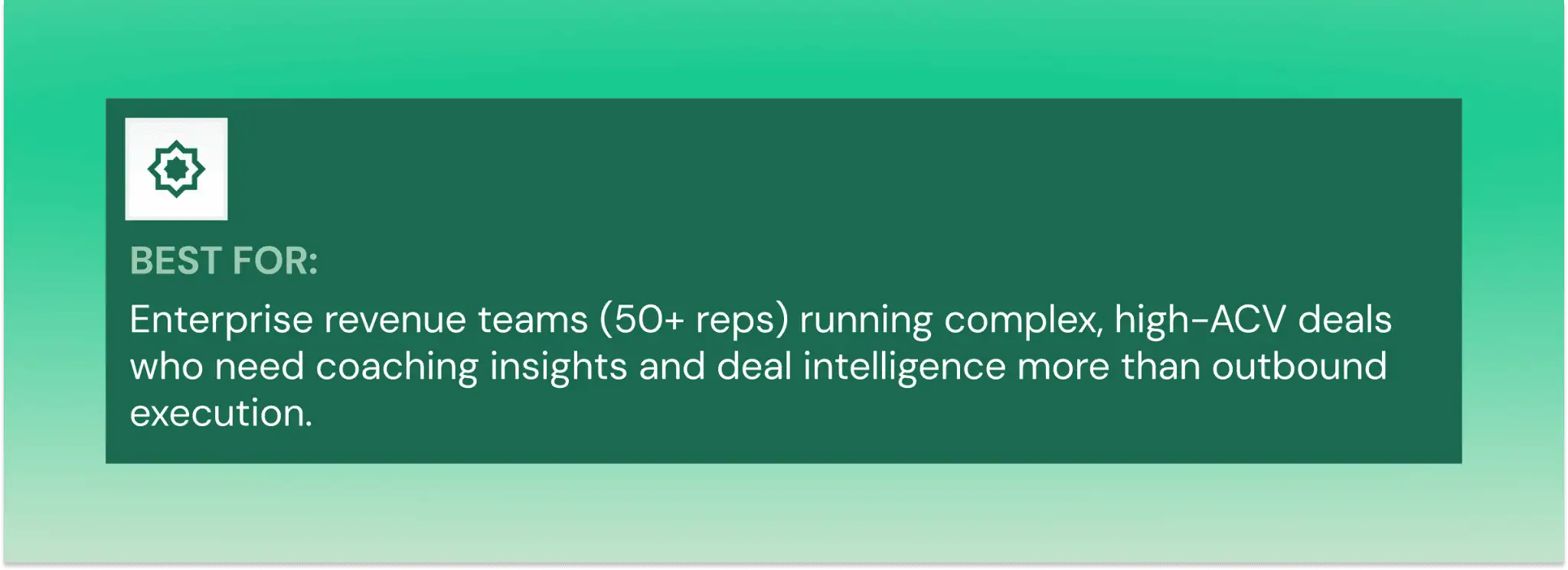
Gong is the strongest choice for conversation intelligence and AI-driven coaching. It’s not the strongest choice for outbound execution. The buyer profile that makes the math work is an enterprise team with 50-plus reps running high-ACV deals, organizations that need better conversion, not more pipeline.
| Feature | Gong | Outreach.io |
| Conversation intelligence | Best-in-class AI, coaching scorecards | Kaia (add-on, less mature) |
| Sales sequences | Gong Engage (limited branching, no task API) | Multichannel with AI, A/B testing |
| Revenue forecasting | AI-driven from conversation signals | Functional but secondary |
| Salesforce writeback | 25MB/day storage impact | Separate data store |
| Platform fee | $5K to $50K/year mandatory | No mandatory platform fee |
| Pricing transparency | Quote-based | Quote-based |
Gong solves the conversation-intelligence question. The companion question most revenue teams face, are we going to hit the number, takes an entirely different tool.
6. Clari
Cost: Quote-based. Revenue Forecasting Essentials at roughly $68 per user per month. Growth tier at roughly $175 per user per month. Copilot conversation intelligence adds $60 to $160 per user per month. The Groove engagement module adds another $50 to $80 per user per month.
Ease of use: Clean UI praised by reps. Forecast submission takes under 5 minutes. Complex initial setup that requires RevOps ownership.
Total cost of ownership: A 50-user deployment with Copilot and Groove runs roughly $73,000 per year per Vendr transaction data. Full-stack deployments can reach $200 to $400-plus per user per month.
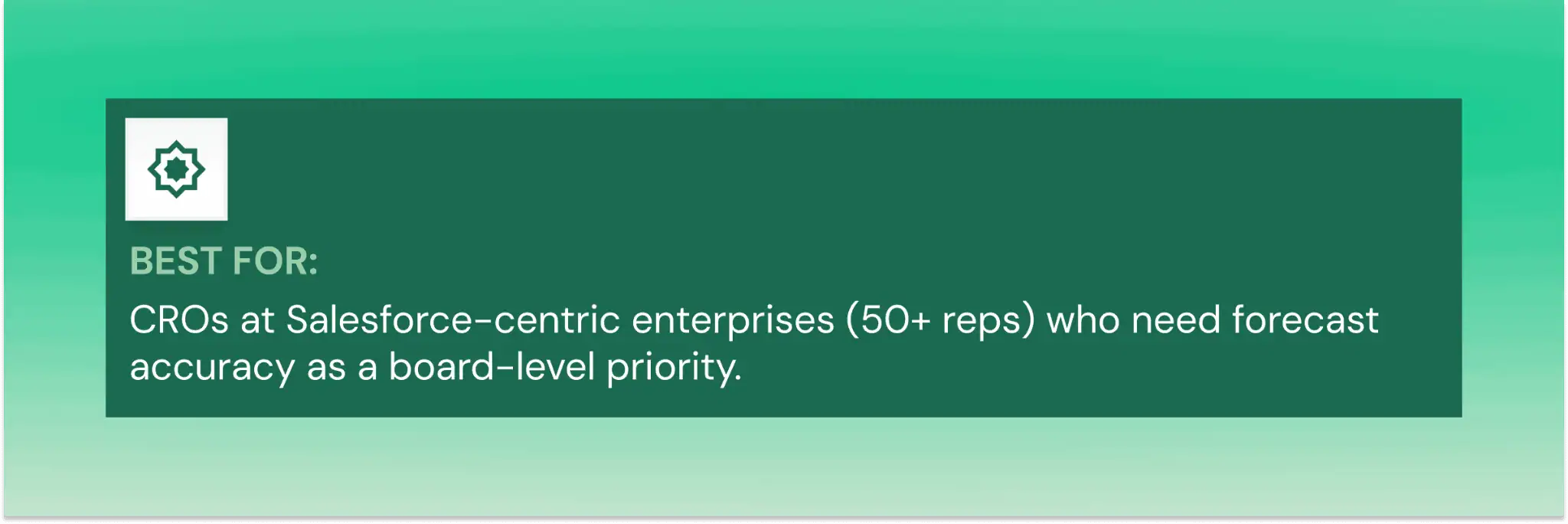
Clari started as the forecasting platform CROs use to answer the question that matters most to the board. That remains its core DNA in 2026. AI-driven commit categories, pipeline waterfall analysis, and revenue analytics have earned it a 4.6/5 G2 rating across roughly 5,600 reviews, plus Leader positions in both Gartner’s December 2025 Magic Quadrant and Forrester’s 2024 Sales Engagement Wave. Clari explicitly advertises no platform fees and includes customer success without an add-on
charge — direct contrasts with Gong’s fee structure. Vendr data shows renewals typically escalate 15–20% annually, and volume discounts don’t kick in until 75-plus users.
The biggest strategic development is the Clari-Salesloft merger completed December 3, 2025. The combined entity now operates two engagement platforms (Groove and Salesloft) and two conversation intelligence systems. Clari’s own FAQ describes unification as spanning “the coming years” — a placeholder, not a roadmap. The practical question for new buyers is which modules survive the eventual rationalization.
The architecture is also worth understanding. Unlike Salesforce-native platforms, Clari is API-based. Pipeline data lives in Clari’s Revenue Database first, then syncs back to Salesforce on a delay of up to 15 minutes with no manual refresh. For teams whose primary need is daily sales execution, Clari is a platform you log into for analysis and review, not to run outreach.
| Feature | Clari | Outreach.io |
| Revenue forecasting | Best-in-class AI rollups, commit categories | Functional (formerly Commit) but secondary |
| Pipeline inspection | Purpose-built deal health and risk alerts | Good views but less analytical depth |
| Sales engagement | Groove + Salesloft (post-merger redundancy) | Native, mature, multichannel |
| Conversation intelligence | Copilot (formerly Wingman) | Kaia (less mature) |
| CRM architecture | API-based, up to 15-min sync delay | API-based, separate data store |
| Daily workflow tool | No — analysis platform | Yes — rep execution hub |
Clari handles the forecasting layer. For teams whose highest priority is keeping Salesforce itself perfect while running sequences, a sibling product in the same portfolio takes a fundamentally different architectural approach.
7. Groove (a Clari company)
Cost: Quote-based. Roughly $50 to $150 per user per month for the Groove engagement module alone. Bundled Clari + Groove deployments typically land in the $200 to $400-plus per-user-per-month range.
Ease of use: Intuitive for basic sequences and email. Simpler than Outreach but less powerful.
Total cost of ownership: A 10-person SDR team runs $24,000 to $60,000 per year for Groove alone. Full Clari + Groove stacks push to $60,000 to $120,000-plus per year plus $15,000 to $25,000 implementation.
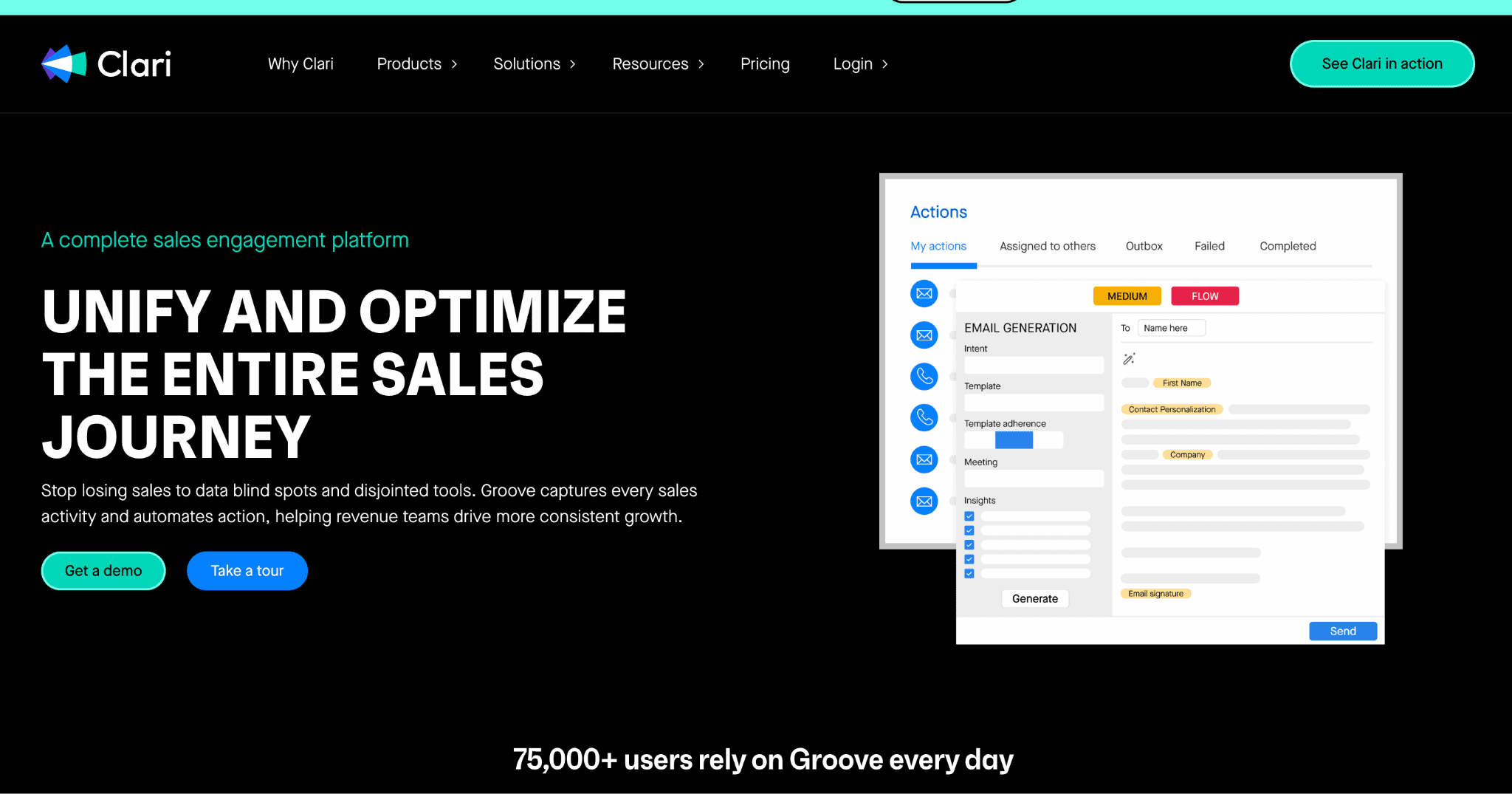
Groove’s defining advantage is architectural, data writes directly to Salesforce objects rather than syncing through an API layer.
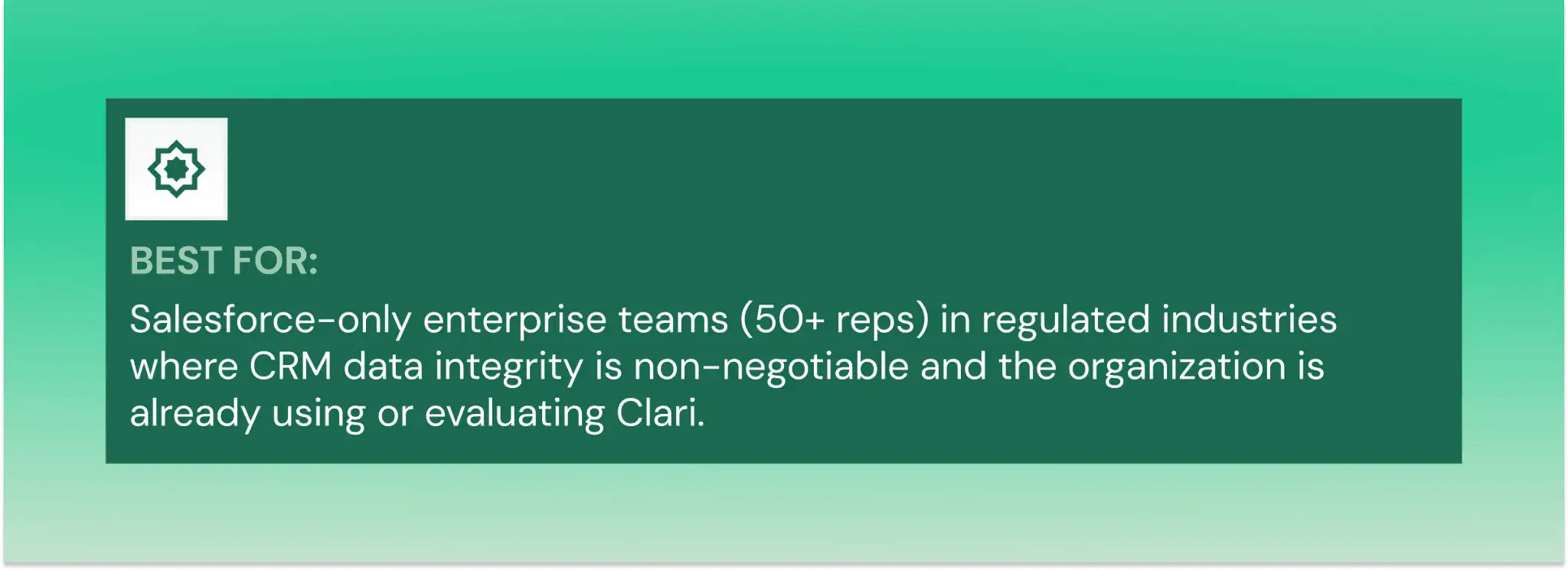
Groove‘s defining advantage isn’t a feature. It’s an architectural decision no other platform on this list has made. All data lives directly inside Salesforce objects rather than in a separate database synced through an API. Every email, call, and meeting writes natively to the right Salesforce record. No sync layer, no duplicate store, no lag. Users consistently report CRM data completeness jumping from roughly 40 percent to 95-plus percent after deploying auto-capture, and G2 reviewers regularly cite its Salesforce integration as the best in the category.
Clari acquired Groove on August 14, 2023. The product is now positioned as the sales engagement module within the broader Clari platform. Groove historically held the number-one enterprise customer satisfaction position on G2 for 18 consecutive quarters. It’s rarely sold standalone anymore — new customers are pushed toward the full Clari suite, which means teams that only want sequences may end up paying for forecasting and CI modules they don’t need.
The critical variable in 2026 is the Clari-Salesloft merger completed December 3, 2025. The combined entity now operates two engagement platforms (Groove and Salesloft) with no clear rationalization timeline. Forrester noted the merger “brings the continuation of Groove integration efforts into question.” The sequence builder also lags Outreach: fewer branching options, limited conditional logic, basic A/B testing. Buying Groove today means betting on which engagement platform survives.
| Feature | Groove (Clari) | Outreach.io |
| CRM architecture | Salesforce-native, data IN Salesforce | API sync, separate database |
| Data integrity | Zero sync lag, no duplicates | Potential sync delays |
| Sequence builder | Basic flows, limited branching | Advanced with AI, A/B testing, branching |
| CRM support | Salesforce only | Multiple CRMs |
| Dialer | Basic built-in | More mature, parallel dialer |
| Product continuity risk | High (Salesloft merger) | Stable as standalone |
Groove makes the native-Salesforce argument at enterprise scale. For teams that want similar data-in-Salesforce benefits without the engagement-platform price tag or the merger uncertainty, a lighter option lives one tier down.
8. Cirrus Insight
Cost: Published pricing. Starter at $17 per user per month, Professional at $29 per user per month, Enterprise at $49 per user per month. Add-ons like Sync+ at $4 and Expert+ at $9 per user per month available.
Ease of use: Highest ease-of-setup score vs. Outreach on G2. Can be running in minutes via browser extension.
Total cost of ownership: A 50-user Professional deployment typically costs $13,200 to $16,800 per year after negotiation, roughly 5 to 7 times cheaper than Outreach at entry level.
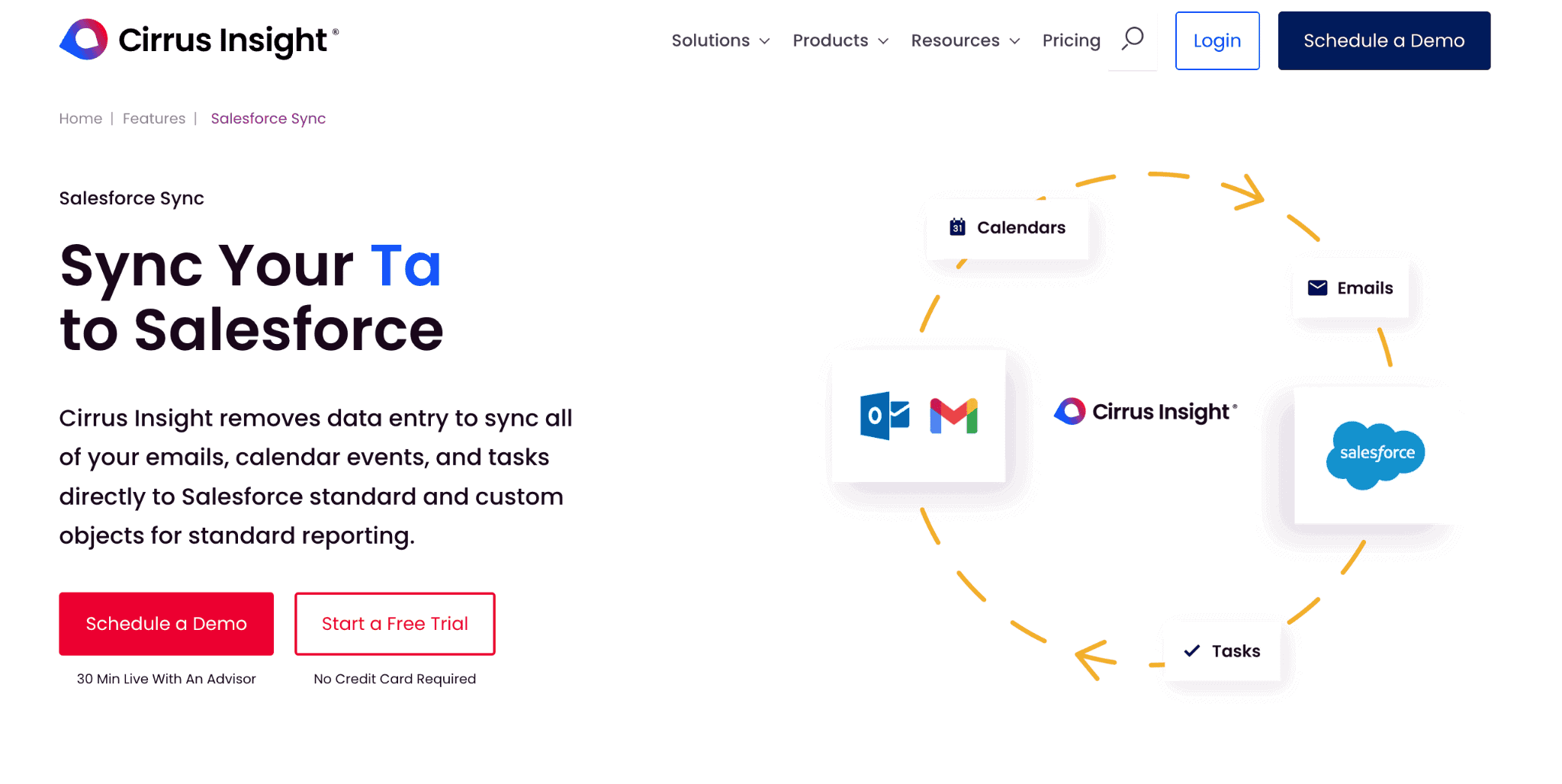
Cirrus Insight embeds a full Salesforce sidebar directly into Gmail and Outlook where reps view, create, and update CRM records without switching tabs.
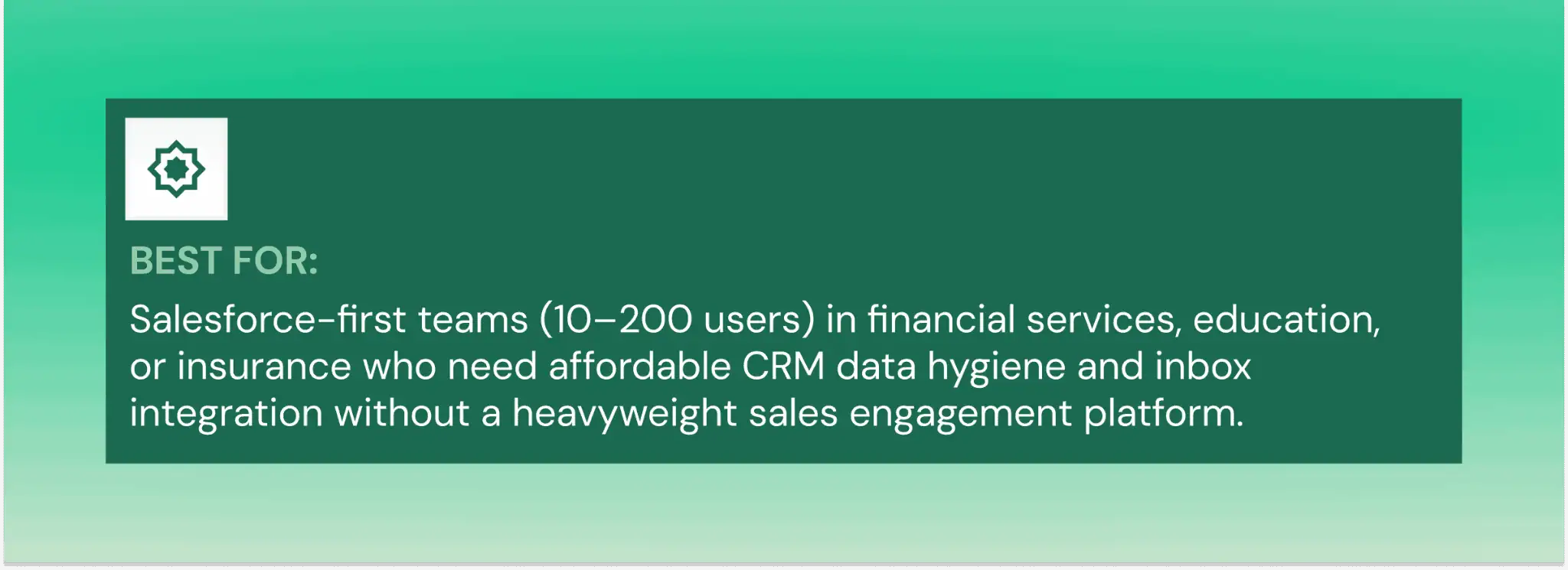
Cirrus Insight occupies a different category than the other tools on this list, and recognizing that early saves a lot of evaluation time. It’s a Salesforce inbox integration, a browser extension that embeds a Salesforce sidebar directly into Gmail or Outlook, letting reps view, create, and update CRM records without switching tabs. At $17–$49/user/mo across three published tiers, it’s the most affordable option here by a wide margin.
The reason teams keep choosing it is narrow and specific. It eliminates manual CRM data entry. Email tracking, calendar sync, and activity auto-capture keep Salesforce current without reps ever leaving their inbox. That’s what it does well, and for many teams that’s enough.
The most persistent complaint is sync reliability. Cirrus Insight’s own March 2026 release notes addressed “more consistent email capture, reducing missing activity”, confirming the gap was real. The Chrome extension requires periodic reauthorization. Auto-renewal requires 30 days’ notice, and the vendor pushes multi-year commitments.
The more fundamental limitation is what Cirrus Insight isn’t. No dialer, no LinkedIn automation, no advanced branching logic. It’s a complement to a sales engagement strategy, not a replacement for one. The ideal buyer is a Salesforce-first team where the priority is getting reps to actually use Salesforce rather than deploying a heavyweight engagement platform.
| Feature | Cirrus Insight | Outreach.io |
| Salesforce inbox sidebar | Purpose-built, deep CRM views in Gmail/Outlook | CRM integration but not sidebar-centric |
| Activity auto-capture | Core strength | Secondary to sequences |
| Sales sequences | Basic cadences | Advanced multichannel with AI |
| Dialer | None | Built-in, mature |
| Pricing | $17–$49/user/mo (published) | $100+/user/mo (quote-based) |
| Setup time | Minutes via browser extension | Weeks |
9. ZoomInfo Sales
Cost: Custom pricing, typically starting at $15,000 per year and climbing fast.
Ease of use: Powerful but complex. Full adoption requires dedicated training and admin support.
Total cost of ownership: Premium tier. Higher than Outreach when bundled with full ZoomInfo data products.
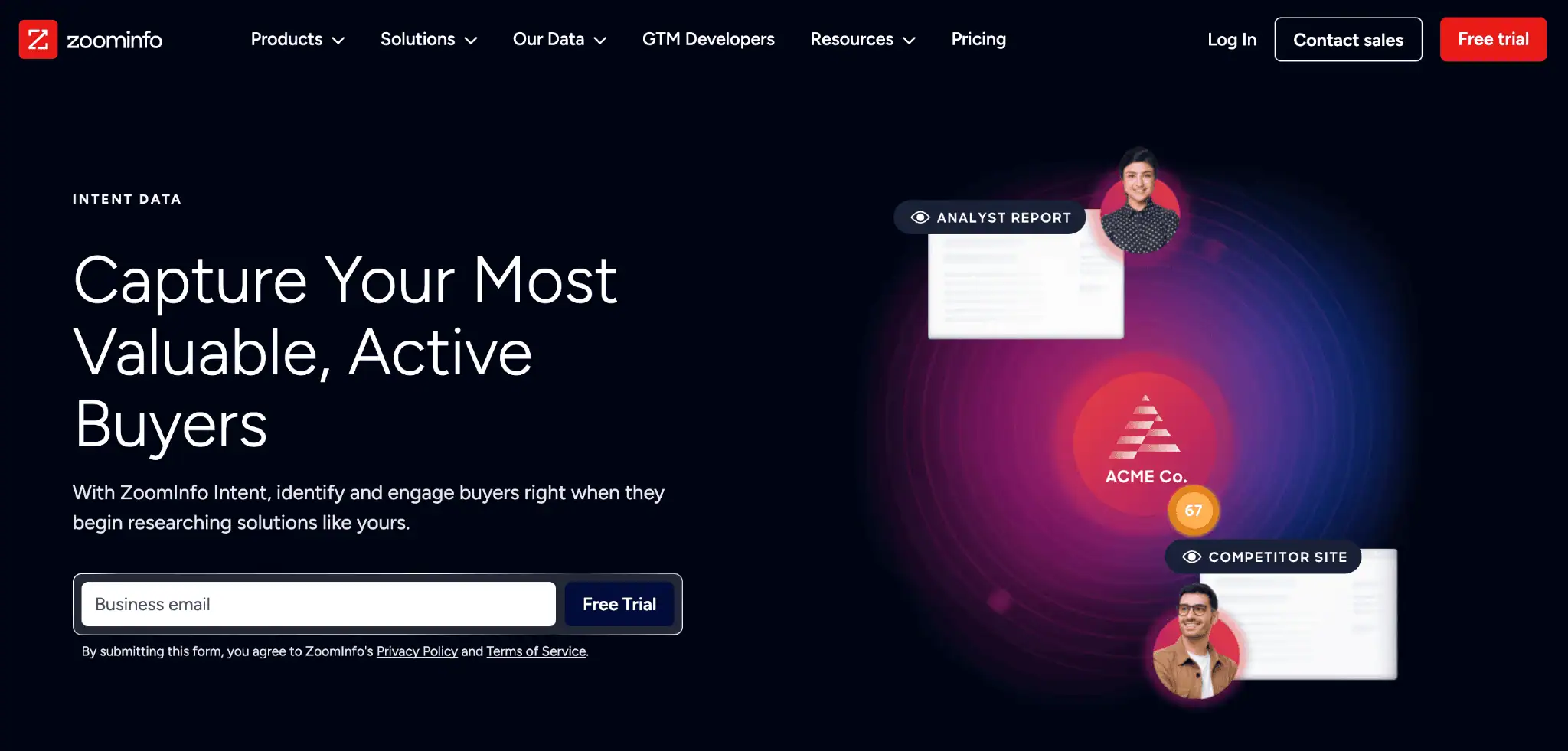
ZoomInfo Sales combines a 100M+ B2B contact database with intent signals and conversation intelligence — the premium consolidation play for enterprise teams.
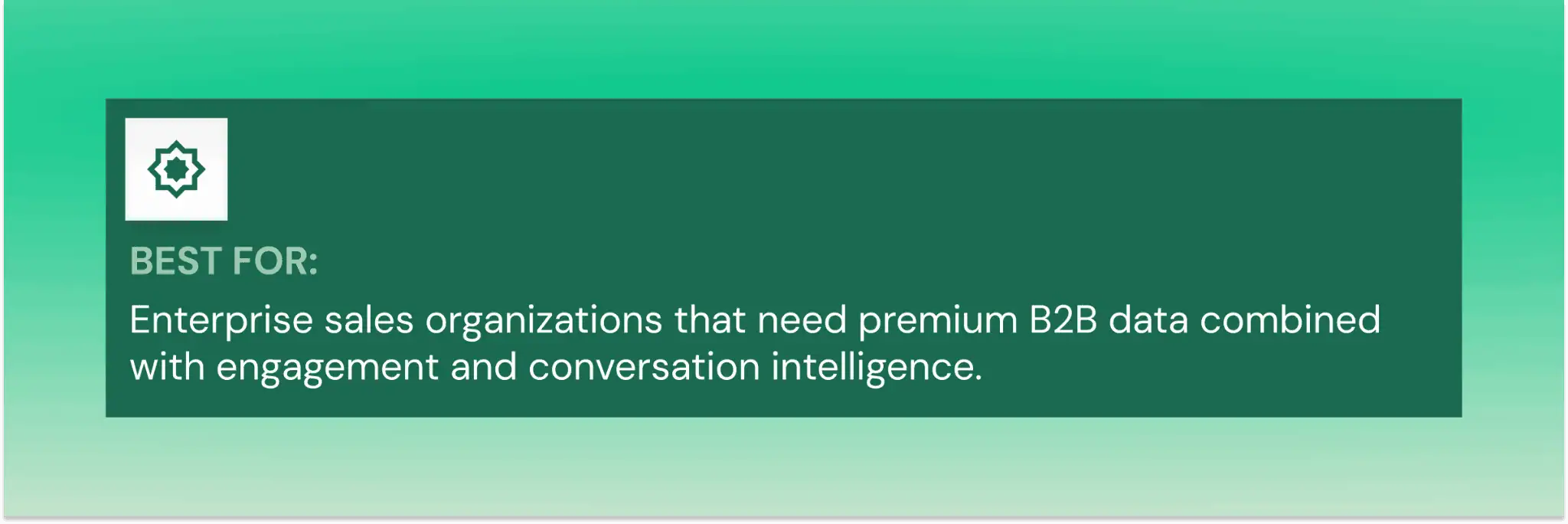
ZoomInfo Sales sits at the top of the price ladder for a reason. The 100-million-contact database and intent-data layer are best-in-class, and the Chorus conversation intelligence acquisition gave it credible call analytics. Website visitor tracking and intent signals tied to firmographic data give SDRs targeting precision that no pure engagement platform can match. For enterprise teams that need data quality, intent signals, and engagement in one vendor, ZoomInfo is the consolidation play.
The cost is real, and it rises fast. Most engagements start at $15,000/year and climb sharply once additional data products attach. Vendr data confirms aggressive auto-renewal terms and limited negotiation flexibility on smaller contracts. Teams under 50 reps will find the platform overkill. Data accuracy is also stronger in North America than EMEA or APAC, which matters for global teams running outbound across regions. G2 reviewers consistently mention a steep learning curve and the need for dedicated ops resources. ZoomInfo isn’t a tool you try. It’s an investment that requires buy-in across sales, RevOps, and sometimes finance before procurement clears the contract.
Smaller teams should explore alternatives that solve narrower problems at meaningfully lower cost. For enterprise organizations whose strategy depends on best-in-class B2B data and whose budget can absorb the premium, ZoomInfo is the right call.
| Feature | ZoomInfo Sales | Outreach.io |
| B2B data depth | Best-in-class (100M+) | No |
| Intent data | Yes | No |
| Conversation intelligence | Yes (Chorus) | Yes (Kaia) |
| Pricing | Higher than Outreach | High |
| Setup complexity | High | High |
ZoomInfo is the premium consolidation play. For teams that want multichannel coverage similar to Outreach without the enterprise data spend, the next platform is built specifically for that middle ground.
10. Outplay
Cost: Free plan available. Growth from approximately $79/user/month with published pricing.
Ease of use: Clean UI, customer support frequently praised in reviews.
Total cost of ownership: Lower than enterprise competitors for comparable channel coverage.
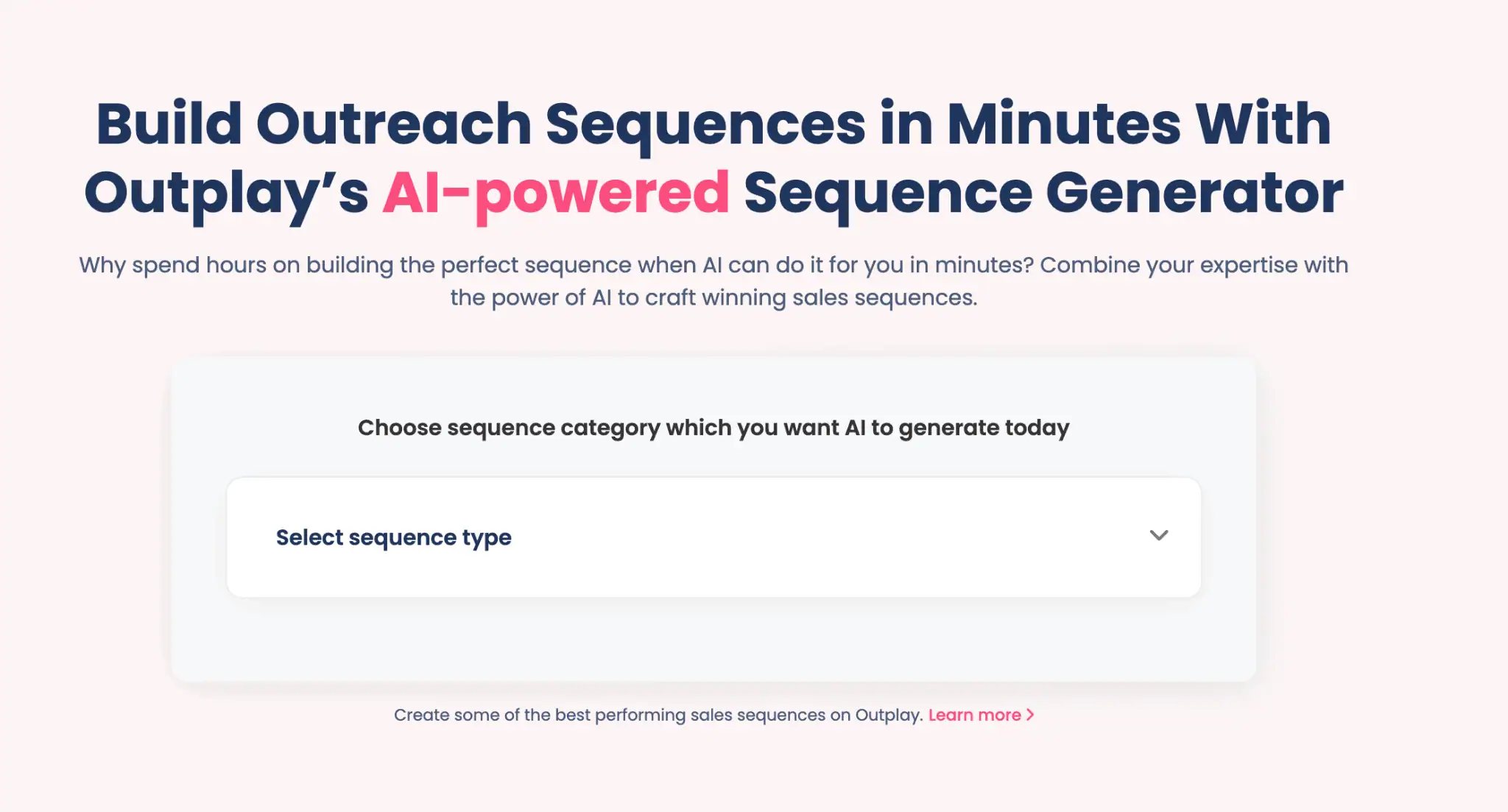
Outplay delivers Outreach.io-level channel coverage at roughly half the per-user cost, making it the strongest fit for growing teams that need multichannel without enterprise pricing.
Outplay competes by offering Outreach.io-level channel coverage (email, phone, LinkedIn, SMS, WhatsApp, chat) at roughly half the per-user cost. For mid-market teams that need true multichannel sequencing without the enterprise price tag, this is the closest match in the market. Customer support consistently shows up as a strength in reviews, which matters for teams that have been frustrated by Outreach’s lower-tier support response times. Pricing is published, the free plan makes evaluation easy, and the platform’s clean UI keeps onboarding manageable.
The trade-offs come from market presence rather than feature depth. Outplay’s user community and integration marketplace are smaller than the major platforms, which means fewer third-party connectors and slower ecosystem growth. Reporting is also less robust than Outreach. Some advanced features are still maturing compared to Salesloft and Outreach, particularly around forecasting and workflow customization. Enterprise teams with complex requirements may hit feature ceilings, and the smaller market presence means fewer publicly available case studies and reference customers, which can slow internal procurement approvals at larger organizations.
Outplay is the right call for growing teams that want multichannel parity without the enterprise price. Larger or more complex sales organizations may find feature gaps that push them back toward the established platforms.
| Feature | Outplay | Outreach.io |
| Multi-channel coverage | Yes (full) | Yes |
| Pricing transparency | Published | No |
| Customer support | Frequently praised | Slow |
| Reporting depth | Moderate | Strong |
Outplay covers the cost-conscious multichannel case. For small teams whose entire workflow already lives inside Gmail and who want something even lighter, one final option rounds out the list.
11. Mixmax
Cost: Inbox/Meeting Copilot $29/user/mo; Engagement Copilot (sequences) $49/user/mo; Suite (CRM sync) $89/user/mo. Annual billing required.
Ease of use: Lives inside Gmail with almost zero setup time.
Total cost of ownership: Low for Gmail teams. Total cost rises if a dialer or LinkedIn automation is needed separately.
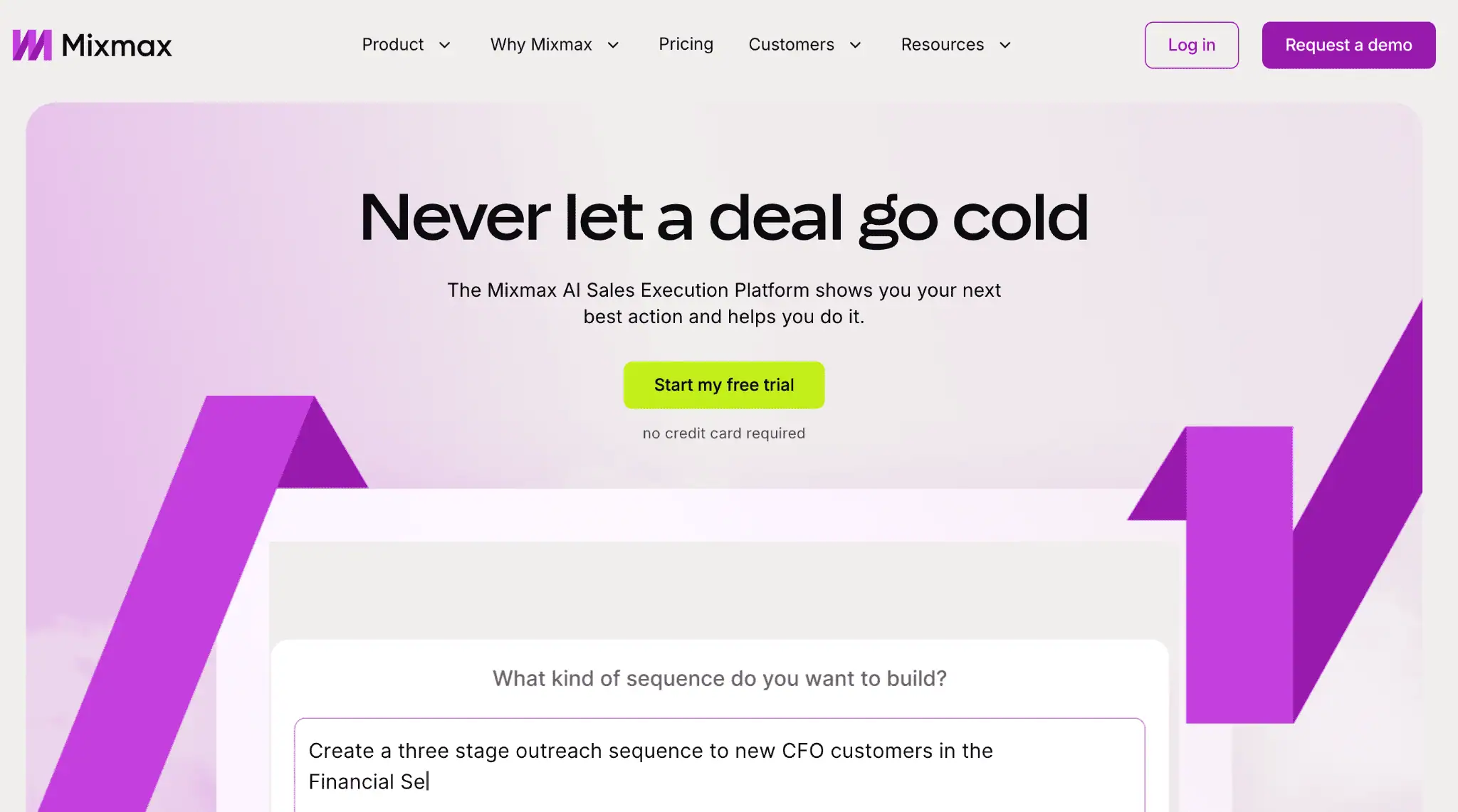
Mixmax lives inside Gmail rather than as a separate workspace — reps access sequences, tracking, and scheduling without leaving their inbox.
Mixmax takes a different design philosophy from every other platform on this list, and that difference is exactly what makes it the right fit for some teams and the wrong one for others. Instead of building a separate workspace, Mixmax embeds engagement capability directly into Gmail. Reps don’t switch contexts because the tool is invisible until they need it. Setup is measured in hours rather than weeks. Pricing is published. Meeting scheduling and email tracking are best-in-class for the price point. For teams under 50 reps that already live in Gmail, the path of least resistance usually leads here.
The constraints become obvious the moment the team’s stack changes. Mixmax doesn’t support Outlook, which rules it out for any Microsoft-first organization. There’s no workaround. If your company runs Microsoft 365 today or might switch in the next two years, the platform is off the table entirely. The platform also caps recipients at 1,500 per month across the entire workspace on most tiers, which a 5-person SDR team can hit within a few weeks of active outbound. Beyond that, dialer pricing isn’t published and has to come through sales, and there’s no LinkedIn automation, no SMS, and no real multichannel sequencing. Despite the sales engagement label, Mixmax is fundamentally an email productivity tool with sequencing bolted on.
Mixmax is the cleanest answer for Gmail-native small teams. Anything beyond that profile usually needs a more complete platform.
| Feature | Mixmax | Outreach.io |
| Gmail-native | Yes | No |
| Outlook support | No | Yes |
| Pricing transparency | Published | No |
| Multi-channel | Limited | Yes |
| Setup time | Hours | Weeks |
Other Outreach.io Alternatives Worth a Mention
A handful of additional tools deserve mention for completeness, even if they didn’t make the main list. Each one solves a narrower piece of the puzzle than the platforms covered above.
- Reply.io — AI-driven multichannel engagement starting around $49 per user per month, with an AI SDR agent and built-in email warm-up. Best for mid-market teams that want AI-first outbound but don’t need enterprise-grade Salesforce workflows.
- Mailshake — Simplified email outreach and LinkedIn automation, starting around $25 per user per month. Best for teams that want simple cold email without the complexity of a full sales engagement platform.
- Yesware — Email tracking and engagement built into Gmail and Outlook, starting around $15 per user per month. Best for individual reps who want tracking inside their inbox without committing to a platform.
- Salesforce Sales Engagement — Native Salesforce engagement layer (formerly High Velocity Sales), with pricing bundled into Salesforce licenses. Best for Salesforce-native organizations consolidating vendors.
- Microsoft Dynamics 365 Sales — Built-in engagement features for Microsoft ecosystem teams. Best for organizations already standardized on Microsoft.
- Revenue.io — Real-time conversation guidance and engagement focused on phone-heavy teams. Best for inside sales operations with heavy call volume.
- Klenty — Multi-channel engagement popular in APAC markets, starting around $50 per user per month. Best for APAC-based teams or budget-conscious organizations.
Tools like Lemlist, Instantly.ai, and Snov.io frequently appear on Outreach alternatives lists but are purpose-built for cold email at the SMB end of the market. They solve a different problem than the platforms covered here and rarely replace a full Outreach deployment at mid-market or enterprise scale. Teams whose sole requirement is high-volume cold email at flat-rate pricing should evaluate those tools directly, not as Outreach substitutes.
Choosing the Right Outreach.io Alternative for Your Team
The shortest answer is that the right choice depends on which problem matters most to your team right now.
- Best for enterprise revenue teams: Salesloft for closest feature parity, Gong for conversation intelligence and deal coaching, Clari for CRO-level forecasting accuracy, Revenue Grid for CRM data quality in regulated industries.
- Best for Salesforce-native organizations: Revenue Grid for complete activity capture with no API sync layer, Groove for enterprise Salesforce-native engagement, Cirrus Insight for affordable inbox-sidebar integration.
- Best for budget-conscious teams: Apollo.io for prospecting plus engagement at a third of Outreach’s cost, Cirrus Insight for Salesforce hygiene at $17 to $49 per user per month, Mixmax for Gmail-native small teams.
- Best for premium data and intent signals: ZoomInfo Sales for best-in-class B2B data combined with engagement and intent layers.
- Best for mid-market multichannel: Outplay for multichannel parity at lower cost, HubSpot Sales Hub for teams already in the HubSpot ecosystem.
- Best for revenue intelligence and coaching: Gong for conversation-driven coaching and deal insights, Clari for forecast-driven pipeline inspection.
- Best for Gmail-native teams: Mixmax for inbox-first workflows, Yesware for individual rep email tracking.
The pattern that emerges across every conversation with revenue teams switching off Outreach.io is the same. Most platforms solve sequencing. A small number solve the broader problem of complete CRM data, pipeline visibility, and forecast accuracy that sequencing alone can’t fix.
For teams whose forecast keeps missing because the CRM doesn’t reflect what’s actually happening in deals, the right answer isn’t another sequence builder. It’s a Revenue Action Platform that captures every interaction natively, gives reps in-record guidance, and lets leaders run pipeline reviews on data they can trust.
Ready to see how complete activity capture and AI-driven pipeline insights can transform your revenue operations?
Book a demo with Revenue Grid
What is the best free alternative to Outreach.io?
Apollo.io offers the strongest free plan: 275M+ contact database access, 5 mobile credits, and basic sequencing. HubSpot Sales Hub provides a free CRM without expiration for teams already in the ecosystem. Cirrus Insight runs a 14-day free trial across all tiers. Most teams need a paid plan within 3–6 months once CRM data capture becomes a real requirement.
How much does Outreach.io cost?
Not published. Vendr data shows $100–$160/user/mo on annual commitments. A 50-user deployment lands around $72,000/year, with negotiated discounts of 15–35% common. No monthly billing, no self-serve trial. Published-pricing alternatives: Apollo $49, Mixmax $29, Revenue Grid $30, Cirrus Insight $17/user/mo.
Can I use these alternatives with Salesforce?
Yes. You can use Salesforce-native options: Revenue Grid, Groove, and SF Sales Engagement where data lives inside Salesforce. Or choose API-based: Salesloft, Apollo, HubSpot, ZoomInfo, Gong, Clari, Mixmax. Cirrus Insight targets inbox-to-Salesforce specifically. For teams where CRM data quality drives forecasting, native architecture is the meaningful differentiator.
What's the easiest to set up?
Cirrus Insight and Mixmax deploy in under an hour via browser extension. Revenue Grid deploys in hours because native Salesforce integration skips API sync configuration. Apollo is quick since prospecting and engagement share one workspace. Outreach, Gong, and Clari typically take 4–8 weeks.
Is Salesloft better than Outreach?
Neither universally. Similar pricing ($125–$180/user/mo), comparable features. Salesloft offers cleaner UX and Drift-powered conversation intelligence. Outreach has deeper analytics and workflow customization. Two ownership changes since 2024: Vista Equity then the Clari merger (Dec 2025) add roadmap uncertainty for multi-year buyers. Demo both.
Sales engagement vs. revenue intelligence?
Engagement platforms (Outreach, Salesloft, Groove) automate outbound communication. Revenue intelligence platforms (Revenue Grid, Clari, Gong) capture interaction data and deliver AI-driven forecasting. Gong leads on conversations. Clari leads on forecasting. Revenue Grid bridges both with native Salesforce activitycapture plus pipeline intelligence in one platform.
How do I migrate from Outreach?
Export contacts, sequences, and performance data before account closure — access is removed permanently. Rebuild top-performing sequences rather than copying 1:1. Pilot with a small group for one week. Time the switch around auto-renewal windows (30–60 days’ notice required). Native-CRM platforms deploy in hours; API-based tools take weeks.
Best alternative for enterprise?
Salesloft for closest feature parity. Gong for conversation intelligence (4.8/5 G2). Clari for forecasting (Gartner 2025 Leader). Revenue Grid for CRM data quality and compliance — SOC 2 Type II, ISO 27001, HIPAA, GDPR. ZoomInfo for premium B2B data. Weigh integration depth and compliance certifications above feature checklists.