

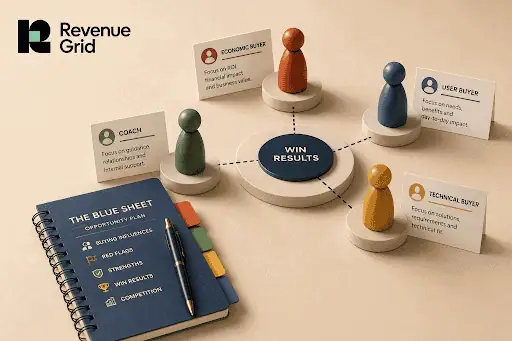
Key Takeaway
- The Miller Heiman sales process is a structured methodology for managing complex B2B deals with multiple stakeholders.
- It is best suited for enterprise sales, long sales cycles, and multi-stakeholder purchases — not transactional or low-value deals.
- The four core buying roles are Economic Buyer, User Buyer, Technical Buyer, and Coach — each requires a tailored engagement approach.
- The Blue Sheet is the central planning tool, capturing buying influences, red flags, strengths, win results, and competitive positioning.
- Red flags — such as no access to the economic buyer or unclear decision criteria — must be identified and addressed early.
- CRM integration strengthens the methodology by making stakeholder data, activity history, and deal risks visible and trackable.
- Key metrics to track include win rate, sales cycle length, forecast accuracy, stakeholder coverage, and red flag resolution rate.
Quick Answer: What Is the Miller Heiman Sales Process?
The Miller Heiman sales process is a structured B2B sales methodology designed to help sales teams navigate complex, multi-stakeholder deals. It focuses on identifying all buying influences, understanding each stakeholder’s priorities, managing risks, and developing tailored strategies that create mutual value for both seller and buyer. As Korn Ferry describes it, the approach “delivers a selling process and action plan to successfully sell solutions that require approval from multiple decision makers in the customer’s organisation.”
At a glance:
- Built for complex B2B sales with multiple decision-makers
- Centres on stakeholder mapping and buying influence identification
- Uses the Blue Sheet as a structured opportunity-planning tool
- Covers four buying modes: Growth, Status Quo, Replacement, and Commodity
- Aims to create win-win outcomes by aligning solutions to buyer priorities
Terminology note: “Miller Heiman sales process” and “Miller Heiman sales methodology” are often used interchangeably. More precisely, Strategic Selling is the opportunity-management framework, the Blue Sheet is the planning worksheet, and Conceptual Selling and LAMP are supporting tools for buyer conversations and large-account management. The methodology is now associated with Korn Ferry’s sales training portfolio.
What is the Miller Heiman Sales Process?
The Miller Heiman sales process is a sales methodology designed to manage complex business-to-business (B2B) deals. It is based on the principle of creating win-win situations for both the seller and the buyer, where the seller helps the buyer solve a problem and achieve a better return on investment (ROI).
The Miller Heiman sales process emphasises the importance of identifying the key decision-makers involved in the buying process, understanding their level of authority and influence, particularly the economic buyer’s role in financial decision-making, and developing a tailored sales strategy to address their specific needs and concerns.
Understanding the priorities of economic buyers, such as ROI and cost savings, is crucial to tailor engagement strategies and develop targeted action plans that address specific stakeholder concerns.
Who Created the Miller Heiman Sales Process?
The Miller Heiman sales process was developed by Robert B. Miller and Stephen E. Heiman in the late 1970s. Miller was a sales consultant, and Heiman was a sales trainer. Together they founded the Miller Heiman Group in 1978 to provide sales training and consulting services.
Miller and Heiman developed a systematic approach to complex sales situations. They believed that successful sales reps need to understand customers’ decision-making process and tailor sales strategies accordingly. They broke down a sales process into specific steps — each of which required specific actions and skills.
The Miller Heiman sales process helps sales professionals enhance their effectiveness in complex sales situations by utilising structured methodologies and various tools throughout the sales cycle.
The methodology has become one of the most widely used sales frameworks in the world. It has been refined and updated over the years to reflect changes in the business environment, and is now associated with Korn Ferry’s sales training portfolio. It continues to be an effective technique for sales teams looking to improve their performance in complex B2B environments.
B2B buying has become significantly more complex, with larger committees, longer cycles, and more stakeholders involved in every purchase. That complexity is precisely what the Miller Heiman methodology was built to address.
Enterprise software decisions now involve an average of 8.2 stakeholders, rising to as many as 25 people for major technology purchases, with 71% of enterprise software decisions made by committee rather than by individuals. Meanwhile, enterprise sales cycles can extend from three to nine months or more depending on deal size and complexity.
In that environment, a structured approach to stakeholder mapping, risk management, and opportunity planning is not optional — it is what separates teams that win predictably from those that rely on gut feel. Standardised sales processes also correlate with up to 28% higher revenue growth, reinforcing the financial case for codifying how opportunities are pursued.
As Forrester puts it: “Think of it as moving from a simple game of checkers to a strategic game of chess. Each member of the buying group plays a different role, from the champion pushing for change to the decision-maker holding the budget.” The Miller Heiman framework gives sales teams the structure to play that chess game deliberately.
Core Components of the Miller Heiman Sales Methodology
The Miller Heiman methodology is built on four interconnected pillars, each addressing a different dimension of complex B2B selling. Together they form a complete system for managing opportunities from first contact through to close.
| Component | Purpose | Best Used For | Expected Output |
|---|---|---|---|
| Strategic Selling | Systematic opportunity management focused on stakeholder mapping and deal strategy | Complex B2B deals with multiple decision-makers | Completed Blue Sheet, stakeholder map, action plan |
| Conceptual Selling | Buyer-centric conversation planning focused on how the prospect defines value | Discovery calls, stakeholder meetings, needs assessment | Validated understanding of buyer’s concept of value |
| Large Account Management (LAMP) | Strategic approach to growing and retaining large, complex accounts | Enterprise accounts with long-term revenue potential | Account growth plan, relationship map, revenue targets |
| Funnel Scorecard | Measurement tool to assess sales process effectiveness and pipeline health | Pipeline reviews, forecast calls, performance tracking | Qualified pipeline, accurate forecast, improvement areas |
Strategic Selling
Strategic Selling is the core of the Miller Heiman methodology. It is a systematic approach to selling that focuses on understanding prospects’ needs, identifying the decision-makers, and developing a customised solution that meets their needs. For this methodology to be effective, all members of the sales team need to be trained and committed — the process relies on team-wide buy-in and cooperation for success.
The strategic sales process is crucial in managing complex B2B sales, enhancing deal qualification, improving forecasting accuracy, and fostering strong customer relationships. Industry benchmarks suggest the average B2B win rate across all opportunities is approximately 21%, rising to about 29% for fully qualified opportunities — which illustrates why opportunity quality and structured pursuit matter so much.
Conceptual Selling
Conceptual Selling focuses on a prospect’s perception of value rather than the seller’s. This approach is based on the belief that prospects will only buy products or services they perceive as valuable. Rather than leading with product features, reps are trained to ask discovery questions that uncover how the buyer defines success, what their concept of an ideal solution looks like, and what confirmation they need before committing.
Effective conversation planning through Conceptual Selling helps reps avoid pitching too early. The goal is to confirm the buyer’s concept before presenting a solution — ensuring the solution lands as relevant rather than generic. Teams with formal coaching programmes built around structured conversation planning see approximately 28% higher win rates and 91% quota attainment.
Large Account Management Process (LAMP)
LAMP is a strategic approach to managing large accounts. It involves understanding the prospect’s business, building relationships with key decision-makers, and developing customised solutions that meet their needs. LAMP extends the methodology beyond individual deals into long-term account strategy, helping teams identify growth opportunities, protect existing revenue, and deepen relationships across the account.
Funnel Scorecard
The Funnel Scorecard is a tool used to measure the effectiveness of the sales process. It helps sales teams identify areas where they can improve performance and track progress over time. By scoring opportunities against defined criteria, teams can prioritise their pipeline more objectively and improve forecast accuracy.
How the Miller Heiman Sales Funnel Supports Complex B2B Deals
The Miller Heiman sales funnel is a structured approach to sales that combines several core frameworks to deliver results. Designed to help sales teams navigate complex B2B sales cycles, the funnel emphasises building strong relationships with customers and delivering value at every stage of the sales process.
Buying Roles in the Miller Heiman Sales Process
One of the most important concepts in the Miller Heiman methodology is buying influence mapping. Every complex deal involves multiple stakeholders, each playing a distinct role in the decision. Identifying and engaging each one correctly is what separates deals that close from deals that stall.
| Buyer Role | Primary Concern | Questions to Ask | Common Objections | Recommended Approach |
|---|---|---|---|---|
| Economic Buyer | ROI, budget, strategic impact | What does success look like in financial terms? What is the cost of inaction? | Price, unclear ROI, competing priorities | Lead with business outcomes and financial impact; quantify the value |
| User Buyer | Ease of use, daily workflow impact, efficiency | How does this affect your day-to-day work? What would make your job easier? | Change management, learning curve, disruption to current workflow | Focus on usability, time savings, and how the solution simplifies their tasks |
| Technical Buyer | Technical specifications, security, compliance, integration | How does this integrate with existing systems? What are the security certifications? | Compatibility, data security, implementation complexity | Provide technical documentation, compliance details, and integration specs |
| Coach | Internal credibility, helping the right solution win | Who else is involved in this decision? What are the internal dynamics? | Limited influence, competing internal agendas | Equip with internal talking points; treat as a strategic partner, not just a contact |
Economic Buyer
The Economic Buyer holds final authority over the budget and can approve or veto the purchase. They are primarily concerned with ROI, strategic fit, and the financial impact of the decision. Reps who never reach the Economic Buyer — relying solely on a champion or user contact — are at significant risk of losing the deal at the final stage. Tailoring messaging to financial outcomes and business impact is essential when engaging this role.
User Buyer
User Buyers are the people who will use the solution day-to-day. They evaluate how the product affects their workflow, efficiency, and job satisfaction. Their concerns centre on usability, disruption, and whether the solution genuinely simplifies their work. Addressing their specific pain points — and demonstrating ease of adoption — is critical to building internal support for the deal.
Technical Buyer
Technical Buyers evaluate whether the solution meets technical, security, and compliance requirements. They often have veto power — not to approve the purchase, but to block it if technical criteria are not met. Reps should engage Technical Buyers early, provide detailed documentation, and address integration and data security concerns proactively.
Coach
The Coach is an internal advocate who wants the seller to win and provides intelligence about the buying process, internal politics, and decision criteria. A strong Coach gives the seller access to other buying influences and helps navigate internal objections. Identifying and cultivating a Coach early in the sales cycle is one of the most important actions a rep can take in a complex deal.
How Does the Miller Heiman Sales Process Work? A Step-by-Step Guide
The Miller Heiman sales process includes five main steps. Each step builds on the previous one, moving from stakeholder discovery through to deal alignment and close. The process places significant emphasis on identifying and understanding different stakeholders, including the technical buyer who evaluates specifications, and the user buyer who prioritises efficiency and experience.
Step 1. Discover Who Influences the Purchase Decision
Action: List all buying influences in the account and map their roles, priorities, and level of support. Output: A stakeholder map identifying the Economic Buyer, Technical Buyer, User Buyer, and Coach. Example: Identify the CFO as Economic Buyer, the IT Director as Technical Buyer, and the Sales Operations Leader as User Buyer.
In this first step, you need to identify all the people involved in the buying decision and understand their role in the process. This includes not only the decision-maker but also other stakeholders, such as technical buyers, who evaluate technical specifications and ensure data security. Gather information about their needs, goals, and priorities and understand how your solution can help them achieve their objectives.
Step 2. Identify Buying Modes that Could Make or Break the Deal
Action: Determine each stakeholder’s current buying mode and adjust your approach accordingly. Output: A clear picture of where each buyer sits and what sales response is most appropriate.
The next step is to understand the buying modes in the decision-making process. This includes determining the prospect’s needs, priorities, and timeline for making a decision. It is crucial to address the specific needs and pain points of user buyers to simplify their daily tasks and improve workflows.
| Buying Mode | Buyer Mindset | Signs to Watch For | Sales Risk | Recommended Response |
|---|---|---|---|---|
| Growth | Actively seeking new opportunities to expand | Asking about capabilities, ROI, and scale | Low — buyer is motivated | Lead with growth outcomes and expansion potential |
| Status Quo | Satisfied with current situation; not actively looking to change | Minimal urgency, vague interest, slow responses | High — deal may stall indefinitely | Surface the cost of inaction; create urgency around a specific pain point |
| Replacement | Actively looking to replace a current solution | Expressing frustration with existing tools; evaluating alternatives | Medium — competitive, but buyer is motivated | Differentiate clearly from the incumbent; address migration concerns |
| Commodity | Focused primarily on price; sees solutions as interchangeable | Asking only about price; minimal interest in differentiation | High — margin pressure; risk of losing on price alone | Reframe value; demonstrate differentiation beyond price |
Step 3. Know Where You Stand in the Market
Action: Assess your competitive position honestly — strengths, weaknesses, and how you compare to alternatives. Output: A clear competitive positioning statement and a plan to reinforce your strengths.
In this step, you must understand your strengths and weaknesses and how they compare to your competition. Think about your unique value proposition and how it compares to your competitors’ offerings. You also need to know your market share, customer satisfaction, and brand reputation.
A sales rep plays a crucial role in creating strategic partnerships and win-win situations, enhancing their effectiveness in winning deals and building long-term customer relationships.
Step 4. Clarify and Evaluate Red Flags and Objections
Action: Identify every unresolved risk or missing piece of information in the deal. Output: A documented list of red flags with a plan to address each one before the deal progresses.
Identify any potential red flags or objections that may arise during the sales process. These could include concerns about price, implementation, or support. Once you’ve understood these objections, you can develop a plan to address and overcome them.
Step 5. Align to Solve and Close
Action: Align the solution to the buyer’s stated priorities and decision criteria. Output: A customised proposal or presentation that maps directly to each stakeholder’s win results.
The final step in the Miller Heiman sales process is to align the prospect’s needs with your solution and convert them into a customer. Reps should develop a customised solution that aligns with their priorities to increase the chance of closing the deal.
What Is the Miller Heiman Blue Sheet and How Do Sales Teams Use It?
The Blue Sheet is the central planning document in the Miller Heiman Strategic Selling framework. It serves as a “strategy on a page” for each complex opportunity, capturing everything a rep needs to pursue the deal effectively.
The Blue Sheet can include components like buying influences, red flags, strengths, win results, competition, and ideal customer profile (ICP).
This sheet is designed to help sales reps think deeply about every aspect of their sales strategy. It ensures reps take all necessary steps to progress the deal through the sales cycle as well as identify and address potential roadblocks early on.
Blue Sheet Checklist — Key Fields to Complete:
- ☐ Buying Influences: Economic Buyer, User Buyer, Technical Buyer, Coach — name, role, level of support
- ☐ Red Flags: Unresolved risks or missing information (e.g., no access to Economic Buyer, unclear decision criteria)
- ☐ Strengths: Areas where your solution has a clear advantage over alternatives
- ☐ Win Results: Measurable outcomes each stakeholder wants from the purchase
- ☐ Competition: Known alternatives being evaluated and your differentiation
- ☐ Decision Criteria: How the buyer will evaluate and select a solution
- ☐ Next Steps: Specific actions, owners, and timelines to advance the deal
- ☐ Ideal Customer Profile (ICP) Fit: How well the opportunity aligns with your target profile
Who should maintain it? The account executive owns the Blue Sheet, but it should be reviewed collaboratively with the sales manager during deal reviews and updated after every significant customer interaction.
When CRM activity data is complete, Miller Heiman planning becomes easier to trust. Revenue Grid captures buyer interactions automatically and maps them to Salesforce, giving teams clearer deal visibility and making Blue Sheet maintenance far less reliant on manual rep updates. Book a demo to see how Revenue Grid supports opportunity planning inside your CRM.
Red Flags, Strengths, and Win Results
Three of the most important concepts in the Blue Sheet — and in the broader methodology — are red flags, strengths, and win results. Understanding each one helps reps move from theory to active deal management.
Red flags are unresolved risks or missing information that could derail the deal. Common examples include: no access to the Economic Buyer, unclear decision criteria, a weak or absent internal champion, no documented business case, or a competitor with a stronger relationship. Red flags are not necessarily deal-killers — but they must be acknowledged and addressed with a specific action plan.
Strengths are areas where the seller has a genuine advantage — a strong relationship with a key stakeholder, a unique capability that addresses a critical need, or a proven track record in the buyer’s industry. Strengths should be reinforced and made visible to the right buying influences throughout the sales process.
Win results are the measurable outcomes each stakeholder wants from the purchase. They go beyond features — a User Buyer’s win result might be “two hours saved per week on reporting,” while an Economic Buyer’s win result might be “15% reduction in customer churn.” Aligning your solution to specific win results for each stakeholder dramatically increases the likelihood of closing.
Operationally, red flags can be made measurable by monitoring indicators such as the number of stakeholders engaged, communication trends, next-step hygiene, and time in stage. When these signals deteriorate, it is a reliable indicator that a deal needs attention.
Pros and Cons of the Miller Heiman Sales Process
The Miller Heiman sales process is strongest for complex B2B deals with multiple stakeholders, long sales cycles, and high contract values. Its main drawback is implementation effort: teams need training, consistent CRM discipline, and time to maintain tools such as the Blue Sheet.
| Advantage | Limitation | How to Mitigate |
|---|---|---|
| Provides a clear, structured approach to managing complex deals — keeps reps organised and focused | Time-consuming to implement, especially for reps new to the methodology | Use CRM templates to pre-populate Blue Sheet fields; reduce manual effort through activity capture automation |
| Prioritises understanding stakeholder needs, which builds stronger relationships and improves win rates | Can feel overly complex for smaller or simpler deals | Apply a qualification threshold — reserve the full methodology for deals above a defined contract value or complexity level |
| Proven track record across many sales organisations in enterprise B2B environments | Designed primarily for complex sales cycles — not ideal for transactional or high-volume inbound motions | Segment your pipeline; apply Miller Heiman to strategic accounts and use a lighter process for transactional deals |
| Improves forecast accuracy by forcing structured opportunity assessment at each stage | Training and certification can be expensive, creating adoption barriers for smaller teams | Invest in manager coaching to cascade the methodology internally; use deal review cadences to reinforce skills without formal certification |
When Should You Use the Miller Heiman Sales Process?
The Miller Heiman sales process is most effective when the deal is complex enough to justify structured opportunity planning. B2B buyers now complete about 70% of their journey before contacting sales, and each purchase typically involves between six and ten stakeholders — exactly the conditions where this methodology delivers the most value.
The methodology is a strong fit when:
- The deal involves multiple decision-makers across different functions
- The sales cycle is measured in months, not days or weeks
- The contract value is high enough to justify structured planning effort
- The buyer is evaluating multiple competing solutions
- The deal requires internal approval from finance, IT, legal, or the C-suite
- You are managing a strategic account with long-term revenue potential
The methodology may be excessive when:
- The deal is transactional with a single decision-maker and a short cycle
- The contract value is low and does not justify the planning investment
- The sales motion is primarily inbound with minimal competitive evaluation
- The team is small and lacks the bandwidth for full Blue Sheet completion on every deal
How does it compare to simpler methodologies? Frameworks like SPIN Selling focus primarily on the discovery conversation, while BANT qualifies deals on budget, authority, need, and timeline. The Miller Heiman process goes further — it maps the entire buying committee, tracks each stakeholder’s mode and concerns, and provides a structured plan for every stage of the deal. That depth makes it more powerful for complex opportunities, but also more demanding to implement consistently than lighter-weight approaches.
How to Measure the Impact of the Miller Heiman Sales Process
Measuring the impact of the Miller Heiman sales process is critical to understanding its effectiveness. By tracking key metrics, sales teams can gain valuable insights into their performance and make data-driven adjustments to optimise their sales strategy.
| Metric | What It Measures | Why It Matters | How to Track |
|---|---|---|---|
| Win Rate | Percentage of qualified opportunities closed as won | Indicates whether stakeholder mapping and deal strategy are improving close rates | CRM opportunity reports; compare before and after methodology adoption |
| Sales Cycle Length | Average time from first contact to close | Shorter cycles suggest better stakeholder alignment and fewer late-stage surprises | CRM stage timestamps; pipeline velocity reports |
| Forecast Accuracy | How closely committed deals match actual closed revenue | Reflects quality of deal qualification and Blue Sheet discipline | Compare forecast commits to actual closed revenue each quarter |
| Average Deal Size | Mean contract value of closed deals | Structured opportunity planning should increase deal size by engaging more stakeholders | CRM opportunity value reports segmented by methodology adoption |
| Stakeholder Coverage | Number of buying roles engaged per deal | Deals with all four buying roles engaged are less likely to stall or be lost to a hidden objector | CRM contact roles on opportunities; Blue Sheet completion rate |
| Economic Buyer Access | Percentage of deals where the Economic Buyer has been directly engaged | Deals without Economic Buyer access are at high risk of late-stage loss | CRM contact role tracking; deal review checklist |
| Red Flag Resolution Rate | Percentage of identified red flags addressed before deal close | Unresolved red flags are a leading indicator of deal loss | Blue Sheet review cadences; manager deal inspection |
| Pipeline Stage Conversion | Percentage of deals advancing from each stage to the next | Identifies where deals are stalling and which stages need process improvement | CRM pipeline stage reports; funnel conversion analysis |
Revenue Grid strengthens these metrics by capturing activity data automatically in Salesforce — giving teams accurate, real-time inputs for win rate, deal velocity, stakeholder coverage, and forecast accuracy without relying on manual rep updates.
How the Miller Heiman Sales Process Works With CRM Software
The Miller Heiman methodology is most effective when it is operationalised inside the tools your team uses every day. A CRM system is the natural home for the methodology’s core concepts — but only if the data inside it is complete and trustworthy.
With 91% of companies with ten or more employees now using a CRM system, the infrastructure for methodology execution is already in place for most teams. The gap is usually data quality — not the absence of a system.
How CRM supports Miller Heiman execution:
- Buying role tracking: Use contact roles on opportunities to map Economic Buyers, User Buyers, Technical Buyers, and Coaches against each deal
- Red flag documentation: Custom fields or notes sections can capture identified risks and the actions planned to address them
- Stakeholder engagement history: Activity capture from email and calendar provides a complete record of who has been contacted and when
- Deal strategy fields: Custom opportunity fields can capture buying mode, win results, competitive positioning, and next steps aligned to the Blue Sheet
- Forecast confidence: Deal health scoring based on actual activity data — not rep self-reporting — produces more reliable forecast inputs
- Pipeline stage conversion: Stage-based reporting shows where deals are stalling and which methodology steps are being skipped
The challenge most teams face is that CRM data is only as good as what reps log manually — and manual logging is inconsistent. Automatic activity capture solves this by ensuring that every email, meeting, and customer interaction is recorded against the right opportunity, giving managers the complete picture they need to coach effectively and forecast accurately.
How to Implement the Miller Heiman Sales Process With Sales Technology
Revenue Grid helps teams apply the Miller Heiman methodology inside the workflows they already use — by capturing customer interactions automatically, mapping activity to Salesforce, surfacing deal risks, and recommending the next best action. Rather than adding another tool for reps to learn, Revenue Grid embeds methodology execution into the CRM and inbox where selling already happens.
- Use Revenue Grid’s Activity Capture to automatically log every email, meeting, and customer interaction to Salesforce — giving managers complete stakeholder engagement history without relying on rep data entry.
- Use Revenue Grid’s Salesforce-native activity data and AI-driven insights to tailor messaging to each stakeholder, deal stage, and risk signal — supporting the Conceptual Selling discipline of meeting buyers where they are.
- Use Revenue Grid’s Deal Guidance tools to surface red flags, stalled deals, and at-risk opportunities before they fall out of the quarter — operationalising the red flag identification step of the methodology.
- Use Revenue Grid’s email automation tools to reach out to prospects and schedule meetings — maintaining momentum across all buying influences throughout the sales cycle.
- Use Revenue Grid’s Meetings Assistance to prepare for stakeholder conversations with CRM-sourced context, capture outcomes automatically, and push follow-up actions back into Salesforce — supporting the Conceptual Selling meeting-planning discipline.
Apply Miller Heiman with trusted Salesforce activity data. Book a demo to see how Revenue Grid operationalises the methodology inside your CRM.
What is the Miller Heiman methodology of sales?
The Miller Heiman methodology is a structured B2B sales framework developed by Robert B. Miller and Stephen E. Heiman in the late 1970s. It helps sales teams manage complex, multi-stakeholder deals by mapping buying influences, identifying risks, and developing tailored strategies for each stakeholder. The methodology is now associated with Korn Ferry’s sales training portfolio and is widely used in enterprise sales environments.
How does the Miller Heiman sales process work?
The process works by guiding sales teams through five structured steps: identifying all buying influences, understanding each stakeholder’s buying mode, assessing competitive position, clarifying red flags and objections, and aligning the solution to buyer priorities to close the deal. Each step builds on the previous one, ensuring no critical stakeholder or risk is overlooked.
What are the main steps in the Miller Heiman sales process?
- Discover who influences the purchase decision
- Identify buying modes that could make or break the deal
- Know where you stand in the market
- Clarify and evaluate red flags and objections
- Align to solve and close
What is the Miller Heiman Blue Sheet?
The Blue Sheet is the central planning document in the Miller Heiman Strategic Selling framework. It captures buying influences, red flags, strengths, win results, competitive positioning, decision criteria, and next steps for each opportunity. It serves as a “strategy on a page” that ensures reps think through every dimension of a complex deal before pursuing it.
Who are the buying influences in the Miller Heiman sales process?
The four buying influences are: the Economic Buyer (controls the budget and final approval), the User Buyer (uses the solution day-to-day and evaluates workflow impact), the Technical Buyer (evaluates technical specifications, security, and compliance), and the Coach (an internal advocate who provides intelligence and helps the seller navigate the buying process).
When should a sales team use the Miller Heiman sales process?
The methodology is best suited for complex B2B deals with multiple decision-makers, long sales cycles (typically three months or more), high contract values, and competitive evaluations. It is less appropriate for transactional, low-value, or simple inbound sales motions where the planning overhead outweighs the benefit.
How long does it take to implement the Miller Heiman sales process?
Initial training typically takes one to three days for the core Strategic Selling framework. However, full adoption — where reps consistently complete Blue Sheets, managers review them in deal inspections, and CRM fields reflect methodology data — usually takes three to six months of reinforcement through coaching and process integration.
Can small businesses use the Miller Heiman sales process?
Yes, but with caveats. The methodology is most valuable when deals are genuinely complex — involving multiple stakeholders, significant contract values, and competitive evaluation. Smaller teams selling simpler products may find the full framework excessive. A practical approach is to adopt the core concepts (stakeholder mapping, buying mode identification, red flag management) without requiring full Blue Sheet completion on every deal.