

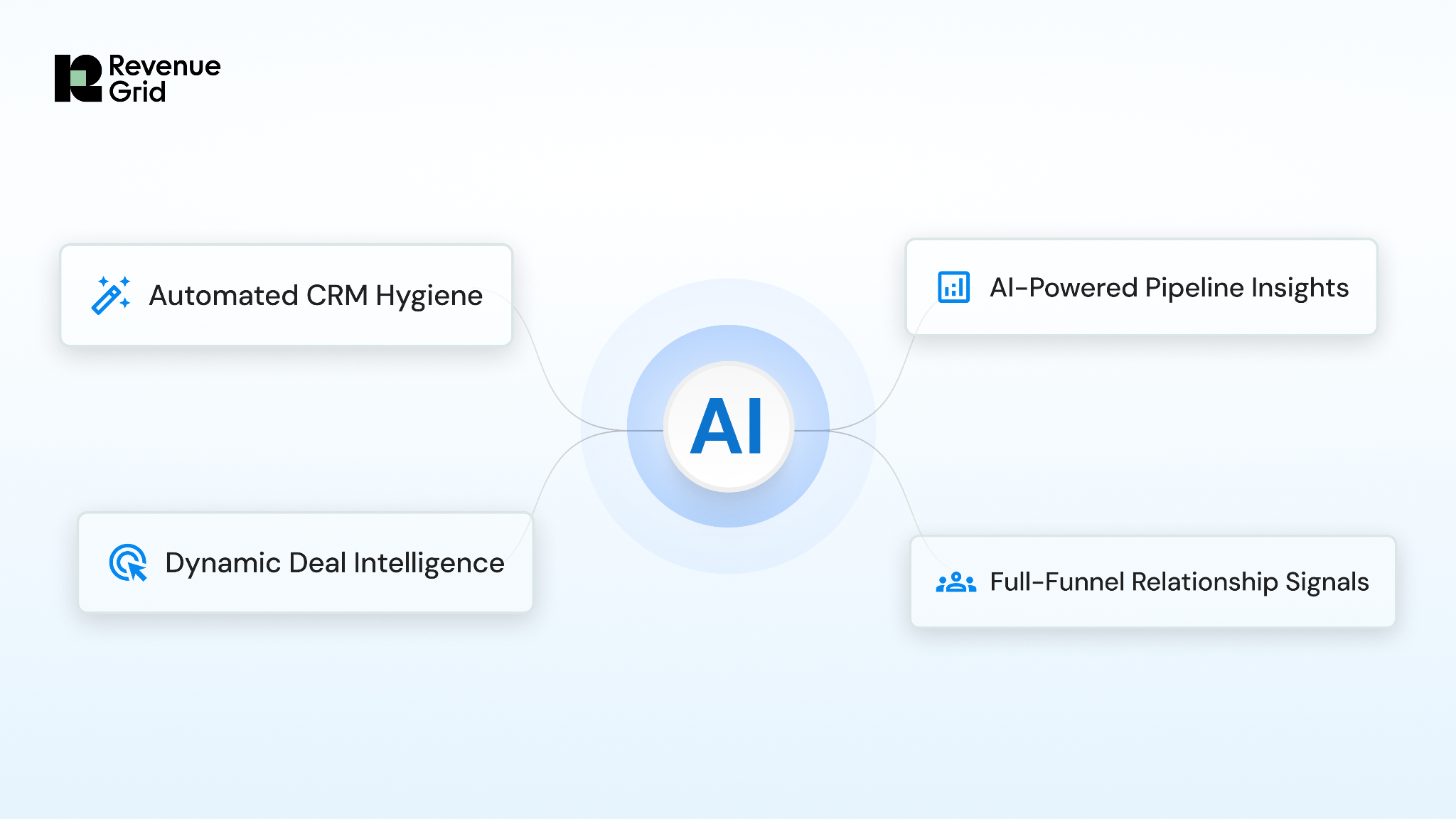
Key Takeaway
- AI in RevOps focuses on eliminating the low-value work (data cleanup, lead routing, manual reporting) that prevents RevOps from operating strategically.
- Every AI use case on this list breaks down without clean, complete CRM data. Before investing in AI tooling, the highest-leverage move is fixing what's flowing into your system of record.
- AI scoring and routing models are only as good as the outcomes they're trained on. If your historical pipeline data is messy or incomplete, the model learns the wrong patterns.
- The biggest untapped opportunity in RevOps isn't forecasting or attribution — it's relationship intelligence. Activity logs tell you what happened; they don't tell you whether the relationship is actually strong enough to close.
- RevOps teams that start governing AI behavior now (what agents can act on, how decisions get audited) will have a structural advantage as autonomous workflows become the norm.
Every time AI comes up in a RevOps conversation, it seems to go one of two ways. Either someone’s telling you agents will run your entire pipeline autonomously by next quarter, or the best example anyone can point to is a chatbot that drafts follow-up emails.
Neither version is that useful to you.
What you need are real uses of AI for RevOps that will help you take the tedious work off your plate. This is so that the function shifts toward the higher-leverage problems that actually need a human brain.
The case for moving in this direction is clear. Over 70% of businesses are utilizing AI to optimize operations, including revenue operations, and companies that extensively adopt AI experience a 9.5% increase in sales growth over five years. Organizations using AI-powered RevOps report achieving 36% more revenue growth and up to 28% higher profitability. AI-driven revenue operations enable real-time orchestration of pipeline activities, moving revenue teams from reactive reporting to proactive management of revenue workflows.
But there’s an important caveat: AI tools are only as effective as the data they are fed. Incomplete or inconsistent data leads to poor performance and unreliable results, which means the foundation of any AI investment in RevOps is data quality, not the tools themselves. Many organizations face real challenges in operationalizing AI within revenue operations due to disconnected systems and inconsistent data across platforms, which can hinder effective automation before it even gets started. RevOps tools help organizations eliminate data silos, improve accuracy, automate workflows, and empower sales operations, marketing efforts, and customer success teams to work as one revenue engine.
When those foundations are in place, AI tools enable RevOps teams to automate routine tasks, enhance decision-making through real-time insights, and improve customer engagement and ultimately driving predictable revenue growth across the entire revenue lifecycle. Automating repetitive tasks alone can reclaim 15-20 hours per week for RevOps professionals, and AI identifies patterns that human analysts might miss, allowing for more precise resource allocation.
In this article, we’re covering 7 AI solutions for automating revenue operations that teams are putting to work right now. Some of these you may already be experimenting with. Others might challenge how you think about your role entirely.
Why Revenue Operations Teams Are Turning to AI Now
Sales leaders struggle with a problem that’s been around for years: the data they need to make decisions lives in too many places. CRM systems, marketing automation platforms, customer success platforms, finance systems. Each one holds a piece of the picture, but none of them holds all of it. The result is data silos that slow down decision-making, create friction between sales and marketing teams, and make it nearly impossible to get a unified view of the entire customer journey.
RevOps tools unify sales, marketing, and customer success data to create seamless data management, automate repetitive tasks, and provide data-driven insights across the entire customer lifecycle. Companies using integrated revenue operations tools see improvements in data quality, higher sales performance, better customer relationships, and more accurate revenue forecasts, with organizations growing up to 19% faster due to better alignment between sales, marketing, and customer success functions.
AI-driven revenue operations take this further by adding a layer of intelligence on top of unified data. Rather than just connecting your revenue systems, AI-powered tools analyze patterns across all the data, surface actionable insights, and trigger automated workflows, turning RevOps from a support function into a proactive growth engine.
The initial investment for AI tools can be high, and organizations may struggle to justify the costs without clear evidence of ROI. Integrating AI tools with existing systems can also be complex, often requiring significant time and resources to ensure compatibility. These are real challenges worth planning for. But for teams that get the foundations right, the return is measurable: better pipeline visibility, more accurate revenue forecasts, and sales professionals who spend their time on high-value work instead of manual data entry and repetitive tasks.
- Automating CRM Hygiene So Clean Data Isn’t a Quarterly Project
Every RevOps team knows the cycle. Data gets messy. Someone flags it. You schedule a cleanup sprint. The team spends a week deduplicating records, filling in missing fields, and fixing stage values. Two months later, it’s messy again.
The cost of dirty data isn’t just the cleanup time, it’s everything downstream that breaks because of it. Lead scoring built on incomplete records. Sales forecasting that misses deals because activity was never logged. Revenue visibility that’s off because customer data is fragmented across disconnected tools. RevOps teams often deal with fragmented customer data across multiple systems, making it difficult to maintain a single source of truth and leading to inefficiencies in decision-making.
AI agents break that cycle by making hygiene continuous instead of periodic. Here’s what it looks like in practice:
- An agent monitors records daily for duplicates, missing fields, and inconsistent formatting
- It cross-references emails, meetings, and call logs to fill in activity gaps that sales reps never logged
- It flags records where the data contradicts itself like a deal marked “Negotiation” with no stakeholder activity in 45 days
- It auto-merges duplicate contacts based on matching rules you define, with exceptions routed to a human for review
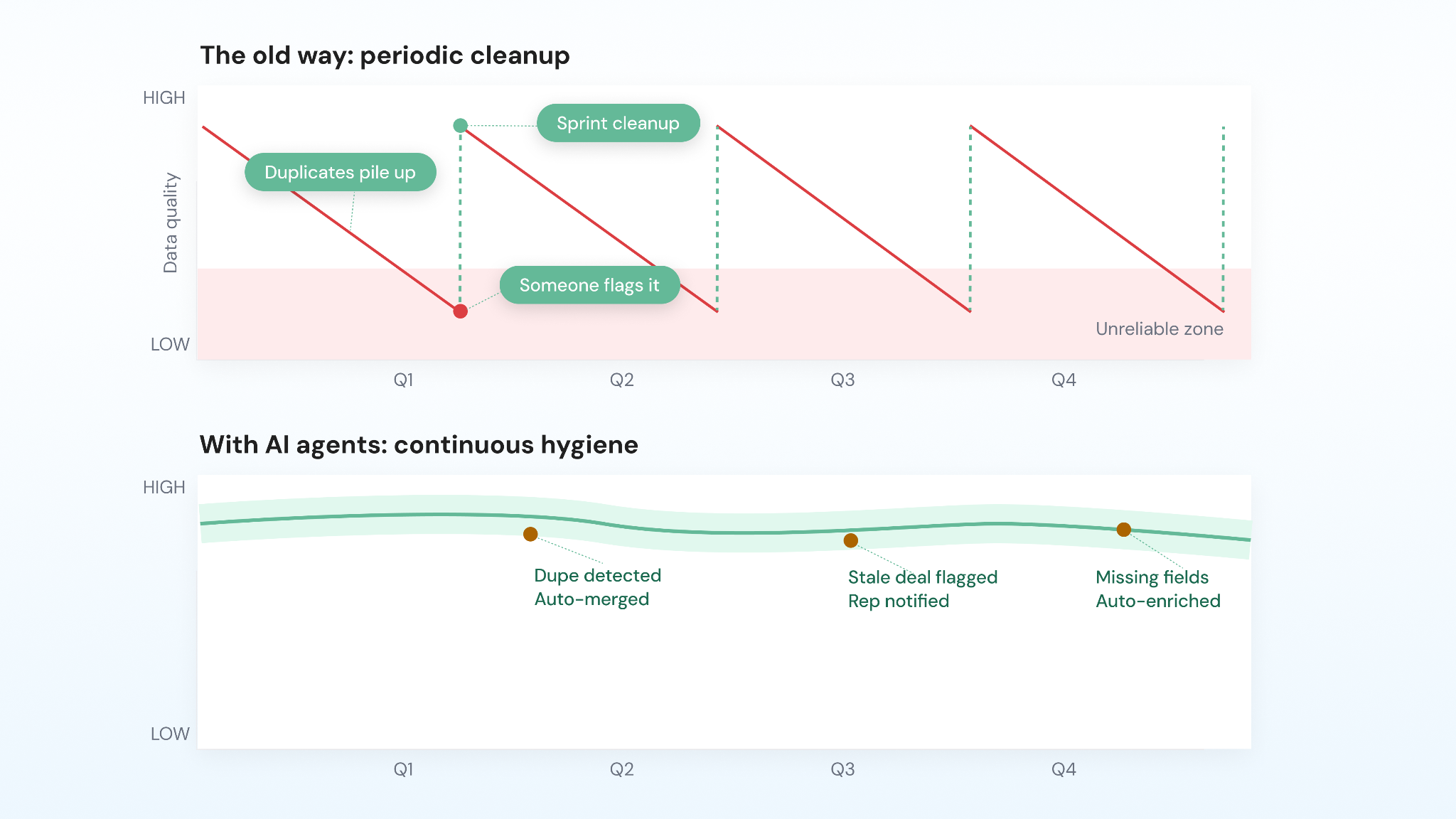
You go from reacting to dirty data to preventing it. And everything downstream, scoring, forecasting, routing, reporting, gets more reliable as a result, because the foundation holds. Improving data quality at this level is one of the highest-leverage investments a revenue operations team can make, because it multiplies the effectiveness of every other AI tool in your stack.
- Building Lead Scoring Models That Actually Reflect Your Close Patterns
Most lead scoring setups work fine at first. You define rules based on firmographic and behavioral attributes, assign weights, and the system scores automatically. The problem isn’t the mechanics. It’s that those rules and weights rarely get revisited.
Buyer behavior shifts. A new product line attracts a different persona. A channel that used to drive quality leads starts pulling in tire-kickers. But the scoring model stays frozen in time, still optimized for a sales pipeline that looked different six months ago.
AI tools can automate lead scoring and prioritization, allowing sales teams to focus on high-potential leads and improve conversion rates. LLM-powered propensity models work backwards from your actual outcomes, instead of you deciding which attributes should carry weight, the model analyzes your historical closed-won and closed-lost deals and surfaces the patterns that genuinely correlate with conversion.
Sometimes the results challenge assumptions. Maybe the signal you’ve been weighing heavily barely matters. Maybe the strongest predictor is something you weren’t tracking as a scoring input at all like a second stakeholder joining an email thread within the first week.
AI agents can also analyze engagement signals and enrichment data to determine which leads should be prioritized, automating updates to CRM records and triggering outreach workflows without manual intervention. Implementing AI in lead management can streamline lead capture and follow-up processes, significantly reducing manual data entry and improving response times for the sales rep picking up the lead.
The real advantage is that the AI model updates as your pipeline evolves. If there’s a new segment or a different buying motion, the scoring adapts without someone on the sales operations team manually reconfiguring rules. For sales and marketing teams that are constantly adjusting their go-to-market motion, this adaptability is what separates a scoring model that stays useful from one that quietly becomes a liability.
- Replacing Brittle Lead Routing With Dynamic Assignment
If you’ve ever maintained a complex routing tree, you know how quickly it turns into a mess that only one person on the team fully understands.
There are dozens of rules. Territory logic that breaks every time someone gets promoted or a region gets restructured. Edge cases that send leads into black holes. And the constant worry that a high-intent buyer sat in a queue for two days because of a rule nobody remembered to update after last quarter’s realignment.
The downstream effect on customer engagement is real — slow routing means slower response times, and slower response times mean lower conversion rates. Sales leaders who have visibility into this problem know it’s not a rep problem; it’s a process problem.
AI-powered routing replaces that static logic with real-time decision-making. Instead of following a fixed script, it factors in:
- Current rep workload and capacity
- Historical conversion rates for similar accounts by rep
- Whether the account already has an existing relationship with someone on the team
- Intent signals and engagement recency
The routing stays accurate without requiring manual adjustments every quarter. That alone saves meaningful hours for sales operations. But the bigger win is fewer dropped leads and faster speed-to-contact, which directly impacts conversion across the entire sales process. AI provides personalized outreach at scale including generating personalized emails and content based on routing context, which further boosts customer engagement from the first touchpoint.
- Running Pipeline Reviews With Pre-Built Intelligence
Forecasting in most revenue orgs still runs on a chain of judgment calls. A sales rep commits a number. A manager adjusts it. A VP pressure-tests it in a pipeline review. The numbers might live in a spreadsheet or a CRM report, but the logic behind them is mostly tribal knowledge and intuition.
This approach creates real problems for sales and finance teams trying to align on a number. Finance teams need accurate revenue forecasts to plan headcount and budget. Sales leaders need pipeline health visibility to coach effectively. When the forecast is built on gut feel rather than data, everyone downstream is working with uncertainty.
AI-powered forecasting changes that by starting with the data and building the forecast from there. Implementing AI in RevOps leads to improved forecasting accuracy, as AI tools analyze historical data and market trends to provide actionable insights for revenue predictions. AI tools provide real-time insights and predictive analytics, enabling data-driven decisions that maximize revenue potential.
Here’s what AI-driven pipeline management can look like in practice:
- The model analyzes every open opportunity according to its stage, deal size, velocity, engagement patterns, and historical conversion rates for similar deals
- It generates a forecast and shows exactly what’s driving it, which deals it expects to close, which ones it thinks are at risk, and why
- Where the AI’s projection disagrees with what a rep has committed, it flags the gap and explains the reasoning, not just “this deal is at risk” but “this deal has been in the same stage for 30 days with no stakeholder activity; similar deals close at 12%, so it’s a risk”
- It surfaces key performance indicators around pipeline health automatically, so revenue teams don’t have to build custom reports before every review meeting
This helps the RevOps team walk into a review meeting with a clear, data-backed picture of the deal pipeline. The meeting shifts from “what’s happening” to “what are we doing about it”. This is a fundamentally more valuable use of everyone’s time.
- Letting AI Handle Attribution and Funnel Analysis
Attribution has always been one of RevOps’ most politically charged responsibilities. Marketing wants credit for the leads they generated. Sales wants credit for the relationships they built. RevOps is stuck in the middle, building models that people fight over.
The underlying problem is that traditional attribution models only capture what tracking pixels and form fills can see. They miss the unstructured signals like the sales calls where a prospect mentioned a webinar that changed their thinking, the email thread where they referenced a case study, the conversation where a competitor came up and the rep handled it well.
AI doesn’t eliminate the politics, but it changes the analytical foundation. LLMs can process unstructured data that traditional attribution models ignore entirely: open-text form fields, call transcript mentions of specific campaigns or events, email threads where a prospect references content that influenced their decision. An LLM can categorize and weight these signals at scale, which means your attribution model reflects what actually happened across the entire customer journey.
The same capability applies to sales funnel analysis. Instead of manually tagging and categorizing conversion paths, AI can surface patterns across thousands of deals: which sequences of touchpoints correlate with faster sales cycles, where buyers tend to stall, and which segments convert at meaningfully different rates. AI identifies patterns that human analysts might miss, enabling more precise resource allocation across marketing efforts and sales activities.
With AI, the kind of data analysis that would take a person weeks to do manually is delivered continuously, which gives giving sales and marketing teams the actionable insights they need to optimize their go-to-market motion in real time rather than after the quarter ends.
- Unifying Relationship Signals Across the Full Customer Lifecycle
This is the use case most RevOps teams haven’t tackled yet and arguably the one with the biggest upside for revenue growth.
Your CRM tracks activities. Emails sent, meetings booked, calls logged. But activities aren’t relationships. A sales rep could have 50 logged touchpoints with an account and still have no real relationship with the economic buyer. Another rep might have a single, trusted contact who picks up the phone every time and that deal closes in half the cycle time.
The gap between activity data and relationship intelligence is massive, and it’s where most revenue engines have a blind spot. When customer success teams, sales teams, and account managers are all working from activity logs instead of relationship health signals, you end up with a fragmented view of customer behavior that makes it nearly impossible to manage churn risk or expansion opportunities proactively.
AI can start closing that gap by analyzing the actual texture of interactions, not just counting them:
- Who is responding, and how quickly? A reply from a VP within an hour signals something very different than a reply from a coordinator three days later.
- How is sentiment shifting across a thread? Are conversations getting warmer, more specific, more action-oriented or are they going circular?
- Are new stakeholders entering the conversation, or is engagement narrowing to a single contact?
- What’s happening across departments? Is the customer success team seeing strong engagement post-sale while the sales team is struggling to expand? Or vice versa?
AI agents can analyze engagement signals and automatically update CRM records, which helps shorten lead-to-opportunity conversion times and improve pipeline velocity. When you surface these signals and connect them across the full revenue lifecycle, from first touch through renewal and expansion, RevOps gains revenue visibility into something the CRM was never designed to show: the actual health and depth of customer relationships.
This kind of unified view also directly supports customer satisfaction. When revenue teams can see relationship health signals early, they can intervene before a customer goes quiet rather than reacting after they’ve already started evaluating alternatives.
This is exactly what we’re building at Revenue Grid. Most of what lives in your CRM today is a log of actions: emails sent, calls made, meetings held. But none of that tells you whether the relationship behind those actions is strong, weakening, or barely there.
Revenue Grid sits on top of your CRM and reads the signals that activity logs miss like which stakeholders are actually engaged and which ones have gone quiet, whether a conversation is progressing toward a decision or going in circles. We call it relationship intelligence. The aim is to give you a clear picture of whether your team’s relationships are strong enough to support the revenue you’re forecasting.
If that’s a gap you’re feeling right now, book a demo and we can walk you through how it works.
7. Using AI to Streamline Cross-Functional Revenue Workflows
The six use cases above mostly live within a single function or system. But some of the biggest efficiency gains in RevOps come from automating workflows that span sales, marketing, and customer success teams, especially the handoffs that fall apart because they depend on someone manually updating a record, sending a notification, or triggering a next step.
Automated workflows powered by AI can eliminate the manual work at these handoff points. When a lead hits a certain score, an outreach sequence starts automatically. When a deal moves to a new stage, the right stakeholders get notified and the right tasks get created. When a renewal is approaching, the customer success team gets a heads-up with relevant engagement data attached. When a customer’s behavior signals expansion potential, an account owner gets an alert with context.
These aren’t complicated automations, they’re the ones that most commonly break down in practice because they depend on manual tasks that don’t always get done. AI-powered tools close those gaps by treating the entire revenue cycle as a connected system rather than a series of handoffs between disconnected tools.
For revenue operations teams managing a high volume of accounts and a complex sales process, this kind of end-to-end automation workflow can be the difference between a revenue engine that runs smoothly and one that constantly requires manual intervention to keep moving. Effective AI solutions for revenue operations focus on transforming the function from a reactive support role into a proactive, predictive growth engine and cross-functional automation is where that transformation becomes most visible.
Where This is All Heading: RevOps as the Governor of AI Systems
Up until now, RevOps has mostly governed processes: how leads get routed, how stages get defined, how data flows between revenue systems. But when AI agents start taking actions on their own like updating records, routing leads, triggering automation workflows, adjusting scores, RevOps starts governing how the AI itself behaves.
And that raises questions nobody had to think about two years ago:
- What data should an agent be allowed to act on without someone reviewing it first?
- If an agent makes a bad routing call at 2 AM on a Saturday, who owns that?
- How do you audit what an agent is doing when it’s making hundreds of small decisions every day?
- What do you do when the agent’s recommendation goes against what a rep believes about a deal?
RevOps is the natural home for these decisions because it’s the function that lives at the intersection of the systems and the business logic those systems are supposed to follow. This is a new kind of operational efficiency challenge, not just optimizing existing processes, but defining the rules that govern autonomous systems operating across the entire revenue lifecycle.
The teams that start thinking about this now will have a real advantage. They won’t just be using AI tools, they’ll be the ones deciding how AI runs across the revenue engine.
Bringing It All Together With Revenue Grid
Almost every use case on this list depends on one thing before anything else: clean, complete, trustworthy activity data in your CRM systems. Without it, your scoring models learn from incomplete inputs, your pipeline reviews miss what’s actually happening, and your sales forecasting is built on gaps. Accurate data is the prerequisite for everything else — not a nice-to-have.
This is the problem that Revenue Grid was built to solve.
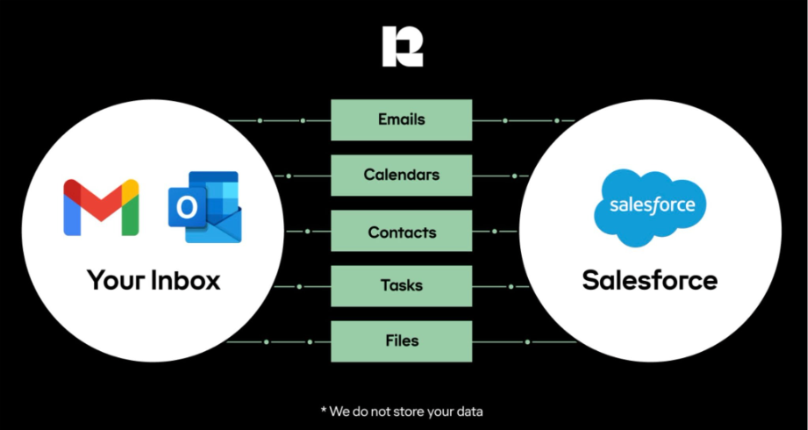
Revenue Grid automatically captures and syncs emails, meetings, contacts, and attachments from your team’s inboxes into Salesforce. You won’t be relying on sales reps to remember what happened on a call last Tuesday. There are no quarterly cleanup sprints to fix what fell through the cracks. All the data flows into your CRM automatically, giving revenue operations teams the foundation they need to actually trust what they’re looking at.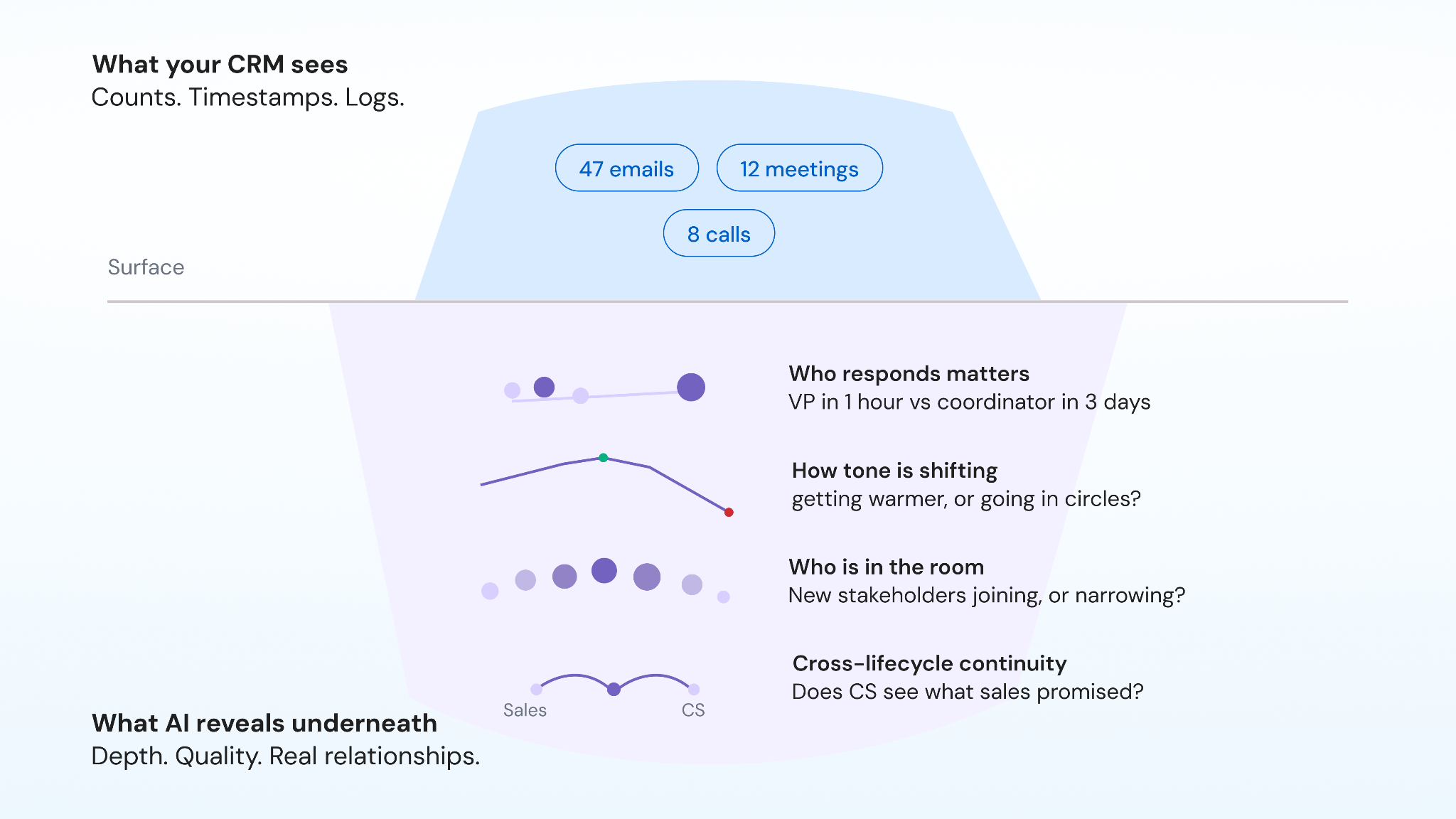
AI can start closing that gap by analyzing the actual texture of interactions, not just counting them:
- Who is responding, and how quickly? A reply from a VP within an hour signals something very different than a reply from a coordinator three days later.
- How is sentiment shifting across a thread? Are conversations getting warmer, more specific, more action-oriented or are they going circular?
- Are new stakeholders entering the conversation, or is engagement narrowing to a single contact?
- What’s happening across departments? Is the customer success team seeing strong engagement post-sale while the sales team is struggling to expand? Or vice versa?
AI agents can analyze engagement signals and automatically update CRM records, which helps shorten lead-to-opportunity conversion times and improve pipeline velocity. When you surface these signals and connect them across the full revenue lifecycle, from first touch through renewal and expansion, RevOps gains revenue visibility into something the CRM was never designed to show: the actual health and depth of customer relationships.
This kind of unified view also directly supports customer satisfaction. When revenue teams can see relationship health signals early, they can intervene before a customer goes quiet rather than reacting after they’ve already started evaluating alternatives.
This is exactly what we’re building at Revenue Grid. Most of what lives in your CRM today is a log of actions: emails sent, calls made, meetings held. But none of that tells you whether the relationship behind those actions is strong, weakening, or barely there.
Revenue Grid sits on top of your CRM and reads the signals that activity logs miss like which stakeholders are actually engaged and which ones have gone quiet, whether a conversation is progressing toward a decision or going in circles. We call it relationship intelligence. The aim is to give you a clear picture of whether your team’s relationships are strong enough to support the revenue you’re forecasting.
If that’s a gap you’re feeling right now, book a demo and we can walk you through how it works.
7. Using AI to Streamline Cross-Functional Revenue Workflows
The six use cases above mostly live within a single function or system. But some of the biggest efficiency gains in RevOps come from automating workflows that span sales, marketing, and customer success teams, especially the handoffs that fall apart because they depend on someone manually updating a record, sending a notification, or triggering a next step.
Automated workflows powered by AI can eliminate the manual work at these handoff points. When a lead hits a certain score, an outreach sequence starts automatically. When a deal moves to a new stage, the right stakeholders get notified and the right tasks get created. When a renewal is approaching, the customer success team gets a heads-up with relevant engagement data attached. When a customer’s behavior signals expansion potential, an account owner gets an alert with context.
These aren’t complicated automations, they’re the ones that most commonly break down in practice because they depend on manual tasks that don’t always get done. AI-powered tools close those gaps by treating the entire revenue cycle as a connected system rather than a series of handoffs between disconnected tools.
For revenue operations teams managing a high volume of accounts and a complex sales process, this kind of end-to-end automation workflow can be the difference between a revenue engine that runs smoothly and one that constantly requires manual intervention to keep moving. Effective AI solutions for revenue operations focus on transforming the function from a reactive support role into a proactive, predictive growth engine and cross-functional automation is where that transformation becomes most visible.
Where This is All Heading: RevOps as the Governor of AI Systems
Up until now, RevOps has mostly governed processes: how leads get routed, how stages get defined, how data flows between revenue systems. But when AI agents start taking actions on their own like updating records, routing leads, triggering automation workflows, adjusting scores, RevOps starts governing how the AI itself behaves.
And that raises questions nobody had to think about two years ago:
- What data should an agent be allowed to act on without someone reviewing it first?
- If an agent makes a bad routing call at 2 AM on a Saturday, who owns that?
- How do you audit what an agent is doing when it’s making hundreds of small decisions every day?
- What do you do when the agent’s recommendation goes against what a rep believes about a deal?
RevOps is the natural home for these decisions because it’s the function that lives at the intersection of the systems and the business logic those systems are supposed to follow. This is a new kind of operational efficiency challenge, not just optimizing existing processes, but defining the rules that govern autonomous systems operating across the entire revenue lifecycle.
The teams that start thinking about this now will have a real advantage. They won’t just be using AI tools, they’ll be the ones deciding how AI runs across the revenue engine.
Bringing It All Together With Revenue Grid
Almost every use case on this list depends on one thing before anything else: clean, complete, trustworthy activity data in your CRM systems. Without it, your scoring models learn from incomplete inputs, your pipeline reviews miss what’s actually happening, and your sales forecasting is built on gaps. Accurate data is the prerequisite for everything else — not a nice-to-have.
This is the problem that Revenue Grid was built to solve.
Revenue Grid automatically captures and syncs emails, meetings, contacts, and attachments from your team’s inboxes into Salesforce. You won’t be relying on sales reps to remember what happened on a call last Tuesday. There are no quarterly cleanup sprints to fix what fell through the cracks. All the data flows into your CRM automatically, giving revenue operations teams the foundation they need to actually trust what they’re looking at.
Once that activity data is flowing, Revenue Grid True Pipeline gives you a real-time view of which deals are progressing, which ones are stalling, and where revenue is leaking between stages. No more stitching together reports to figure out what’s going on across your sales pipeline. The pipeline health monitoring is built in, continuous, and visible to everyone who needs it.
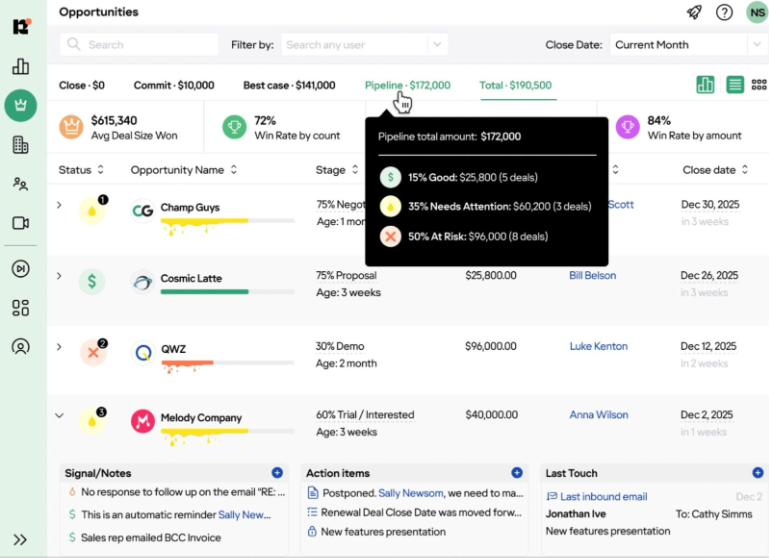
And once you can see what’s happening, the question becomes what to do about it. That’s where Guided Selling comes in. It takes the patterns in your data (the activity sequences that lead to wins, the warning signs that show up before a deal goes dark), and turns them into real-time nudges that help reps take the right next step. Your best playbooks stop being tribal knowledge and start being something the whole team actually follows.

Here’s what makes Revenue Grid different from other RevOps tools:
- You own your data completely. No retention limits, no third-party storage risks. Your Salesforce instance stays your single source of truth, with full historical data preservation.
- You control exactly what gets synced. Standard or custom objects, with rules and filters your team defines. You decide what to capture, how to store it, and what to exclude.
- Reps don’t have to change how they work. They keep working from their inbox. Revenue Grid syncs everything in the background, so adoption isn’t a battle you have to fight.
- It’s built for teams where compliance matters. GDPR, CCPA, and HIPAA compliance are built in from the ground up, not bolted on as an afterthought. If you’re in financial services, healthcare, or any regulated industry, this is the part that usually makes the decision.
Teams using Revenue Grid see up to 400% more activity in their CRM, 90% forecast accuracy, and over 30 hours saved per person every month which aligns closely with broader research showing that automating repetitive tasks can reclaim 15–20 hours per week for RevOps professionals.
Book a demo and we’ll walk you through how Revenue Grid can help your RevOps team build solutions that actually hold up.
What's the difference between AI automation and traditional workflow automation in RevOps?
Traditional workflow automation follows fixed rules. For example: if X happens, do Y. It breaks the moment conditions fall outside what the rule anticipated. AI-powered automation is adaptive; it makes decisions based on patterns in your data rather than a static script, which means it holds up better as your sales process, team structure, or market conditions evolve.
How do you measure ROI on AI investments in revenue operations?
The most reliable metrics are time reclaimed on manual tasks, improvement in forecast accuracy quarter over quarter, lead response time, and conversion rate changes at key funnel stages. Start by establishing a baseline before implementation without it, any ROI claim is directional at best. Teams that tie AI adoption to specific operational metrics (not just cost savings) tend to build stronger internal cases for continued investment.
Which RevOps function benefits most from AI in the short term?
CRM hygiene and lead scoring tend to show the fastest, most measurable impact because the feedback loop is tight and the baseline problems are well-defined. Forecasting and attribution take longer to improve because the models need sufficient data history to become reliable. If you’re making the case for AI internally, starting with data quality is the easiest win to demonstrate.
What should RevOps teams do before implementing AI tools?
Audit your data first. Map where customer and deal data lives, how it flows between systems, and where it breaks down. AI amplifies whatever is in your pipeline. Good data gets better and bad data produces confidently wrong outputs. The teams that get the most out of AI tools are the ones that treated data infrastructure as a prerequisite, not an afterthought.