
Clients are more open to AI than many advisors assume
Firms often assume clients will see AI as a threat to the trust they have built with their advisor. Matt’s research suggests that assumptions need to be tested.
His study covered affluent Americans with at least $100,000 in investable assets, excluding their homes. 68% had a somewhat or very positive view of AI. Among respondents already working with an advisor, 76% were comfortable with their advisor using AI.
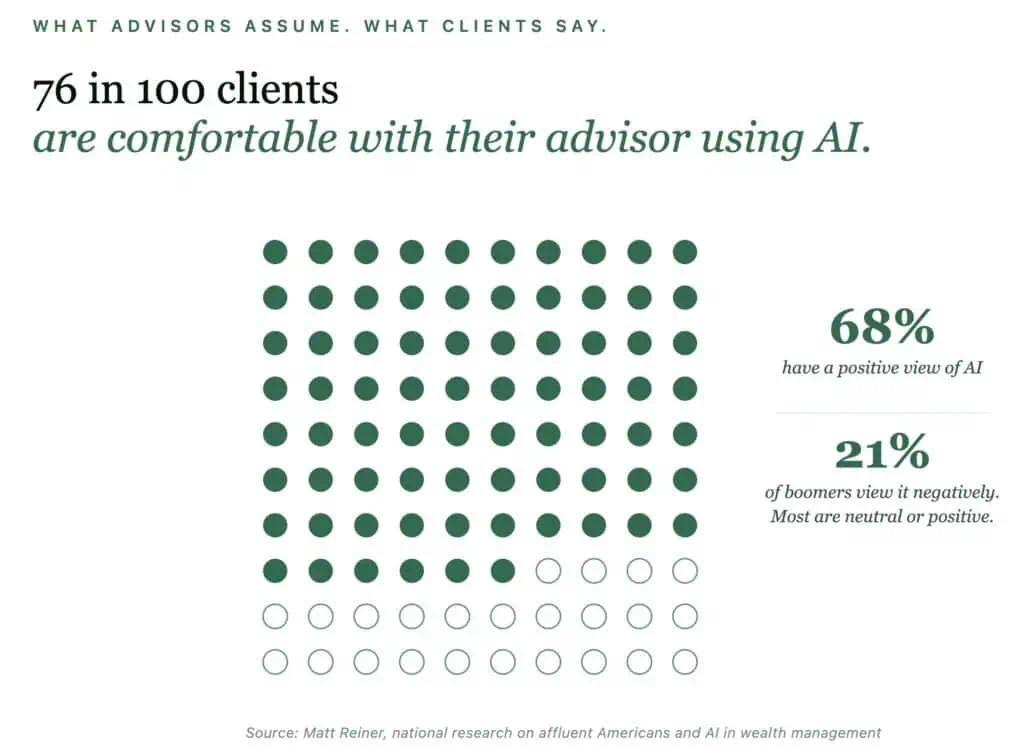
Higher-net-worth respondents were among the most comfortable with an AI-enabled advisor. They were also more likely to use AI personally. Even among boomers, only 21% expressed a negative view. Many were neutral, which suggests openness even when enthusiasm is limited.
Clients are also beginning to connect technological capability with the quality of an advisory firm.
In Matt’s research, 79% of affluent Americans currently using an advisor said that keeping up with the latest technology is part of being a great advisor. More than 70% believed advisors would need to use AI within two years.
However, comfort with the general idea of AI does not tell a firm where or how to use it. That depends on the role technology is being given.
Clients’ comfort changes with the role AI plays
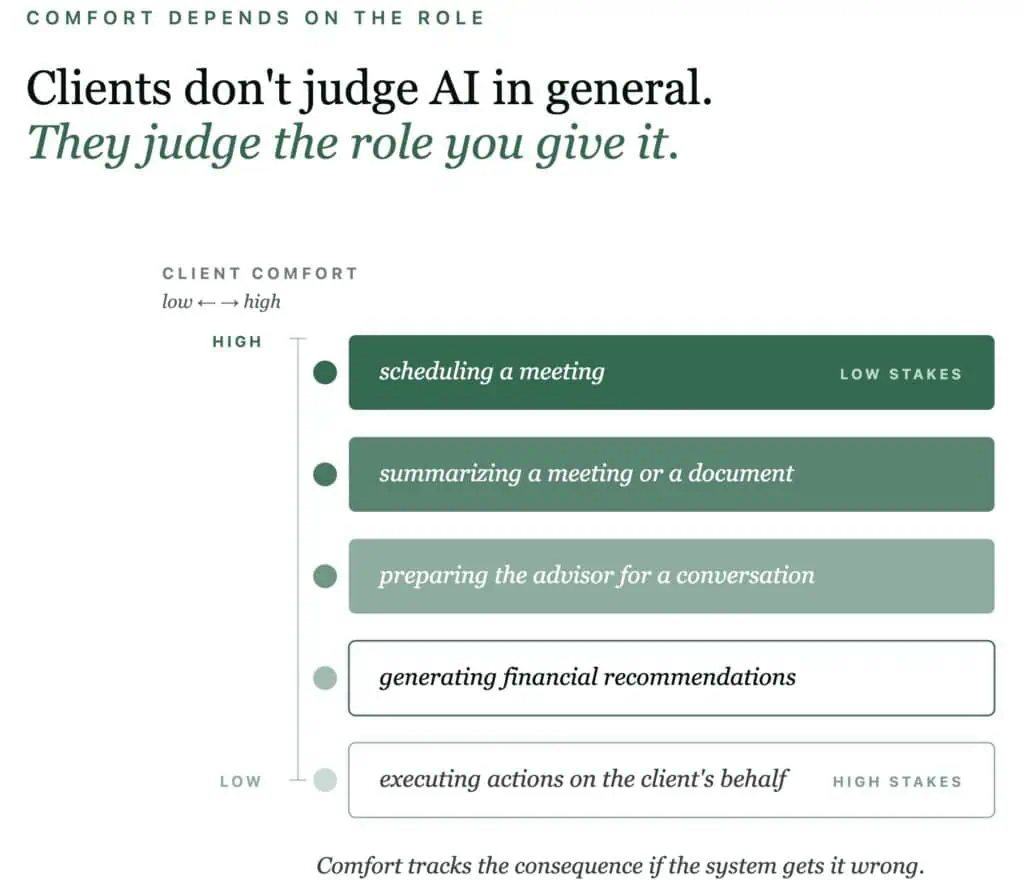
AI can sit at several different points in the client experience. It can schedule a meeting, summarize a transcript, prepare an advisor for a conversation, or create a follow-up email. It can also analyze financial information, contribute to recommendations, and execute actions.
Clients do not evaluate all of these uses in the same way. Their comfort depends on the consequences if the system gets something wrong. A scheduling error is inconvenient. An incorrect assumption in a financial plan can affect an important decision.
The amount of control given to the client matters as well. People want to understand how AI would be used and what it would mean to them. As Matt put it, “They want to be able to consent. And they want to understand what it means for them.”
That points to a practical approach for firms.
Clients should know when AI is being used in a way that materially affects their information or experience. They should also understand the purpose. “We use AI” says very little. Explaining that it helps the advisor review earlier conversations, prepare for meetings or create faster follow-ups gives the client something specific to assess.
So, if firms start using AI, the next question is: Who checks what the system produces?
Advisor oversight changes how clients judge AI
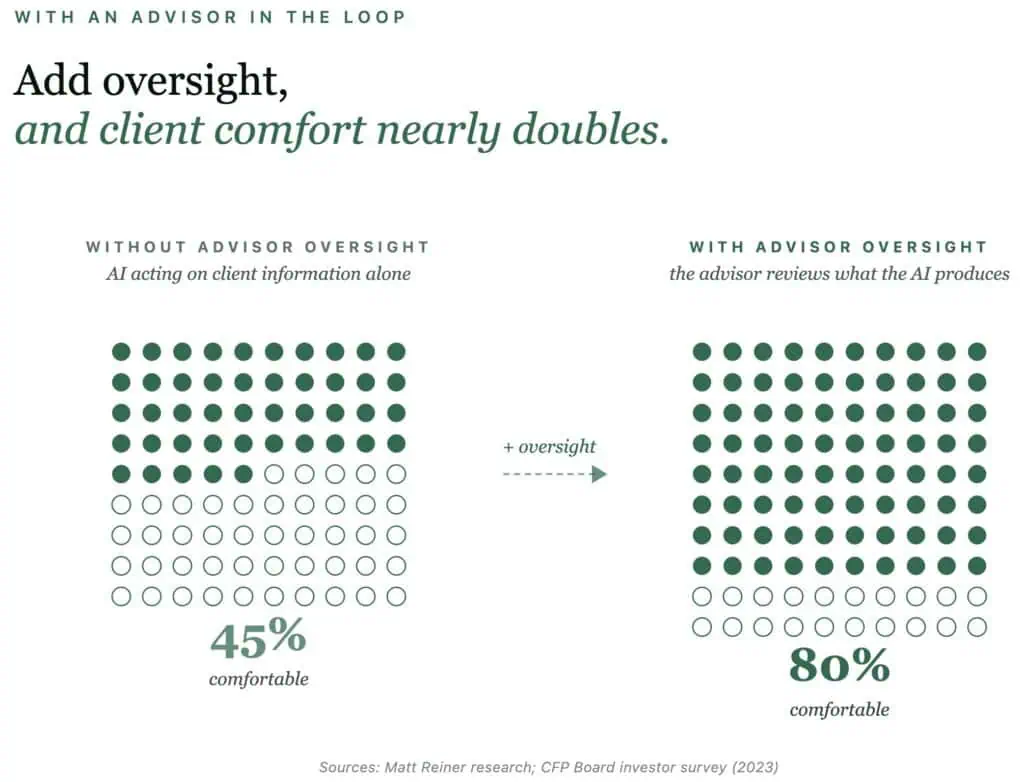
When people were asked whether they were comfortable with personal or financial information being shared with AI without oversight, about 45% said yes. With advisor oversight, the number rose to nearly 80%.
CFP Board research found a similar pattern. 31% of investors were comfortable acting on advice produced by a generative AI tool without verification. Once a financial planner had reviewed it, comfort increased to 52%.
The advisor provides context that may be absent from the available data. This is an expertise that understands the client’s life around the numbers. An AI system may have account information, meeting notes, and a financial plan. But it may still lack the significance of a recent family conversation, the client’s anxiety about a decision or an unstated disagreement between spouses.
Oversight therefore requires more than approving an output. It means applying the judgment that gives the output meaning. That helps explain why clients can be comfortable with an advisor using AI while remaining cautious about receiving financial advice directly from an AI tool.
If AI handles more of the preparation and production around advice, where should the advisor use the capacity, it creates when it comes to client relationships?
Clients expect technology to leave more room for human advice
Matt describes AI’s role as “task replacement, not job displacement.”
Financial planning, meeting preparation, research, follow-up emails and administrative coordination consume a substantial part of an advisor’s day. Clients benefit from these activities, although they rarely see them as the main value of the relationship.
In Matt’s research, 89% of affluent Americans said that humans deliver value beyond what technology alone can provide. They also wanted their advisors to engage more deeply with questions of purpose, meaning and the life their wealth is intended to support.
Deeper advice requires the advisor to be fully present. When an advisor has a tightly scheduled day and still needs to complete trades, prepare plans and send follow-ups before the day ends, every meeting has an implied time limit.
That becomes a problem during a major life event, when a client may need longer than planned to explain what has changed and work through the decisions ahead.
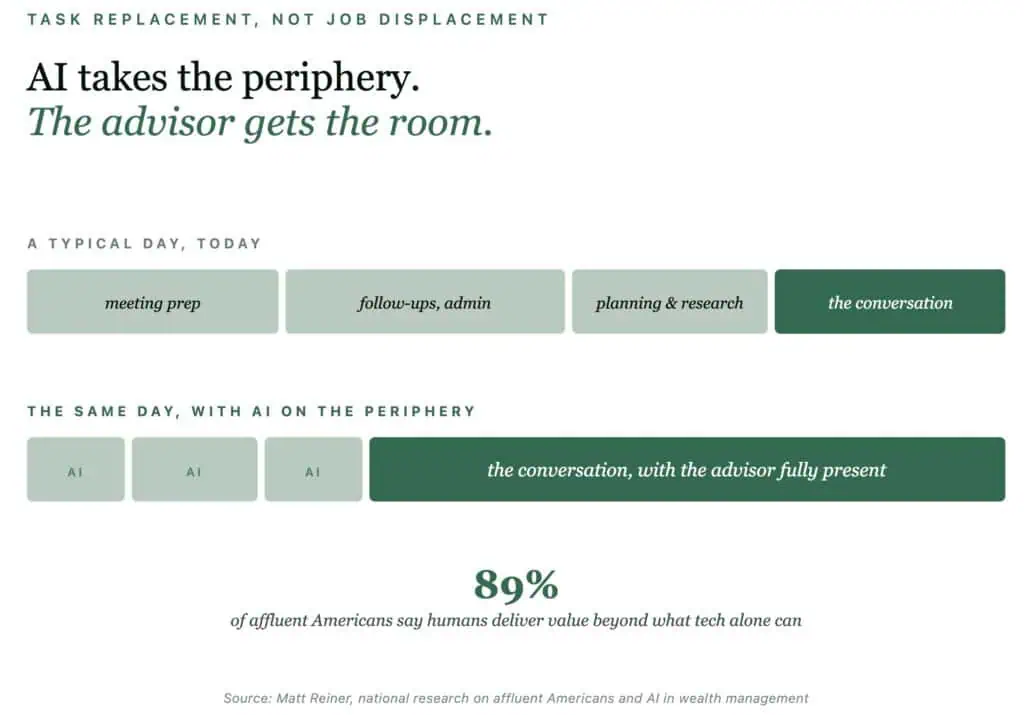
AI can take on parts of the preparation and administrative work surrounding these conversations. It can also bring together relevant information from earlier meetings, financial plans, and recent client activity before the advisor enters the room. With stronger context and fewer competing tasks, the advisor can listen more carefully, recognize what has changed, and give the client the attention it requires.
The next test, therefore, is whether the firm can turn its internal efficiency into a noticeable improvement in client experience.
The value of AI has to show up in the client experience
A wealth management firm may measure AI through hours saved or tasks automated. Clients are more likely to notice whether their advisor remembers important details, follows up quickly and identifies relevant planning needs before being asked.
Matt demonstrated this with an AI notebook built from a portfolio statement, a meeting transcript, and documents from his investment team. From the same source material, it created a briefing document, an infographic, a slide deck, and an interactive resource that could answer questions using only the information provided.
This addressed a familiar problem.
Clients can leave a planning meeting feeling clear about what they need to do and return six months later having taken a few of the agreed actions. A long follow-up document may not help. Different clients prefer to absorb information through different formats.
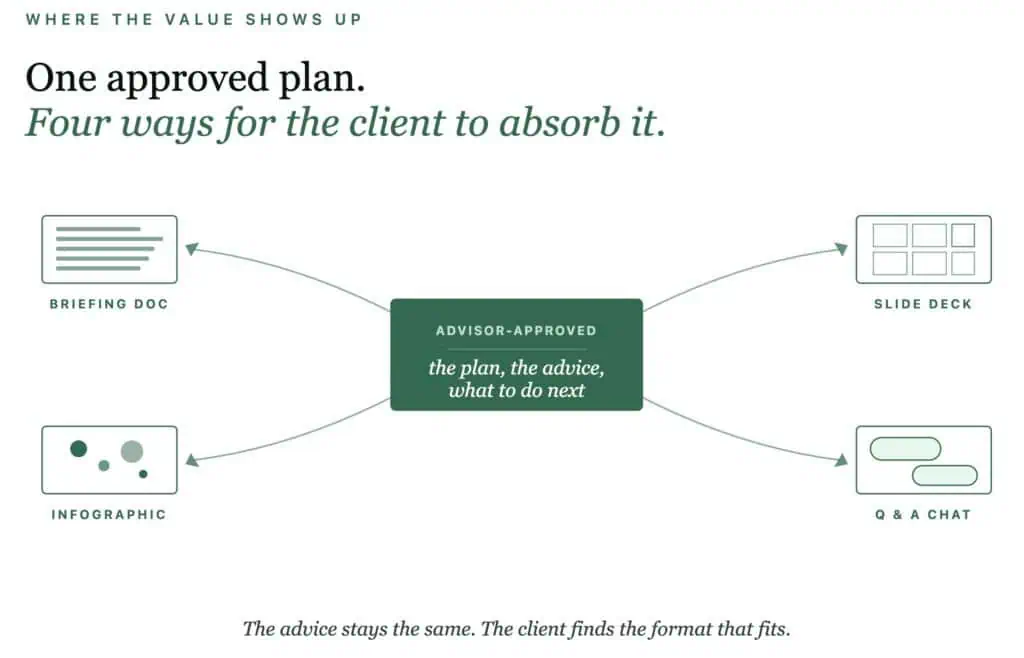
AI can make the same approved advice easier to revisit and act upon. It can also help other members of the firm understand what has happened in the relationship. For a larger wealth manager, that continuity is valuable because the client’s experience often involves several advisors, service professionals, and specialists.
Delivering it consistently, however, depends on the quality of the firm’s data and controls.
Trust has to be built into the firm’s systems
Client information may be spread across CRM fields, emails, meeting notes, financial plans, portfolio systems, and uploaded documents. The same fact may appear differently in several places. Take monthly spending as an example. One figure may sit in the CRM, another in an email, and a third in the planning system. Before AI can use that information reliably, the firm needs to know which source is authoritative.
This is why AI implementation quickly becomes data and process work. Firms need approved tools, rules for personal information, clear access permissions, and a defined process for reviewing outputs. Compliance also needs to be involved while a workflow is being designed.
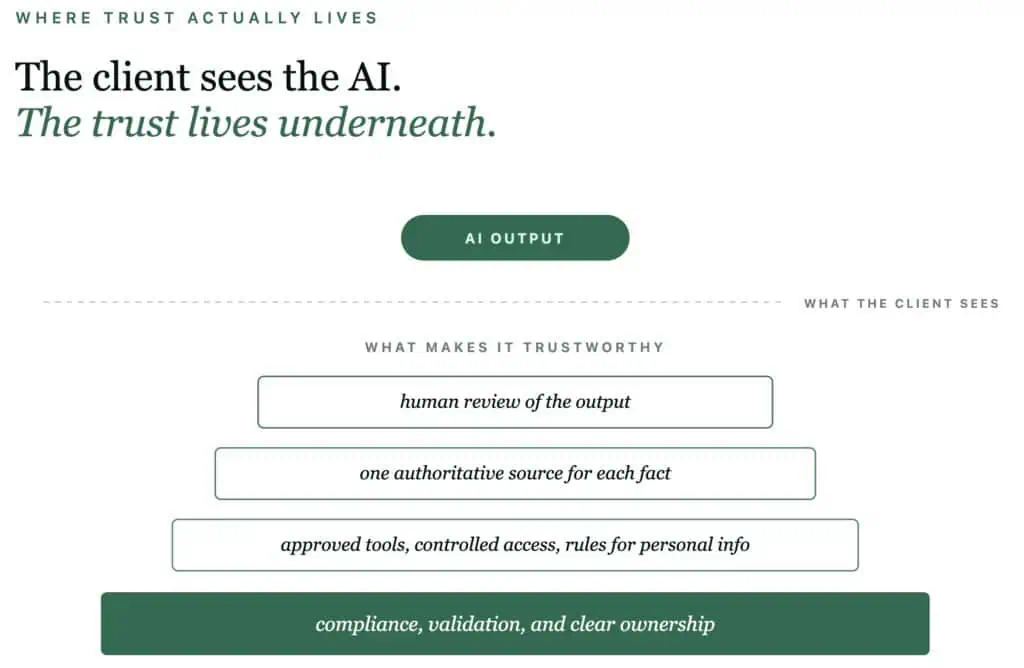
Firms also have to account for employees who are already using AI independently. Without approved tools and training, client information may enter personal accounts or systems the organization cannot monitor. The 2025 adviser survey by ACA found that 44% of firms that had adopted AI had no formal process for testing or validating its outputs.
A client may never see these controls, but the quality of the experience depends on them. Reliable data produces better preparation and more relevant communication. Weak controls create errors that the advisor may not notice until they reach the client.
Start with the improvement the client should experience
Clients appear willing to let AI play several roles within an advisory relationship. Their comfort changes with the task, the information involved, and the level of human oversight. They also want to understand what technology means to them.
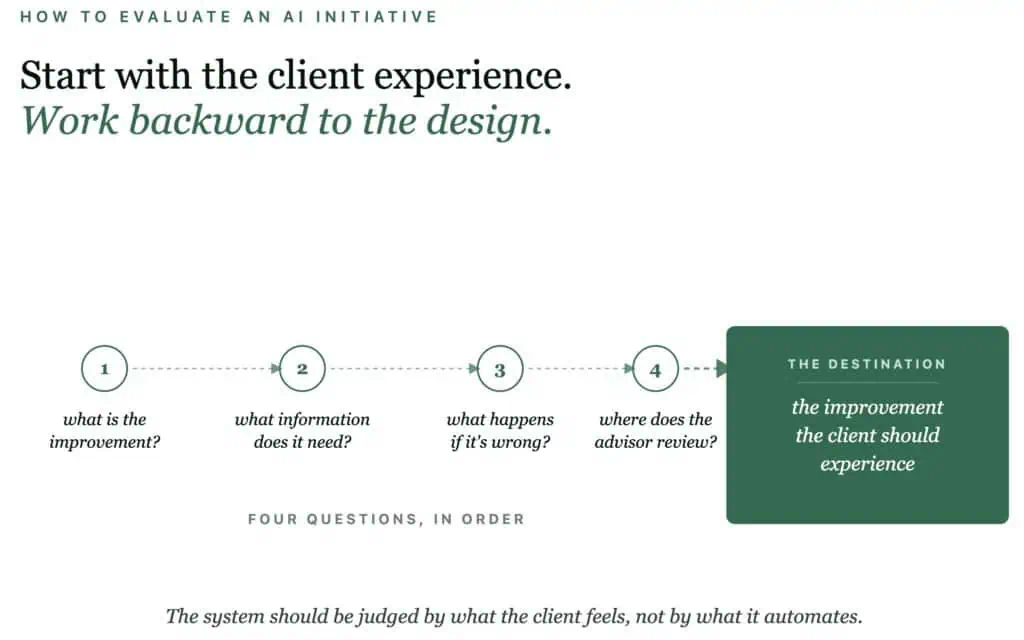
That gives wealth management firms a useful way to evaluate AI initiatives. Begin by identifying the improvement the client should experience. Then determine what information the system requires, what could happen if it is wrong, and where an advisor must review the result.
The strongest use cases will help advisors understand clients more fully, respond more thoughtfully, and spend more time on decisions that require human judgment. That is the standard clients are likely to use when deciding whether AI has made their advisory relationship better.