

Key Takeaway
- 57% of sales professionals say the sales cycle is getting longer
- Sales reps spend 60% of their time on non-selling tasks, draining funnel velocity
- 73% of B2B buyers actively avoid sellers who send irrelevant outreach
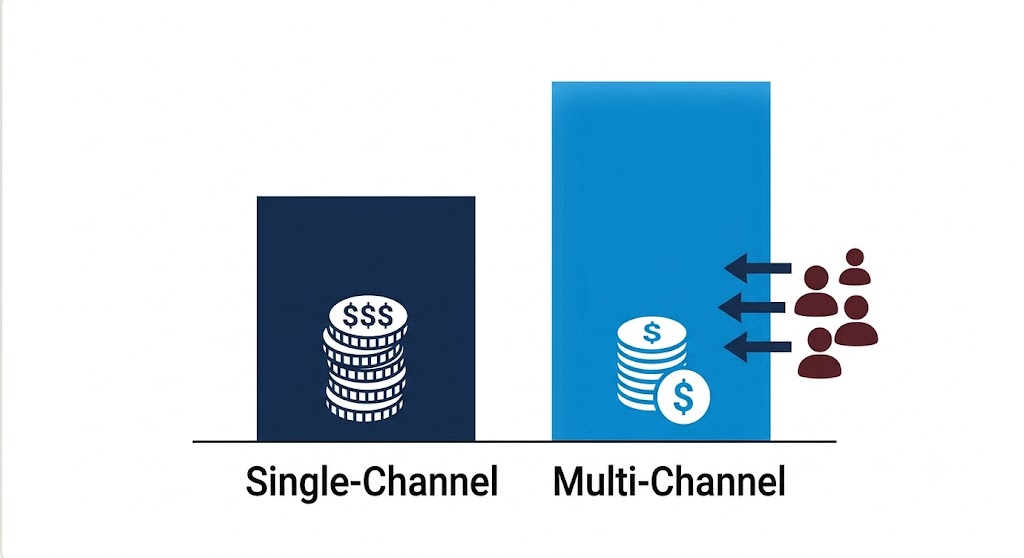
- Multi-channel campaigns deliver a 31% lower cost per lead and a 31% uplift in leads versus single-channel outreach
- Four-fifths of successful sales take five or more follow-up calls
- B2B SaaS funnels convert roughly 39% Lead to MQL and 42% SQL to Opportunity
- 40% of marketers name lead quality and MQLs as their most important success metric
The sales funnel remains the clearest way to understand how prospects move from first touch to closed deal — but the data behind it is shifting fast. This article gathers 15 verified sales funnel statistics covering conversion benchmarks, buyer expectations, follow-up cadence, and the technology trends shaping pipeline performance. Use them to benchmark your own funnel and find the leaks costing you revenue.
Cycles are lengthening
The funnel is taking longer to travel through. A majority — 57% — of sales professionals now say the sales cycle is getting longer 1. For B2B revenue teams, longer cycles mean more stages where deals can stall, more touchpoints to manage, and a greater need for accurate forecasting at every funnel stage.
Selling time is shrinking
One of the biggest drains on funnel velocity is how reps actually spend their day. Sales reps spend 60% of their time on non-selling tasks 1. When manual data entry and administrative work consume more than half the workweek, fewer hours are left to advance opportunities through the funnel. This is exactly the gap that automation and activity capture are designed to close — and where Revenue Grid focuses by automatically logging activity and surfacing the next best action so reps stay in selling mode.
Buyer Expectations Shaping the Funnel
Relevance is non-negotiable
Top-of-funnel outreach only works when it lands with the right message. Today, 73% of B2B buyers actively avoid sellers who send irrelevant outreach 1. That single statistic reframes prospecting: irrelevant volume doesn’t just underperform, it actively pushes buyers out of the funnel before a conversation can start.
Email is the channel buyers prefer
When buyers do want contact, they’re clear about how. Nearly three-quarters — 73% — of B2B buyers want vendors to contact them via email 2. Email gives buyers control over timing and gives sellers a documented, trackable channel that integrates cleanly into the funnel and CRM.
Multi-channel outperforms single-channel
Buyers move across channels, and so should your funnel strategy. Multi-channel campaigns achieved a 31% lower cost per lead than single-channel outreach 2, and they also see a 31% uplift in leads compared to single-channel approaches 2. In other words, coordinating email, phone, and social activity feeds more qualified prospects into the top of the funnel at a lower cost.
Persistence pays off
Most deals are won in the follow-up, not the first touch. Four-fifths of successful sales take five or more follow-up calls 2. Funnels that lose momentum after one or two attempts leave the majority of winnable deals on the table — a strong argument for systematic, tracked follow-up cadences.
Speed-to-conversion windows are short
Once a lead shows intent, timing matters. Of the leads that visit a vendor’s website, 40% convert within 30 days and 25% convert within seven days 2. That compressed window underscores why fast, well-timed follow-up is one of the highest-leverage moves in the funnel — slow responses simply miss the buying moment.
Sales Funnel Conversion Rate Benchmarks
Conversion benchmarks vary widely by industry, so comparing your funnel against the right peer set matters. The figures below come from multi-year benchmark analysis 3.
B2B SaaS
For B2B SaaS organizations, the funnel breaks down as 39% Lead to MQL, 38% MQL to SQL, 42% SQL to Opportunity, and 37% SQL to Closed 3. These rates reflect longer evaluation cycles and multiple stakeholders typical of software buying.
Higher Education
Higher Education funnels convert at notably higher rates: 45% Lead to MQL, 46% MQL to SQL, 61% SQL to Opportunity, and 66% SQL to Closed 3. Strong late-stage conversion suggests that once prospects qualify, intent is high.
eCommerce
eCommerce shows a different shape — a narrow top and a strong middle and bottom: 23% Lead to MQL, 58% MQL to SQL, 66% SQL to Opportunity, and 60% SQL to Closed 3. The lower Lead-to-MQL rate reflects high volumes of early-stage traffic that need heavy filtering.
The broader conversion reality
Zooming out beyond qualified pipelines, raw conversion can be brutally low. The average conversion rate across all e-commerce sites is under 2% 4. That benchmark is a reminder that most visitors never enter the funnel at all — making qualification and targeting essential.
What Marketers Say About Funnel Performance
Conversion optimization is getting easier
There’s good news for teams working to improve their funnels. Nearly 56% of marketers say it’s much easier to improve conversion rates now than it was ten years ago 4. Better tooling, analytics, and integrated data have lowered the barrier to meaningful funnel optimization.
Lead quality is the metric that matters
When marketers measure success, quality beats quantity. 40% of marketers reported lead quality and marketing qualified leads as their most important metric in measuring success 4. This aligns directly with the buyer data above — irrelevant, low-quality leads don’t just waste effort, they erode the entire funnel.
The Technology Behind a Healthier Funnel
Consolidation is the direction of travel
Fragmented tech stacks create blind spots between funnel stages. A striking 84% of sales teams without an all-in-one platform plan to consolidate their technology 1. The motivation is clear: scattered tools produce scattered data, and scattered data makes it nearly impossible to see the full funnel in one place.
This is where a Revenue Action Platform earns its place. Revenue Grid delivers 360-degree pipeline visibility and AI-driven insights natively inside Salesforce, SAP, Oracle, and Microsoft — giving revenue teams a single, connected view of how deals move through every funnel stage rather than a patchwork of disconnected reports. Combined with automated activity capture, it directly addresses the two biggest drags the data reveals: lost selling time and limited pipeline visibility.
Conclusion
The data paints a consistent picture: sales cycles are lengthening, buyers demand relevance, and the funnel rewards teams that follow up persistently across multiple channels while keeping a clear view of every stage. With reps spending 60% of their time on non-selling tasks and 84% of teams without an all-in-one platform planning to consolidate, the path forward is unifying data and automating the busywork that slows pipeline down. Revenue Grid helps revenue teams do exactly that — connecting full-funnel visibility and AI guidance inside the CRM they already use. To see how it maps to your own funnel, book a demo.
References
What is a sales funnel?
A sales funnel is the visual model of how prospects progress from initial awareness to a closed deal, typically through stages like Lead, MQL (Marketing Qualified Lead), SQL (Sales Qualified Lead), Opportunity, and Closed. Tracking conversion rates between each stage shows where deals advance and where they stall.
What is a good sales funnel conversion rate?
It depends heavily on your industry. B2B SaaS funnels convert around 39% from Lead to MQL and 37% from SQL to Closed, while Higher Education sees rates as high as 66% SQL to Closed 3. Always benchmark against your specific vertical rather than a single universal number.
Why are sales cycles getting longer?
Longer cycles reflect more stakeholders, more careful evaluation, and buyers who do extensive research before engaging. A majority of sales professionals — 57% — report that cycles are lengthening 1, which makes accurate stage-by-stage funnel tracking and consistent follow-up more important than ever.
How many follow-ups does it take to close a sale?
Persistence is critical. Four-fifths of successful sales require five or more follow-up calls 2. Teams that give up after one or two attempts miss the majority of deals that could have been won with a structured follow-up cadence.
Does multi-channel outreach improve funnel performance?
Yes. Multi-channel campaigns generate a 31% uplift in leads and a 31% lower cost per lead compared to single-channel outreach 2. Coordinating email, phone, and social touches feeds more qualified prospects into the funnel at lower cost — provided the messaging stays relevant.