

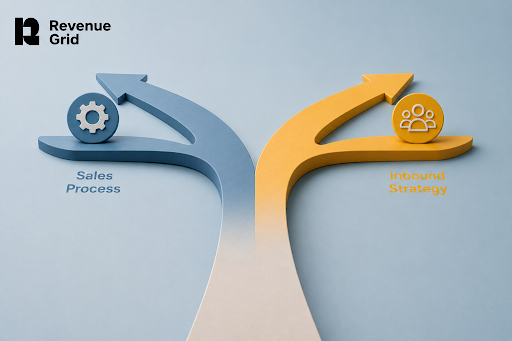
Key Takeaway
- Sales process: your repeatable playbook for closing deals efficiently
- Inbound strategy: adapts to buyers' journeys for higher conversion rates
- The best approach combines structured processes with buyer-centric strategy
- Revenue Grid empowers both approaches with actionable insights and automation
- Choose your emphasis based on buyer awareness, team maturity, and sales complexity
- Sales Process Definition
- Inbound Sales Strategy Definition
For B2B SaaS sales leaders and revenue operations teams, understanding the difference between a sales process and an inbound sales strategy is crucial for driving predictable growth. While a sales process involves steps a salesperson takes to convert a prospect into a paying customer, an inbound sales strategy focuses on identifying people who are already aware of their need for a product like yours and meeting their specific needs.
Different sales teams can have different sales processes depending on their goals, products, resources, and working styles. But they might still apply the same inbound sales strategy.
Apart from that, a sales team traditionally designs their sales process to try to close deals as fast as possible. When applying an inbound sales strategy, you do things differently. You define the buying journey and analyze specific buyers’ needs first, and then create a customized experience that proves your offering is the right solution and simplifies purchase decisions.
Key Differences Between Sales Process and Inbound Sales Strategy
The following table summarizes the core distinctions between these two approaches:
| Aspect | Sales Process | Inbound Sales Strategy |
| Focus | Internal steps and activities | Buyer journey and needs |
| Approach | Standardized, repeatable steps | Personalized, adaptive engagement |
| Primary Goal | Close deals efficiently | Attract and nurture qualified prospects |
| Timing | Salesperson-driven pace | Buyer-driven timeline |
This comparison shows how sales processes provide structure while inbound strategies provide buyer alignment.
What Is a Sales Process?
A sales process is a series of repeatable steps a sales rep takes to turn an early-stage lead into a new customer. Each step in a sale process may include several selling activities, helping reps achieve sales goals. Because of that, a sales process can be considered a roadmap and guide for salespeople.
Typically, a sales process consists of eight steps:
Common Steps in a Sales Process
1. Preparation
- Preparation: Learn about your project, target customers, competitors, and industry.
2. Prospecting
- Prospecting: Find potential customers from sources like your CRM database, social media, meetups, conferences, online search, etc.
3. Research & Lead Qualification
- Research: Determine true prospects who actually need what you’re selling.
4. Approach
- Approach: Identify ways you can approach your prospects.
5. Presentation & Demo
- Presentation: Pitch your product through an in-person meeting, an online demo, or a phone call.
6. Objection Handling
- Objection handling: Answer questions and handle objections as well as rejections.
7. Closing
- Closing: Send a proposal or quote covering the tailored solution you’re offering and finalize the deal.
8. Follow-up
- Follow-up: Nurture customers after the first sale to maintain relationships with them. This step can involve upselling, asking for referrals, or collecting feedback.
A good sales process should be goal oriented, clearly defined, replicable, and measurable. It should also be flexible enough to accommodate changes in sales operations, tech stacks, and business climates.
💡 Pro Tip: For enterprise B2B sales, your process should include multiple stakeholder touchpoints and account for longer decision cycles typical in complex deals.
What Is an Inbound Sales Strategy?
An inbound sales strategy is a buyer-centric sales approach that prioritizes individual customers’ needs and pain points. You focus on finding what people are suffering from and adapt your sales process to their buying journey. Your goal is to create personalized buying experiences for your customers.
Common Stages in the Inbound Sales Journey
In inbound sales, a buyer’s journey has three core stages:
Awareness Stage
- Awareness: A person is aware of their problem and decides to find a solution. At this stage, prospects are researching their challenges and exploring potential approaches.
Consideration Stage
- Consideration: The person considers various options. Buyers are now evaluating different solutions, vendors, and implementation approaches.
Decision Stage
- Decision: The person determines a product that fits their need and makes a purchase. Final selection is made based on fit, value, and trust established throughout the journey.
With an inbound sales strategy, you identify prospects who are already actively buying—in other words, qualified leads. Then, all you need to do is create hyper-personalized messages to approach and push them towards your desired action. That’s what makes an inbound sales strategy an effective way to get more customers and more sales.
💡 Pro Tip: In B2B SaaS, inbound prospects who engage with your content are 3x more likely to convert than cold outbound leads.
When to Use a Sales Process vs. Inbound Sales Strategy
Understanding when to emphasize each approach can significantly impact your sales results:
Use a Traditional Sales Process When:
- You have a new sales team that needs structure and consistency
- Your product requires extensive education or demonstration
- You’re in a market with low buyer awareness
- Time-to-close is critical for cash flow
Use an Inbound Sales Strategy When:
- Your buyers are already researching solutions online
- You have strong content marketing and lead generation
- Your sales cycle is complex with multiple stakeholders
- Customer lifetime value is high and worth the investment in personalization
How Revenue Grid Empowers Both Approaches
Revenue Grid’s platform unifies your sales process and inbound strategy, giving your team actionable insights at every stage. From automated activity capture to AI-driven deal guidance, we help you close more deals, faster.
Whether you’re following a structured sales process or adapting to inbound buyer journeys, Revenue Grid provides the data and automation you need to succeed in complex B2B sales environments.
Ready to implement both approaches at scale? Book a personalized demo with our sales enablement experts.
What is the main difference between a sales process and inbound sales strategy?
A sales process is your step-by-step playbook for converting prospects into customers, while an inbound sales strategy focuses on attracting and nurturing buyers who are already aware of their needs by aligning with their journey.
When should you use a sales process versus an inbound sales strategy?
Use a traditional sales process when you need structure and speed, especially with new teams or low buyer awareness. Use inbound strategy when buyers are already researching solutions and you have strong content marketing capabilities.
Can you use both a sales process and inbound sales strategy together?
Yes, the most effective B2B sales teams combine both approaches. They use a structured sales process as their foundation while adapting their engagement strategy to match where prospects are in their buying journey.