


Key Takeaway
- Revenue orchestration is the unified coordination of sales, marketing, and customer success activities through a single platform that captures data automatically, surfaces AI-powered signals, and drives consistent execution.
- Forrester coined the "Revenue Orchestration Platform" category in Q1 2024; Gartner validated it with "Revenue Action Orchestration" in December 2025.
- Current ROPs are primarily sales orchestration platforms — expansion into customer success and retention remains a major capability gap.
- 95% of revenue orchestration implementations fail because organizations start with technology instead of business objectives, ignore change management, or attempt orchestration on top of dirty CRM data.
- Revenue orchestration success requires a crawl-walk-run approach: fix data capture first, add intelligence second, orchestrate third.
- Salesforce-native architecture, transparent pricing, and automatic activity capture are the evaluation criteria that separate vendors with real value from those with marketing claims.
You know that moment when your revenue stack looks “fully loaded,” yet your pipeline still feels shaky.
Sales is working deals in one place. Marketing is tracking intent in another. RevOps is keeping Salesforce clean, one field at a time. Forecast calls still turn into a Friday fire drill. The problem is rarely effort. The problem is coordination.
Salesforce research shows reps spend only 28% of their time actually selling, the rest lost to admin, internal updates, and chasing context. Sales-marketing misalignment costs $1.1 trillion annually in lost productivity. And 93% of sales leaders cannot forecast within 5% even with two weeks left in the quarter.
These are not minor inefficiencies. They shape cycle length, conversion, and forecast reliability. Revenue orchestration exists to make execution consistent. It connects revenue signals to workflows across sales, marketing, and customer success. It keeps teams aligned in the tools they already use, so momentum does not rely on manual follow-ups.
This guide breaks down what revenue orchestration is (and what it is not), how it works in Salesforce-first orgs, what to look for in a platform, and how to roll it out without creating another tool mess.
What is revenue orchestration (and what it is not)
At its core, revenue orchestration is the coordination of revenue work across sales, marketing, and customer relationships through a single system of execution. It connects signals from your revenue stack to the actions teams need to take next. It also makes those actions repeatable, measurable, and harder to ignore.
In simple terms, it merges data from various sources and systems, such as CRM, buyer signals, and proprietary data, to create a unified, comprehensive view that enhances decision-making and sales alignment.
Forrester created the Revenue Orchestration Platform (ROP) category in Q1 2024.
Their definition: “Technology that enables B2B frontline resources to design, execute, capture, analyze, and improve buyer and customer engagement while optimizing productivity and internal revenue processes.”
Gartner validated the category nine months later with their first Magic Quadrant for Revenue Action Orchestration.
The convergence that created this category
Three previously distinct categories merged into revenue orchestration platforms:
- Sales engagement platforms (Outreach, Salesloft) that automated multi-channel outreach sequences
- Conversation intelligence platforms (Gong, Chorus) that recorded and analyzed sales calls
- Revenue intelligence platforms (Clari, BoostUp) that aggregated pipeline data and improved forecasting
As Forrester analyst Anthony McPartlin explained in the Operations podcast: “No one set out to create this category. These vendors each had unique entry points and converged into ROPs organically.” Gong started with call recording and expanded into engagement. Outreach started with sequences and added intelligence. Clari started with forecasting and acquired engagement capabilities. The result is a new “supergroup” where platform boundaries have dissolved.
Revenue orchestration vs. revenue operations vs. revenue intelligence
These terms are frequently confused. The distinctions matter for vendor evaluation and technology planning:
- Revenue Operations (RevOps) is a business function. RevOps teams align sales, marketing, and customer success around shared goals, metrics, and processes. Technology supports RevOps; it doesn’t replace it.
- Revenue Intelligence describes platforms that aggregate activity data to surface insights: pipeline health, deal risk, forecast accuracy. These platforms tell you what’s happening but don’t execute actions.
- Revenue Orchestration encompasses both intelligence and action. The platform captures data, generates actionable insights, and executes responses: automated sequences, guided selling prompts, real-time alerts, within a unified workflow.
See how AI guided-selling works:
The critical distinction: Revenue intelligence platforms require humans to act on insights. Revenue orchestration platforms take action or enable action within the same system where insights surface.
Why revenue orchestration exists
Revenue orchestration platforms exist because the alternative: operating with fragmented tools across disconnected teams, has become economically unsustainable.
This shows up in four patterns that repeat across almost every revenue org:
- The pipeline looks healthy, but deal momentum says otherwise. A deal can sit in the right stage with the right close date and still be dead. The warning signs show up outside Salesforce first: meeting cadence drops, responses slow, stakeholders disappear. Most teams catch this late because signals surface in silos. By unifying buyer engagement and customer interaction data, revenue orchestration platforms provide early warning signals that help teams proactively address pipeline risks.
- Marketing creates demand, but sales misses the timing. An account visits a pricing page, attends a webinar, downloads a buyer guide. Sales follows up days later with a generic email because context is scattered across tools. The buyer does not wait. Orchestration fixes speed and context by pushing the right signal to the right person before the moment disappears.
- CRM hygiene depends on discipline, and discipline does not scale. Salesforce becomes unreliable when updates depend on memory. Reps spend only 28% of their time selling, the rest goes to admin and coordination. Orchestration reduces that burden by capturing activity automatically and keeping the system of record closer to reality.
- Execution breaks at handoffs. SDRs qualify a lead, then AEs restart discovery. Sales closes a deal, then CS begins onboarding with incomplete notes. Every reset costs time and trust. Revenue orchestration standardizes handoffs through shared workflows and enforced context, so “starting over” stops being the default. These platforms also streamline related revenue processes, ensuring seamless transitions between teams and reducing friction throughout the revenue lifecycle.
What many organizations call “forecasting” is actually a ritualized process where numbers are negotiated, massaged, and emotionally agreed before they are analytically validated. Revenue orchestration platforms address this by replacing subjective inputs with objective, automatically-captured activity data.
Must-have features in revenue orchestration solution
Most platforms will claim they “orchestrate revenue.” The difference is whether they actually remove the failure modes you just read, or whether they add another layer of reporting.
A comprehensive solution should deliver repeatable and consistent outcomes, improve operational efficiency, and support consistent growth by combining AI insights with human expertise to streamline workflows and ensure predictable results.
This section is your buying checklist. Each capability below maps to a real operational pain. If a vendor cannot show it working in a Salesforce-first environment, treat it as a red flag.
1) Automated activity capture that keeps Salesforce honest
Manual logging does not scale. It creates blind spots, delays, and messy pipeline inspection. A modern platform should capture emails, meetings, attendees, and key engagement data with minimal rep effort. It should also write back cleanly into Salesforce without creating duplicates or breaking reporting.
What to look for
- Ability to capture and sync customer data for a unified view and personalized engagement.
- Effective lead management as part of automated activity capture, ensuring leads are routed, assigned, and tracked efficiently.
- Admin controls and auditability.
2) Signal-to-action workflows, not just alerts
Alerts are cheap. Everyone already has too many. Orchestration means signals trigger owned actions. Deal risk should route to the manager. A stalled opportunity should trigger a play. Stakeholder drop-off should trigger multi-threading.
What to look for
- Next-best action guidance that provides real-time, role-aware recommendations to sellers.
- AI-driven insights that help teams refine sales strategies based on behavioral signals and intent data.
- Ability to manage the underlying processes supporting engagement, ensuring workflows are coordinated and effective.
- Configurable triggers tied to your sales process.
- Clear ownership and escalation.
3) Deal health based on behavior, not stage labels
The stage is self-reported. Behavior is harder to fake. A real revenue orchestration platform should assess deal health based on engagement patterns, stakeholder coverage, meeting cadence, and activity quality.
What to look for
- Analysis of sales reps’ performance and engagement patterns, including how they close deals and follow up on leads within the revenue orchestration process.
- Integrated sales coaching features that help sales reps improve their own engagement and deal outcomes as part of a unified revenue orchestration platform..
4) Guided execution for reps and managers
Execution breaks when “best practices” live in a playbook nobody opens. Guided workflows surface the next step in context. That is how you reduce variability across 50–500 reps without micromanaging.
What to look for
- Contextual nudges in the tools reps already use.
- Manager workflows for inspection and coaching.
- Clear connection between guidance and outcomes.
5) Salesforce-safe writeback and governance
Enterprise orgs do not buy tools that bypass governance. Orchestration must respect permissions, field rules, and audit requirements. This matters for adoption and security reviews.
What to look for
- Role-based permissions and admin visibility.
- Configurable writeback rules.
- Support for custom objects and fields without brittle mappings.
6) Cross-functional routing that reduces handoff leakage
Revenue execution is cross-team by nature. A platform must coordinate handoffs between marketing, sales, and customer success with shared context, not Slack guesswork.
What to look for
- Integrated workflows and data sharing among market teams such as sales, marketing, and customer success.
- Handoff templates that preserve context.
7) AI that improves decisions, not just productivity
AI summaries are useful, but they are not orchestration. AI should prioritize, predict risk, and recommend actions tied to the deal’s reality. It should also be controllable, so teams can trust it.
What to look for
- Predictive signals grounded in your historical outcomes.
- Transparent drivers behind recommendations.
- Guardrails that prevent hallucinated updates in Salesforce.
8) Adoption instrumentation and operational reporting
If you cannot measure usage, you cannot improve it. Orchestration must show whether workflows are being followed, where deals are breaking, and what is changing as a result.
What to look for
- Workflow completion metrics by team and role.
- Visibility into what actions actually move the pipeline.
- Reports RevOps can run without heavy custom builds.
Quick red flags
- “Single pane of glass” that still requires reps to jump between tools.
- AI that cannot explain why it flagged a deal.
- Integration that creates duplicates or delays Salesforce visibility.
- A platform that sells “alignment” without enforcing shared workflows.
If a vendor checks most of these boxes, you are not just buying software. You are buying a system that makes revenue execution consistent across your org.
How a revenue orchestration platform works in Salesforce-first organizations
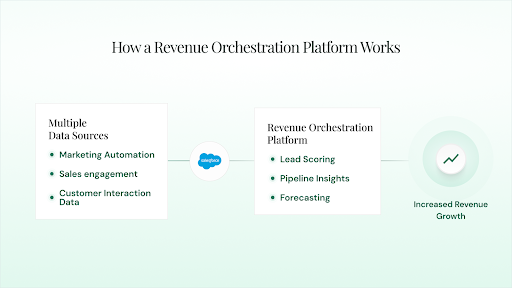
Revenue orchestration connects key data sources to Salesforce to improve scoring, pipeline visibility, and forecasting.
Salesforce is already the system of record for most revenue teams. The problem is not where data lives; it is what happens between updates. Activity data arrives late or incomplete. Reps log meetings after the fact. Signals from calls, emails, and intent tools live outside the CRM. By the time leadership reviews the pipeline, reality has already moved on.
A revenue orchestration platform closes this gap through a simple flow: Capture → Interpret → Act
Capture: Real activity, automatically
The platform captures emails, meetings, attendees, and engagement activity directly from the tools teams already use. This data is written back to Salesforce with rules and governance, without relying on rep memory.
Outcome: Salesforce reflects actual behavior, not best-effort updates.
Interpret: Behavior becomes deal health
Rather than looking only at stage and close date, the platform analyzes patterns:
- Engagement rising or declining
- Stakeholder coverage expanding or shrinking
- Meeting cadence accelerating or stalling
These patterns turn raw activity into leading indicators of deal risk, momentum, and priority.
Outcome: teams see problems earlier, while they are still fixable.
Act: Signals trigger owned workflows
Insights are only useful if they change behavior. Orchestration platforms convert signals into owned actions:
- At-risk deals route to managers for inspection
- Stakeholder gaps trigger multi-threading tasks
- Late-stage deals with weak engagement surface guided next steps
Outcome: execution becomes consistent, not dependent on memory or heroics.
Update: Salesforce stays current with context
As workflows run, Salesforce fields update with supporting context. Forecast views reflect reality faster, while managers inspect fewer deals, but the right ones.
Outcome: pipeline and forecast accuracy improves without increasing admin work.
The core shift is signal-based selling. Buyer and seller behavior drives prioritization and execution.
Example: What this looks like in a Salesforce-native platform

In Salesforce-native orchestration platforms like RevenueGrid, activity from email and calendar tools is captured, evaluated against historical deal patterns, and converted into Revenue Signals and Deal Guidance directly inside Salesforce. The goal is not more alerts, but fewer surprises and clearer next actions.

Here's what we mean by RevenueGrid's deal guidance:
How to implement revenue orchestration without breaking your RevOps stack (30/60/90-day plan)
Revenue orchestration fails when teams try to fix everything at once, layering workflows, dashboards, AI, and handoffs before the foundation is stable. Adoption drops, trust erodes, and Salesforce gets blamed.
So, roll it out one motion at a time, and prove behavior change before you scale. Here’s a standard plan:
Days 0–30: Make Salesforce data harder to lie with
Start with activity capture and clean writeback.
Emails, meetings, attendees, and notes must land in Salesforce consistently, without relying on rep memory. Weak foundations amplify bad data, especially once automation and AI are layered on.
This phase will expose governance gaps, inconsistent stage definitions, opinion-based forecasts, unnecessary fields. Fix them now.
Success signal: measurable improvement in activity completeness and reduced manual logging within 30 days. Your CRM should reflect reality more consistently.
Days 31–60: Pick one execution motion and make it repeatable
Do not launch ten workflows. Prove one.
Choose a high-impact motion, typically late-stage risk. Define risk using observable behavior signals, stakeholder drop-off, slipped close dates, declining meeting cadence. Route risk to a clear owner and track whether the corrective action happens.
Managers should feel the shift first. Pipeline reviews become targeted. Coaching focuses on intervention, not cleanup.
Success signal: fewer stalled late-stage deals and measurable completion of risk workflows.
Days 61–90: Extend orchestration across handoffs and teams
Once one motion works, expand deliberately.
Connect marketing, sales, and customer success workflows. High-intent accounts receive faster, contextual follow-up. Handoffs preserve notes and stakeholder context instead of restarting discovery.
Governance tightens here. Permissions, writeback rules, and escalation paths must remain controlled as surface area grows.
Success signal: reduced handoff friction, faster response times, and lower forecast variance across teams.
The role of AI in revenue orchestration (what actually works in 2026)
AI is no longer the differentiator. Operationalizing AI is.
Most revenue teams already have call summaries, email insights, and “next steps” floating in tools. Execution still breaks because insights do not consistently convert into owned action. RevOps ends up chasing reps for updates. Leaders end up chasing a forecast that is always slightly behind reality.
This is where orchestration changes the role AI plays. It turns AI from “information” into “intervention.”
AI prevents forecast surprises by catching the behavior shift
Late-stage deals rarely fail because one email went unanswered. They fail because momentum quietly changes. Meetings drop. Stakeholders disappear. Response time slows. Close dates move.
In a Salesforce-first org, those signals show up in email and calendars before they show up in pipeline stages. A strong orchestration layer uses AI to detect the pattern early, flag the deal, and trigger a workflow. The point is not prediction. The point is prevention.
Salesforce research keeps the context honest: reps spend only 28% of their week actually selling, with the rest going to admin and other work. That is why “more manual inspection” is not a strategy. It is a tax.
AI prioritizes the right work when everything feels urgent
Reps do not struggle because they lack tasks. They struggle because too many deals look equally important on paper.
Orchestration makes AI useful by tying prioritization to execution. A risk signal should route to a manager. A stakeholder gap should trigger a multi-threading task. A proposal with no follow-up should trigger a time-bound action. This is the difference between “AI insights” and revenue control.
A recent Jan 2026 sales automation guide captures the practical direction: AI should recommend next-best actions, trigger pipeline alerts, and deliver just-in-time coaching, so reps can focus on high-impact selling work.
AI fails fast when the data foundation is weak
AI can only be as reliable as the CRM data it builds on. That sounds obvious. Most teams still underestimate it.
Validity’s 2025 research found 76% of organizations say less than half of their CRM data is accurate and complete, and 37% reported losing revenue directly due to poor data quality. AI layered on top of that does not create truth. It amplifies noise.
This is why orchestration platforms that automate activity capture and enforce clean writeback into Salesforce matter more than flashy AI demos.
Just like RevenueGrid’s AI mentor:
The Bottom Line for Revenue Leaders Making This Decision
Revenue orchestration is no longer optional for B2B organizations seeking predictable growth. The 5% of companies achieving “future-built” status with integrated AI-powered orchestration deliver 1.7x revenue growth and 1.6x EBIT margins. The gap between leaders and laggards will only widen as AI capabilities mature and data-driven competitors move faster.
Start with data, not dashboards. Start with reps, not reports. Start with one workflow, not a transformation. The organizations pulling ahead aren’t implementing revenue orchestration as a technology project; they’re executing it as a business discipline with clear P&L accountability.
The question is whether to do it with a $500/user/month Frankenstack or a unified platform with transparent pricing and Salesforce-native architecture.
Revenue Grid brings revenue orchestration inside Salesforce, starting at $30/user/month for Activity Capture 360. Named a Major Player in IDC MarketScape’s 2024 Revenue Intelligence assessment, RevenueGrid combines automatic data capture, AI-powered signals, and True Pipeline visibility in a Salesforce-native platform that deploys in weeks, not months.
Book a demo to see how it works.
What is revenue orchestration?
Revenue orchestration is the coordination of revenue work across sales, marketing, and customer success through a unified platform. It connects signals from your revenue stack to owned actions, capturing data automatically, surfacing AI-powered insights, and driving consistent execution in the tools teams already use.
How does revenue orchestration differ from revenue operations?
Revenue operations is a business function that aligns teams around shared goals. Revenue orchestration is the technology layer that executes that alignment, automating data capture, routing signals to owners, and enforcing consistent workflows. RevOps defines the strategy; orchestration makes it repeatable.
What is the difference between revenue orchestration and revenue intelligence?
Revenue intelligence platforms surface insights about pipeline health and deal risk. Revenue orchestration platforms convert those insights into action, triggering workflows, routing tasks to owners, and tracking completion. Intelligence tells you what’s happening; orchestration makes sure the right response happens.
Why do most revenue orchestration implementations fail?
Three primary reasons: starting with technology instead of business objectives, ignoring change management, and attempting orchestration on dirty CRM data. Success requires defining outcomes first, managing organizational change, and fixing data capture as the foundation before adding intelligence and automation.
What are the must-have features in a revenue orchestration platform?
Seven capabilities matter most:
- Automated activity capture,
- Signal-to-action workflows with ownership,
- Behavior-based deal health scoring,
- Guided execution for reps and managers,
- Salesforce-native architecture,
- Cross-functional handoff routing, and
- AI that recommends actions, not just surface insights.
How long does it take to implement revenue orchestration?
A phased approach works best.
- Days 0-30: implement activity capture and fix data foundation.
- Days 31-60: prove one execution motion (typically late-stage risk).
- Days 61-90: extend to cross-team handoffs. Full value realization typically occurs within 90 days, with initial productivity gains in the first month.
What is the ROI of revenue orchestration?
Organizations with effective orchestration report 1.7x revenue growth and 1.6x EBIT margins. Specific outcomes include 4-5 hours saved per rep weekly, 20-25% improvement in forecast accuracy, and measurable reduction in late-stage deal slippage. Forrester TEI studies document 300%+ ROI with payback under six months.
How does AI work in revenue orchestration platforms?
AI detects patterns humans miss: engagement drops, stakeholder changes, timing shifts, and converts them into prioritized actions. It recommends next-best steps, predicts deal risk, and triggers workflows automatically. The key is AI that improves decisions, not just productivity.
Why does Salesforce-native architecture matter?
API-based integrations introduce delays, duplicates, and brittle field mappings. Salesforce-native platforms write activity directly to CRM objects in real-time, respect permissions and governance, and make data immediately reportable using standard Salesforce analytics. Native architecture also simplifies security reviews and accelerates adoption.
How do I evaluate revenue orchestration vendors?
Focus on six criteria:
- CRM-native vs. CRM-adjacent architecture,
- Data capture completeness,
- AI maturity,
- Time to value,
- Total cost of ownership (not just per-seat), and
- Full-lifecycle coverage.
Watch for red flags: platforms requiring reps to jump between tools, AI that can’t explain its flags, and integrations that create duplicates.