

Key Takeaway
- Revenue lifecycle management is an operating model. The goal is to get every revenue-touching team (marketing, sales, CS, finance) working off the same data, the same handoffs, and the same view of every account.
- Most revenue leakage doesn't happen because of bad deals. It happens in the gaps between teams where context gets lost, renewals get missed, and expansion signals go unnoticed because nobody owns the full picture.
- Connecting your systems solves the infrastructure problem, not the data problem. If the activity flowing into those systems is incomplete, your health scores, forecasts, and handoffs will all be working from a partial picture.
- The five RLM platforms covered here (Salesforce Revenue Cloud, Zuora, Chargebee, DealHub, Conga) each cover different parts of the lifecycle. The right choice depends on your billing model, CRM ecosystem, and how much of the process you need to automate.
- Relationship data is the variable most RLM platforms don't capture on their own. Pipeline stage and contract dates tell you what was logged, not whether the relationship is strong enough to actually close, renew, or expand.
We often think about revenue in pieces. Marketing brings in leads. Sales closes deals. Account management handles renewals. Finance takes care of invoicing. Each team does its part.
But when they don’t operate as one connected unit, the problems start. If a sales rep closes a deal but doesn’t pass along what the customer actually cares about, onboarding fails. Small misses like that add up over a quarter, a year, and eventually show up in your revenue numbers in the form of revenue leakage, missed renewal opportunities, and declining customer lifetime value.
Revenue lifecycle management (RLM) solves such problems. RLM involves understanding the customer lifecycle from beginning to end, identifying key moments of opportunity, and optimizing each step in the process to drive predictable revenue growth. RLM empowers companies to optimize every stage of their revenue processes, delivering measurable gains in customer engagement, operational efficiency, and profitability through data-driven decision-making.
In this blog, we’ll break down what revenue lifecycle management actually is, why it matters for sales teams and sales leaders, and how you can start bringing it into your organization.
What Is Revenue Lifecycle Management?
Revenue lifecycle management is a way of running your revenue operations where every team (marketing, sales, customer success, finance) works off the same system, the same customer data, and the same playbook across the entire customer journey. It spans the full revenue cycle, from lead generation and customer acquisition through contract creation, order management, subscription management, renewal processes, and post-sales support.
Without it, each team tracks its own metrics, uses its own tools, and makes decisions based on incomplete information. Sales doesn’t know what marketing promised. Customer success doesn’t know what the sales team sold. Finance doesn’t know why a customer churned. Everyone is doing their job, but nobody has the full picture.
Key components of RLM include customer journey management, automation of revenue processes, and data integration across various systems to ensure seamless collaboration and visibility into revenue operations. A successful RLM strategy also requires deep integration with ERP systems to ensure financial accuracy, compliance, and end-to-end visibility. This supports real-time revenue recognition and reduces errors in order-to-cash processes.
Signs You Need Revenue Lifecycle Management
If any of these sound familiar, you’re likely operating without a real revenue lifecycle strategy:
- Your sales reps spend the first 10 minutes of every call looking for context that should already be in the CRM
- Renewals sneak up on your team because nobody tracks contract timelines in one place
- Handoffs between sales and CS lose critical context, and customers have to repeat themselves
- Your revenue forecast is really just a pipeline forecast, it doesn’t account for churn risk, downgrades, or expansion potential
- Contacts go dark, and nobody notices until the renewal conversation falls flat
- Your teams rely on different tools and dashboards, and nobody agrees on the numbers
With revenue lifecycle management, you create a single view of every account: how they came in, what they bought, how they’re using the product, when their contract is up, and where the next revenue opportunity sits.
The obvious step to solve for revenue lifecycle management is simple: connect your CRM, billing platform, CS tools, and finance systems. But wiring your tools together only solves the infrastructure problem. It doesn’t solve the data problem. If what’s flowing through those connected systems is incomplete or outdated, you can still end up with health scores that miss churn signals, forecasts that come in short, and handoffs where critical context disappears.
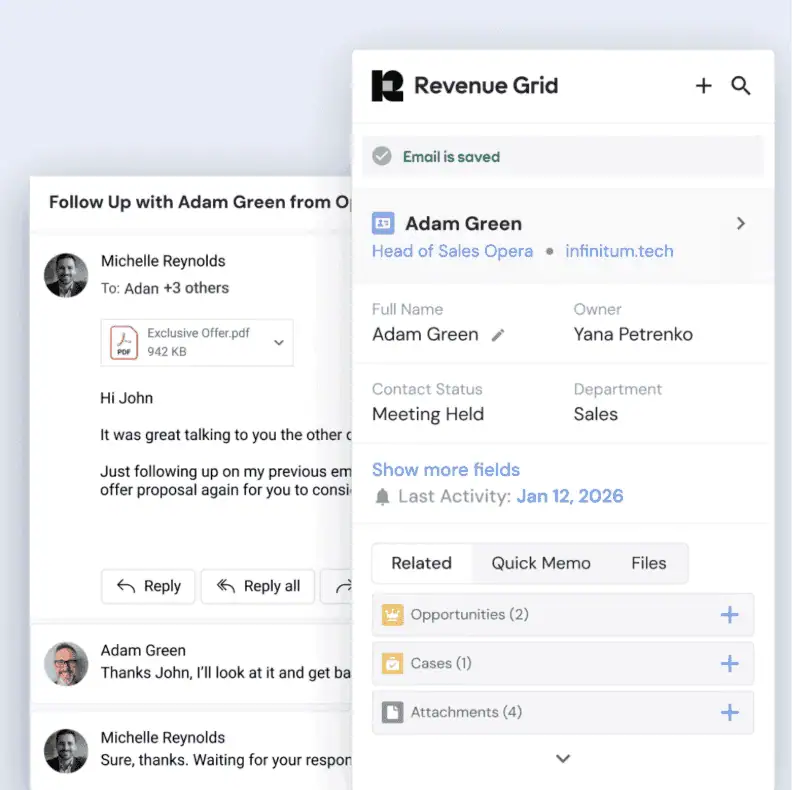
Revenue lifecycle management only works when the data feeding your systems is accurate, complete, and current. This is the gap Revenue Grid fills, capturing and syncing every customer interaction into Salesforce without anyone on your team changing how they work, so every system in your revenue lifecycle is always running on the full picture.
What Is the Role of a Revenue Lifecycle Management Team?
A revenue lifecycle management team doesn’t replace your sales, marketing, or CS teams. It connects them. It owns the process layer that sits across all revenue functions and makes sure they operate as one system instead of separate departments that happen to share a revenue target.
Building a Single Source of Truth
In most companies, customer data about the same account lives in five different tools and none of them agree with each other. Your CRM shows one version of the account, your billing platform shows another, and your CS tool tells a different story entirely. RLM software integrations consolidate data from across the organization, creating a single source of truth for revenue-related activities, enabling real-time visibility into sales performance and customer behavior.
When an AE opens an account, they should see the full history: which campaigns were sent, what content the prospect engaged with, what was discussed during the sales process, what support tickets exist, and when the contract comes up for renewal. A CSM logging into the same account should see the exact same thing, the full relationship history that shows how the account has actually been managed.
Designing the Handoffs
One of the places revenue quietly slips away is in the transitions between teams from marketing to sales, from sales to onboarding, from CS to the renewal conversation.
Marketing qualifies a lead based on engagement scoring, but sales gets no context on what the prospect actually cares about. So discovery starts from zero, and the lead loses interest. Or sales closes a deal, but onboarding never learns that the customer has a hard go-live deadline in three weeks. Implementation drags, and the relationship starts on the wrong foot.
What makes these handoffs especially difficult is that it’s not just process context that gets lost, it’s also the relationship. The AE spent weeks building trust with a champion, navigating objections, learning what matters to the buying committee. But none of that lives anywhere the CSM can find it. So the next team inherits the account but not the relationships, and the customer feels like they’re starting over. This directly impacts customer satisfaction and customer retention.
The revenue lifecycle team designs the rules, triggers, and automated workflows that make these handoffs seamless.
Tracking Revenue Signals Across the Journey
The revenue lifecycle team doesn’t just look at the sales pipeline or bookings. They monitor what’s happening after the sale because that’s where retention and growth revenue live. By analyzing behavioral data and segmentation insights, businesses can anticipate customer needs, deliver timely offers, and create value at each touchpoint, resulting in higher retention and customer lifetime value.
They track product usage patterns and flag accounts where adoption is dropping. They monitor onboarding timelines and escalate when implementation falls behind. They watch for expansion signals (new users being added, feature requests, growing usage) and route those to the right rep at the right time. They keep an eye on renewal timelines so conversations start early, not sixty days before a contract expires when it’s already too late.
Apart from product signals, engagement signals matter too. How often are contacts responding to emails? Are meetings getting rescheduled or skipped? Has a key stakeholder gone quiet? These are often the earliest warning signs that something is off. A customer can be using the product daily and still be evaluating competitors. The relationship data tells you what the usage data can’t.
Owning Forecast Accuracy
In most companies, the revenue forecast is built from whatever sales say will close this quarter. But that’s only new business. It doesn’t account for the customer who’s likely to churn next month, the three accounts sitting on expansion opportunities, or the renewal that’s about to downgrade because nobody followed up on a support escalation.
The revenue lifecycle team brings all of these inputs together like new pipeline, existing customer health, renewal timelines, expansion likelihood and builds a revenue forecast that reflects the full picture, not just what’s coming in the front door. This comprehensive view is what enables truly sustainable revenue growth rather than quarter-to-quarter guesswork.
Identifying and Closing Revenue Leaks
Every company leaks revenue. Reduce revenue leakage, and you grow without spending a dollar on new customer acquisition. The revenue lifecycle team’s job is to find those leaks and fix them.
Sometimes it’s a pricing problem, customers sitting on legacy plans paying well below current rates, with no one flagging the gap. Or it’s a process gap where a deal closes without a defined onboarding plan, leading to slow adoption and early churn. By automating key revenue processes, RLM eliminates manual tasks, reduces human error, and accelerates the sales cycle allowing teams to focus on strategic initiatives instead of administrative work.
Key Components of Revenue Lifecycle Management
Effective RLM isn’t a single tool or a single team. It’s a set of interconnected capabilities that together cover the entire revenue lifecycle:
Contract lifecycle management: Covering contract creation, approval workflows, redlining, execution, and renewal processes. Proactive management of contracts helps reduce financial risks and ensures compliance with revenue recognition standards.
Pricing strategies and dynamic pricing: Including tiered pricing, custom pricing, and flexible pricing models that let teams optimize revenue streams based on market demands and customer segments. RLM allows rapid creation, modification, and simulation of pricing models to maximize revenue.
Order management and product catalog management: Ensuring that the entire product portfolio is accurately reflected in quotes, orders, and invoices, with no gaps between what’s sold and what’s billed.
Subscription management: Automating renewals, upgrades, downgrades, and usage-based billing to keep revenue recognition accurate and customers moving smoothly through their lifecycle.
Revenue recognition: Maintaining compliance with ASC 606 and IFRS 15 standards, and ensuring that finance operations reflect the true state of revenue across the business.
Customer engagement and post-sales support: Tracking customer behavior and engagement signals to identify growth opportunities, reduce churn risk, and increase customer satisfaction across the full customer lifecycle.
Top 5 Revenue Lifecycle Management Software
Revenue lifecycle management software is a platform that gives your team one place to track and manage revenue across every stage. Instead of jumping between your CRM for pipeline data, a CS tool for health scores, a billing platform for invoicing, and a spreadsheet for renewal tracking, a revenue lifecycle management platform brings all of that into a single platform.
RLM software enhances operational efficiency by automating key revenue processes such as quoting, contract approvals, and billing — reducing manual tasks and accelerating the sales cycle. RLM software also provides advanced analytics and AI capabilities that help companies predict customer behavior, detect revenue leakage, and identify high-value opportunities, supporting continuous optimization and scalability.
Here are 5 tools worth evaluating.
1. Salesforce Revenue Cloud (Agentforce Revenue Management)
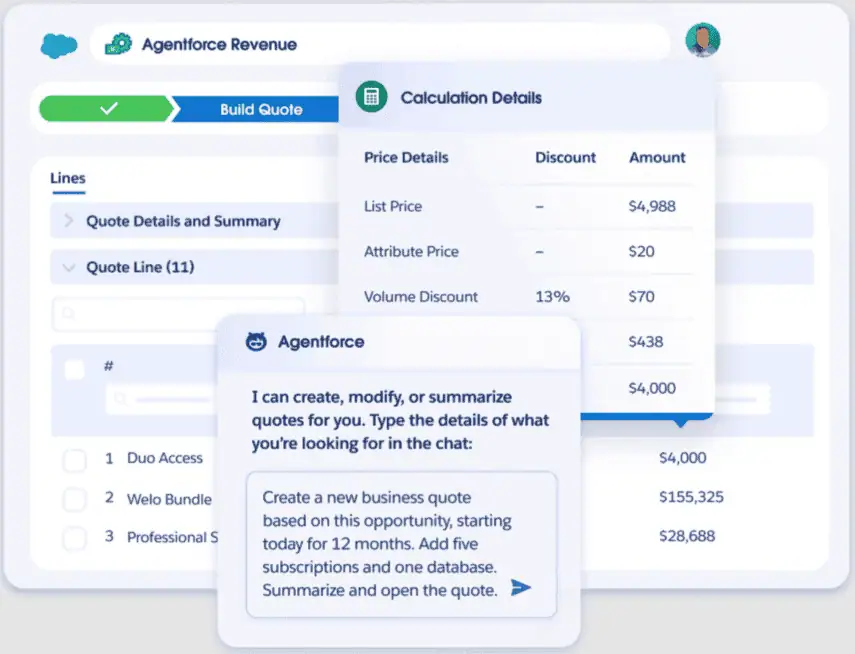
Salesforce Revenue Lifecycle Management is a revenue lifecycle management platform built natively on Salesforce. It connects everything from product catalog management and flexible pricing models to quoting, contract lifecycle management, order management, and invoicing. If your company already runs on Salesforce, this is the most natural fit. The data, workflows, and AI capabilities all live on the same platform your reps and managers are already working in.
Key features:
- AI-powered quoting that lets reps generate, update, and send quotes using natural language. No manual configuration needed
- Constraint-based product configurator that handles complex multi-year deals, ramp pricing, nested bundles, and scheduled uplifts
- Contract lifecycle management with AI-assisted clause generation, collaborative redlining, automated amendments, and pre-approved template libraries
- Asset lifecycle management that tracks every product, service, and entitlement a customer owns, with automated notifications for renewals and amendments
- Order orchestration engine that decomposes complex orders into fulfillment plans and tracks progress in real time
- Billing and invoicing for subscriptions, usage-based pricing, one-time purchases, and hybrid models
2. Zuora
Zuora is an enterprise-grade subscription management and recurring revenue platform used by large enterprises to automate complex subscription billing, revenue recognition, collections, and analytics across global operations. It’s built specifically for companies running recurring, usage-based, or hybrid revenue models and is particularly strong on the finance and compliance side of the revenue lifecycle.

Key features:
- Support for subscriptions, tiered pricing, usage-based billing, and hybrid bundles without manual workarounds
- Automated revenue recognition compliant with ASC 606 and IFRS 15, with configurable rules for any business model
- End-to-end quote-to-cash orchestration covering upgrades, renewals, payments, and lifecycle changes globally
- Pre-built dashboards for MRR, ARR, churn cohorts, and revenue waterfalls
- AI capabilities that surface billing and payment insights to reduce manual data entry and investigation
3. Chargebee
Chargebee is a subscription management and billing platform that automates revenue operations and streamlines the subscription lifecycle. It’s built primarily for SaaS and subscription businesses and sits more on the billing and subscription management side of the revenue lifecycle rather than covering the full quote-to-contract process. For mid-market companies that need strong billing automation without the overhead of a full enterprise platform, it’s a practical choice.

Key features:
- Flexible product catalog supporting flat-rate, tiered, usage-based, and hybrid billing models
- Smart dunning management to recover failed payments and reduce involuntary churn among paying customers
- Automated revenue recognition compliant with ASC 606 and IFRS 15
- Integration with third-party accounting systems like NetSuite, Xero, and QuickBooks for financial reporting and tax compliance
4. DealHub
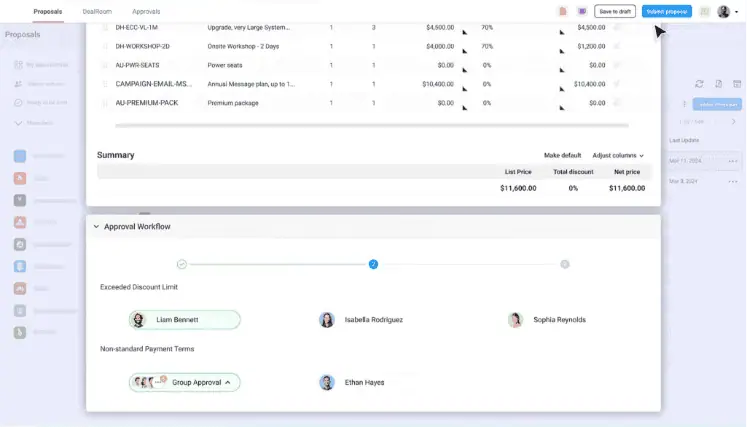
DealHub is a comprehensive quote-to-revenue platform that unifies CPQ, contract management, subscription billing, consumption metering, and automated revenue recognition into a single system. It’s a strong option for companies that want full lifecycle coverage without the implementation complexity of a larger enterprise ecosystem.
Key features:
- AI-assisted pricing optimization, deal insights, and predictive revenue analytics throughout the revenue lifecycle
- No-code implementation that gets teams up and running in weeks without relying on IT or developers
- Native CRM and ERP integration with Salesforce, Microsoft Dynamics, and HubSpot
- Subscription management that automates renewals, recurring payments, upselling, cross-selling, and co-terming
- Digital DealRoom for sending interactive sales proposals with buyer engagement tracking
5. Conga
Conga’s Revenue Lifecycle Management platform is an intelligent, cloud-based software solution that spans every aspect of RLM from CPQ for pricing and quoting, to document automation for business document creation and signature, through to contract lifecycle management. It’s purpose-built for revenue lifecycle management and is particularly strong for companies that deal with complex contracts, document-heavy sales processes, and multi-step approval workflows.
Key features:
- CPQ that automates the quoting process by applying preprogrammed rules for product configurations, pricing models, discount structures, promotions, and dependencies
- Contract lifecycle management that optimizes end-to-end contract processes, including drafting, approval, execution, and renewal
- Document automation that generates customized quotes, proposals, order forms, and invoices directly from structured data
- AI-powered analytics for real-time insights into deal pipelines, revenue forecasting, and contracting trends
- AI-driven contract review that automatically flags high-risk clauses and recommends redlines to secure more favorable terms
Your Revenue Lifecycle Is Only as Good as the Relationships Behind It
Revenue lifecycle management gives you the process including the handoffs, the signals, the forecast model, the single view of every account. That’s the infrastructure. But infrastructure only works when it’s fed the right inputs.
And in revenue, the most important input isn’t pipeline stage or deal size. It’s relationships. Who has a connection with the economic buyer. Whether your champion has gone quiet. Whether the person running the renewal conversation has full context or is starting from scratch. This is the intelligence that determines whether a deal closes, an account renews, or an expansion lands.
Why Relationship Data Is the Biggest Gap in Your Revenue System
Most CRMs track transactions: the opportunities created, stages updated, deals closed. But the relationship layer (the actual interactions between your team and your customers) usually lives outside the system entirely. It sits in email threads, calendar invites, and meeting notes that never get logged. Not because teams don’t care, but because reps are busy selling and CSMs are managing dozens of accounts. So the data stays scattered, and your revenue lifecycle platform ends up running on an incomplete picture. That’s how health scores miss churn signals, handoffs lose context, and forecasts come in short.
How Revenue Grid Fills That Gap
Revenue Grid automatically captures and syncs every customer interaction into Salesforce without anyone on your team changing how they work. No manual processes. No behavior change. Just a complete, continuously updated picture of every relationship across your revenue lifecycle.
- Automatic capture and sync of all emails, meetings, contacts, and documents to the right accounts and opportunities in Salesforce
- New contacts created and associated to records without manual data entry
- Full relationship history and engagement context available to every team, directly inside Salesforce
- Engagement pattern tracking that surfaces which contacts are active, which have gone dark, and how interaction frequency is trending
- Enterprise-grade security built for industries where compliance and data privacy are non-negotiable
With complete relationship data flowing into Salesforce, your handoffs carry full context. Your health scores reflect actual engagement. Your forecasts account for what’s happening inside accounts, not just what was logged. And your entire revenue lifecycle runs on the complete picture it was always supposed to have.
Book a demo to see how Revenue Grid brings full relationship context into your revenue lifecycle.
What's the difference between revenue lifecycle management and CRM?
A CRM tracks transactions from deals created, stages updated, contacts logged. Revenue lifecycle management is broader: it covers everything from lead generation and quoting through contract execution, billing, renewal, and expansion. A CRM is one input into an RLM strategy, not a substitute for it. The gap shows up most clearly post-sale, where CRMs tend to go quiet but the revenue risk is often highest.
Which teams should own revenue lifecycle management?
RLM typically lives under RevOps, but it only works if sales, CS, finance, and marketing are all aligned to it. RevOps owns the process layer: the handoffs, the data flows, the forecast model. Each function contributes its part of the lifecycle. Companies that assign RLM purely to one team without cross-functional buy-in tend to end up with a better-organized version of the same silos they started with.
How do you measure whether your RLM process is working?
The clearest indicators are forecast accuracy, renewal rates, time-to-close, and revenue leakage. If your forecasts are consistently off, handoffs are losing context, or renewals are being caught late, those are process failures that RLM is specifically designed to address. Tracking these metrics before and after implementation gives you the clearest picture of ROI.
Do you need dedicated RLM software, or can your existing tools cover it?
It depends on your revenue model. Teams with simple, low-volume sales processes can often stitch together a CRM, a billing tool, and a spreadsheet and get by. But as soon as you’re managing subscriptions, usage-based pricing, complex contracts, or multi-team handoffs at scale, purpose-built RLM software pays for itself quickly. This primarily occurs by reducing the revenue that quietly slips through manual processes and disconnected systems.