

Key Takeaway
- Establish baseline metrics (close rates, deal size, sales cycle, ramp time, forecast accuracy) before implementing a Conversation Intelligence platform.
- Calculate ROI using three core levers: increased revenue, reduced admin time, and faster new-hire ramp-up.
- Adoption is the biggest determinant of success-CI tools should fit naturally into existing rep workflows with minimal manual effort
- The value of CI extends beyond sales, benefiting marketing, enablement, customer success, and forecasting through conversation data.
- Embed CI insights into pipeline reviews, coaching sessions, forecast calls, and onboarding programs to maximize long-term ROI.
If you are building a business case for a conversation intelligence platform, or defending one that you already use, you need a realistic answer on what kind of return CI (Conversation Intelligence) platform actually produces, and a way to prove that number to a CFO who wants to see the math, not just the multiple.
CI ROI varies meaningfully across companies.
It is based on team size, sales motion complexity, the state of your CRM data hygiene, how willing your management team is to change coaching workflows during the rollout, and how much of the platform actually gets adopted in the first 90 days.
Companies running the same platform routinely land at very different ROI numbers, and both can be right.
This article walks through what you can put in your business case: where CI ROI actually shows up inside a sales organization, how to calculate it against your own baseline rather than against a generic average, and which operational levers move the number once the platform is in place.
How to calculate the ROI of your conversation intelligence platform
The number you want is calculable, but it has to come from your business, not from a vendor calculator filled with industry averages. These three steps get you there:
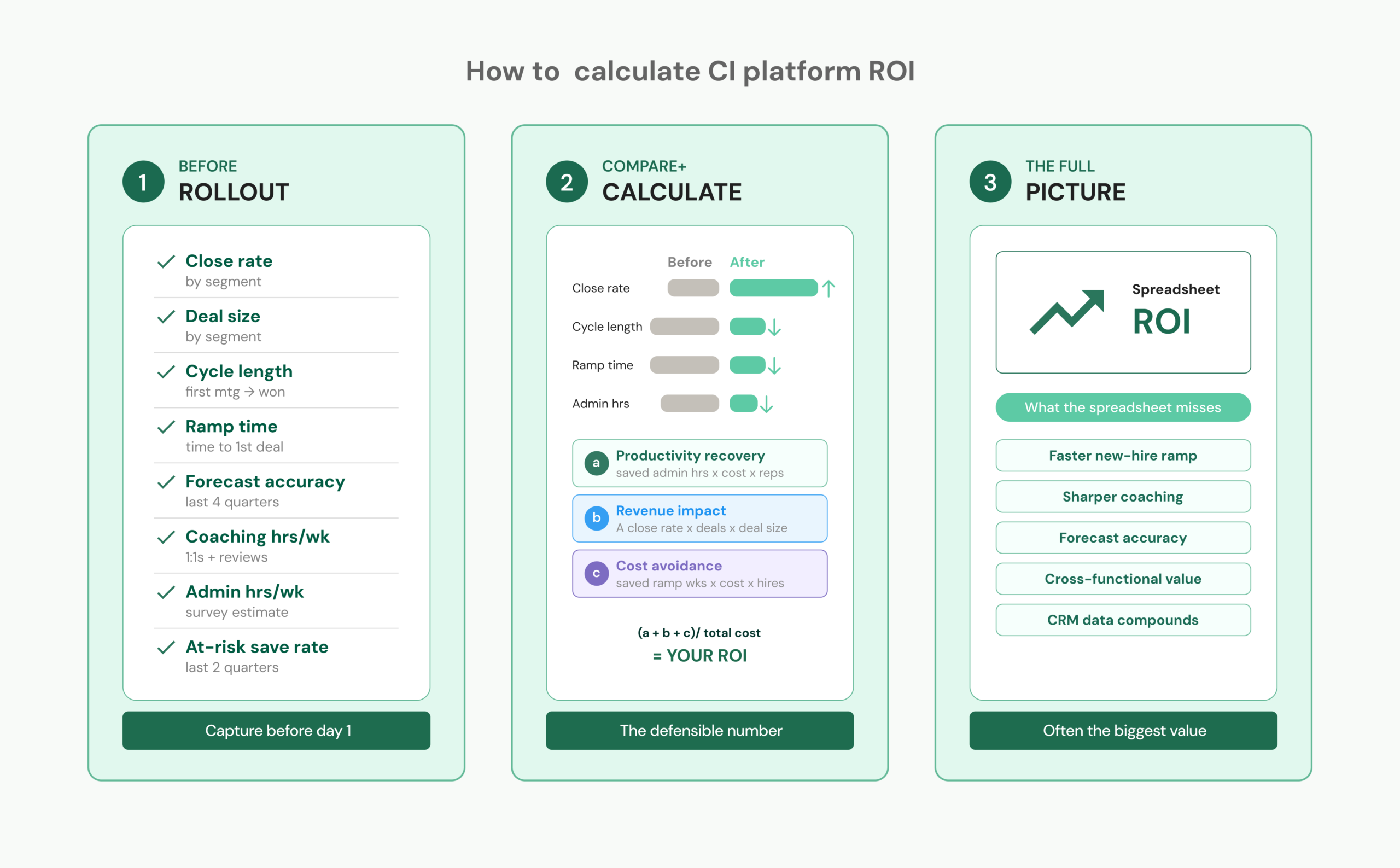 1.Start with your baseline numbers
You can’t measure ROI from a CI platform unless you know what your sales motion looked like before the platform showed up. Write these numbers down before rollout starts.
Here’s the list to capture:
- Average close rate, overall and broken out by segment, if your team sells into more than one
- Average deal size by segment
- Average sales cycle length, from first meeting to closed-won
- Average new-hire ramp time, measured as time-to-first-closed-deal
- Forecast accuracy across the last four quarters (actual revenue compared to what your team predicted at the start of each quarter)
- Sales manager coaching hours per week, across 1:1s and call reviews
- Rep admin hours per week (a team survey estimate is fine here)
- At-risk-deal save rate over the last two quarters
2.Compare the same numbers six months in
Two principles when you re-measure. Give it time, and measure the same way you did at baseline.
CI effects compound. The first 30 days are mostly going to go into tool adoption. Months two and three start to show behavior change. Real deal-level impact shows up at month four or five and stabilizes around month six.
When you’re ready to do the math, three formulas cover most of it.
- a) Productivity recovery = (baseline rep admin hours per week minus current rep admin hours per week) × 50 weeks × fully loaded hourly cost × number of reps
- b) Revenue impact = (current close rate minus baseline close rate) × deals worked × average deal size, applied conservatively. Use 20 to 30 percent attribution if other initiatives ran in parallel, which they always do.
- c) Cost avoidance = (baseline ramp time in weeks minus current ramp time in weeks) × ramp cost per week × number of new hires per year
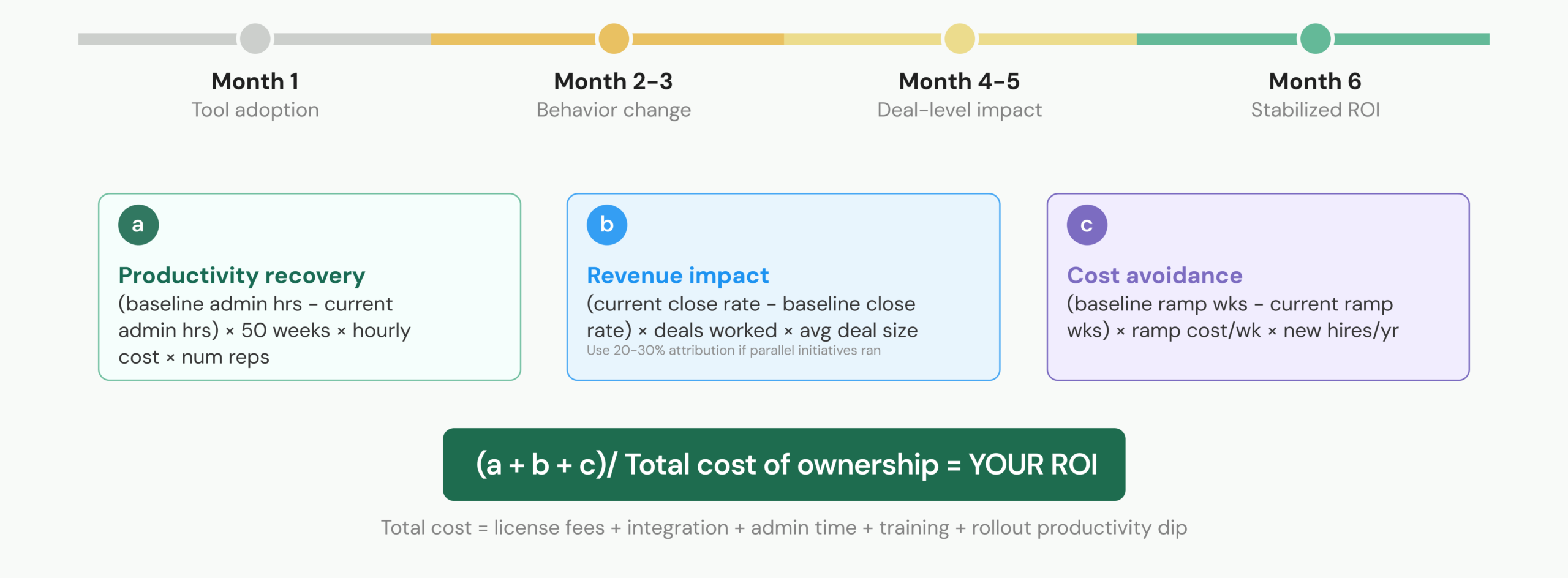
Add the three, then divide by your full cost of ownership. That includes license fees, integration, admin time, training, and the productivity dip during rollout.
3.Layer in the benefits that aren’t on the spreadsheet
The three formulas above will give a number you can defend in the budget meetings. But they don’t capture everything that’s actually changed in your business. Add these to your case as supporting evidence:
- Faster ramp for new hires: Every week shaved off time-to-first-deal flows straight to margin. Track the cohort of reps onboarded after CI rollout against the cohort onboarded before, and the gap is real.
- Sharper coaching at the same cost: Your managers don’t have more hours, but each coaching hour is built on real call data instead of rep self-reporting. Same input, better output.
- Better forecast accuracy: When pipeline data reflects what reps actually did rather than what they remembered to log, predictions get closer to reality. Fewer surprise quarters.
- Cross-functional value: The same transcripts that drive sales coaching also surface competitive language for product marketing, show CS what sales committed to before handoff, and give enablement a library of real customer conversations to train against. None of this appears in vendor calculators, and for some organizations, it’s the largest single source of value.
- CRM data quality compounds: Every other forecasting and analytics workflow you run depends on activity data. When that data goes from 30 percent coverage to near-complete, the lift extends well past CI itself.
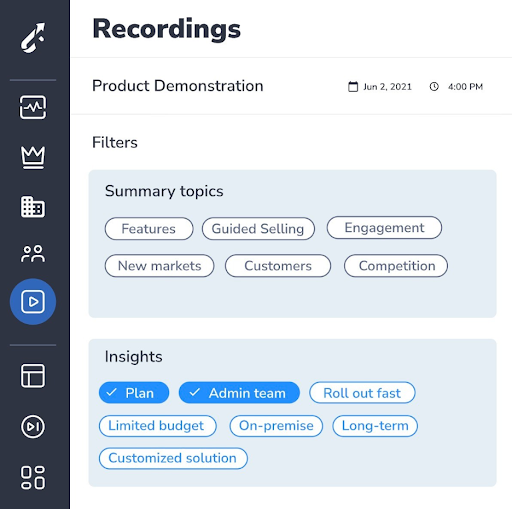
Revenue Grid’s Conversational Intelligence makes the cross-functional layer accessible by extracting topics, keywords, and conversation trends across every captured call. Product marketing can see the actual language buyers use about competitors and pricing without combing through transcripts, and the sales team can pull training libraries by theme without waiting for managers to remember which call covered what.
Your final number won’t be a fixed multiple, and you should be skeptical of anyone who tells you it should be. ROI from a CI platform depends on team size, sales motion complexity, adoption rate, and how much your management team is willing to change coaching workflows alongside the deployment.
How to improve the ROI of your conversation intelligence platform
The work of improving CI ROI happens between rollout and renewal rather than on either of those dates. The levers are mostly operational, and most of them are available without changing the platform or budget you currently have.
Make adoption an architectural problem, not a willpower problem
Partial adoption brings your CI ROI down. When 40%-60% of your team uses the platform consistently, the per-user license cost effectively doubles, and the data feeding every downstream insight is incomplete. Most adoption failures share a root cause: the platform asks reps to do something they were not previously doing, whether that is logging calls, tagging recordings, or opening a separate dashboard to review AI summaries.
Revenue Grid’s Conversational Intelligence is built around this principle. Calls and meetings from Zoom and GoToMeeting are recorded and transcribed automatically, then linked to the right Salesforce Accounts and Opportunities without a rep tagging, uploading, or pressing save.
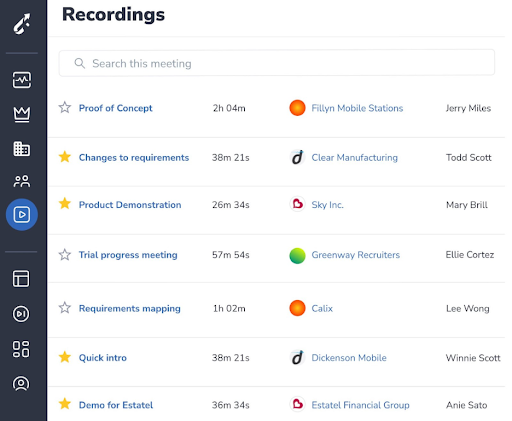
The more the platform runs in the background and the less it asks reps to change their day, the higher the sustained adoption rate becomes.
Feed the engine with full activity data, not just calls
A CI platform that only sees recorded calls misses most of what actually moves a deal forward. In enterprise B2B, the buying process happens largely between scheduled meetings rather than during them. Some examples of what calls in isolation cannot see are:
- The email thread where a champion forwards your deck to the CFO.
- The calendar invite that gets scheduled or a cancelled call when the buying committee shifts.
- The internal back-channel where procurement starts comparing your terms against a competitor’s quote.
- The follow-up question your champions send
The improvement comes from treating call recordings as one input among several others, such as email, calendar, and CRM activity, feeding into the same engine.
This is the architectural decision underneath Revenue Grid’s Conversation Intelligence Platform, where conversation analysis sits on top of complete activity capture rather than on a separate call-recording pipeline.
Train coaching evaluation against your own playbook
Most CI platforms ship with generic coaching benchmarks. These typically include standardized talk-to-listen ratios, filler-word counts, and objection-handling templates that reflect what works on average across the vendor’s customer base. The problem with averages is that your top performers do not match them, and your middle performers cannot operate from them.
Let’s say there’s a senior rep on your team who runs discovery calls at a 65% talk ratio, well above the platform’s recommended 35% benchmark. The generic benchmark flags every one of her calls as a coaching opportunity.
In reality, she is selling to technical buyers who specifically ask her to walk through architecture, and her win rate in that segment is the highest on the team. The signal is not just unhelpful; it is wrong.
Configuring the AI evaluation against your own methodology, your KPIs, and the patterns that actually win in your market shifts the coaching layer from generic to actionable. The standard reflects how your company sells rather than how the average company sells, and the resistance from senior reps drops accordingly.
Build CI data into the workflows you already run
The fastest way to kill CI adoption is to schedule new meetings around it. The fastest way to drive ROI from it is to feed CI data into the cadences your managers already run. The four worth feeding first:
- Pipeline reviews, where deal-engagement signals replace rep self-reporting as the primary input.
- Weekly 1:1s, where call data points to specific coaching moments instead of anecdotes.
- Forecast calls, where activity-backed deal scores support or challenge the rep’s confidence number.
- New-hire ramp reviews, where call libraries from top performers replace passive shadowing as the primary training mechanism.
A common version of this pattern is the pre-meeting brief. Instead of managers spending the first twenty minutes of every pipeline review pulling together rep activity and deal context, the brief is generated automatically and arrives before the meeting starts. The conversation moves from data gathering to decision making.
A short check before your next renewal
If you are already a CI customer weighing renewal, three questions tell you most of what you need to know.
- Are more than 70% of licensed users active in the platform weekly?
- Are managers using CI data inside their pipeline reviews and 1:1s rather than as a separate exercise?
- Has forecast accuracy improved over the last two quarters compared to the two before that?
If two of the three answers are no, the underlying problem is process rather than software, and the next platform will produce the same outcome unless the process changes first.
Choose Revenue Grid to Maximize the ROI of your Conversation Intelligence
If you’re looking for a platform that maximizes ROI on conversation intelligence, you need to look at more than just the recorded calls. Most of what actually moves a deal happens across email, calendar, text, and follow-ups between meetings, and the ROI gets bigger when all of that runs on the same engine.
Revenue Grid’s Conversational Intelligence is built that way.
The CI layer sits on top of an activity-capture engine that also pulls in emails, calendar exchanges, contacts, and CRM activity, so the conversation insights, deal scoring, and coaching signals reflect the whole buyer engagement rather than the recorded call alone.
What you get:
- Automatic recording and transcription, saved to the right Salesforce Account and Opportunity with no rep tagging. It recovers the admin hours that anchor the productivity recovery line, and keeps the data complete so the rest of the ROI math holds up.
- Topic, keyword, and trend analysis across every captured call. Helps you cut the hours product marketing, enablement, and leadership spend listening for signal, and surfaces it before the next pipeline review.
- Deal intelligence that flags at-risk deals and accounts going cold. It lifts deal-save rate by catching slipping deals weeks before the rep notices, which feeds the revenue-impact line of the ROI math.
- Revenue Signals tied to your team’s winning patterns, with coaching configured against your playbook. It drives the coaching-efficiency lift and win-rate move, without the top-performer pushback that generic benchmarks create.
- Searchable call libraries by topic, vertical, or deal stage. Helps you compress new-hire ramp time, the most measurable cost-avoidance category in any CI ROI calculation.
Book a demo to see how Revenue Grid helps you get the most out of your conversational intelligence platform.