

Key Takeaway
- Revenue Grid is the only Salesforce-native platform on this list that bundles engagement, activity capture, pipeline visibility, and AI-driven forecasting into one managed package.
- Outreach and Salesloft (now merged with Clari) remain the enterprise category leaders for high-volume multichannel sequences, though both store engagement data outside Salesforce.
- Gong dominates conversation intelligence and recently expanded into engagement with Gong Engage, though its pricing model (platform fee plus per-user plus add-ons) makes it the most expensive option.
- Apollo.io offers the strongest value for SMB and mid-market teams with its free tier and built-in prospecting database.
- The sales engagement platform you choose is fundamentally a data quality decision: where engagement data lives determines whether your pipeline reports and forecasts are trustworthy.
- CRM integration depth, AI capability tier, compliance posture, and total cost of ownership matter more than feature count.
- The August 2025 Salesloft/Drift breach (700+ organizations compromised) made security and compliance a non-negotiable evaluation criterion.
RevOps leaders evaluating ai-powered platforms for sales engagement face a market where every vendor claims AI capabilities. The actual quality of CRM integration, activity capture, and pipeline impact varies enormously across these tools.
This guide compares 15 sales engagement platforms through a structured evaluation framework built for RevOps teams that care about pipeline data quality, not just outbound email volume.
Each platform is scored on the same criteria, with honest limitations included. Below, you’ll find an evaluation framework, detailed reviews of 15 platforms, side-by-side AI capability comparisons, and a decision guide based on your team type and CRM environment.

Evaluating 15 AI-powered sales engagement platforms across six RevOps-specific criteria: CRM integration depth, AI capabilities, pipeline visibility, compliance, multichannel sequencing, and total cost of ownership.
What Makes a Sales Engagement Platform “AI-Powered” in 2026
The label “AI-powered” appears on nearly every sales engagement software product page. The gap between marketing copy and actual capability is significant. Evaluating any AI sales platform in 2026 requires distinguishing between three tiers of AI integration.
Tier 1 (Surface-level): AI-generated email subject lines, basic send-time optimization, and template suggestions. These are table stakes. Most platforms shipped these features by 2023.
Tier 2 (Workflow-level): AI sequence generation from scratch, AI-powered A/B testing that automatically shifts traffic to winning variants, conversation intelligence with automated call summaries, and AI research agents that enrich prospect data before outreach. This is where the majority of platforms on this list operate.
Tier 3 (Revenue-level): AI that connects engagement activity to pipeline outcomes. Deal risk prediction based on engagement patterns (e.g., “champion went dark for 14 days”). Automated pipeline updates from conversation analysis. AI-driven forecast adjustments. Autonomous agents that execute multi-step workflows without human intervention. Platforms at this level don’t treat engagement and pipeline as separate systems. Instead, they treat engagement data as the foundation for revenue prediction.

Tier 1 covers basic email optimization. Tier 2 adds workflow automation and conversation intelligence. Tier 3 connects engagement signals to pipeline outcomes and forecasting. Most platforms operate at Tier 1-2.
The evaluation framework below uses these three tiers to assess each platform’s AI depth. Tracking these sales engagement trends matters because the gap between Tier 1 and Tier 3 is the gap between AI sales automation as a marketing phrase and AI as an architectural foundation.
How to Evaluate AI Sales Engagement Platforms: A RevOps Framework
Most leaders compare and evaluate sales engagement platforms on outbound email volume and multichannel sequencing. That matters. For RevOps leaders responsible for pipeline accuracy and forecast defensibility, the evaluation criteria look different. The framework below is built for RevOps teams making a platform decision that will affect data quality across their entire revenue stack.
| Criterion | What It Measures |
| Multichannel Sequencing | Email, phone, SMS, LinkedIn, social automation capabilities |
| CRM Integration Depth | Native vs. sync-based architecture, activity capture, custom object support |
| AI Agent & Copilot Capabilities | AI depth from email drafting to autonomous workflow execution |
| Pipeline Visibility & Forecasting | Whether engagement data feeds deal health scores and forecasts |
| Compliance & Security | SOC 2, ISO 27001, GDPR, HIPAA, deployment options |
| Pricing & Total Cost of Ownership | Per-seat cost, platform fees, implementation, tech stack consolidation math |

The six evaluation criteria RevOps leaders should use when comparing sales engagement platforms. CRM integration depth and AI capability tier matter more than feature count.
Industry estimates suggest that without automated activity capture, a significant share of sales activities (some analysts cite 40-60%) never make it into CRM. Salesforce’s own research found that sales reps spend 70% of their time on non-selling tasks, including manual CRM updates (Salesforce State of Sales, 2024). Pipeline reports built on incomplete data are structurally unreliable.
Multichannel Sequencing and Automation Capabilities
The baseline: email sequences, phone/dialer integration, SMS, LinkedIn automation, and social touches. The distinction that matters is between fully automated steps (system sends without rep intervention) and semi-automated steps (system queues the action, rep executes). A/B testing for email content and sequence structure, plus AI-generated email content and personalization, vary significantly across platforms. Every platform on this list offers sales engagement automation through multichannel sequencing. The differentiators are in the five criteria below.
CRM Integration Depth and Activity Capture
CRM integration quality varies enormously across platforms, and this is where most comparison guides fall short. Three integration tiers exist:
- Batch API sync: The engagement platform sends data to Salesforce on a schedule (e.g., nightly or every few hours). CRM data is always 12-24 hours stale.
- Bidirectional real-time sync: Data flows between the engagement platform and Salesforce in real time, though the engagement platform maintains its own data store. Two systems of record.
- CRM-native architecture: The engagement platform is built on Salesforce. Engagement data lands directly in Salesforce as native records, available to standard reports, the API, Process Builder, and Flow without a separate data store.
Sub-criteria worth evaluating: automatic activity capture, custom object support, whether data is stored natively in CRM versus a third-party system, and sync frequency. Einstein Activity Capture, Salesforce’s built-in option, illustrates why this criterion matters. Its default retention window is limited to six months. It doesn’t support custom objects. Captured data is stored on AWS outside Salesforce. It can’t be queried via standard Salesforce APIs or included in standard reports.
AI Agent and Copilot Capabilities
The spectrum of AI capabilities extends well beyond email generation. AI research agents that enrich prospect data before outreach. AI copilots that suggest next-best actions during a sequence. AI agents that autonomously execute multi-step workflows: prospect research, personalized email draft, sequence enrollment, follow-up scheduling. Conversation intelligence integration, specifically whether the platform records and analyzes calls, extracts action items, and feeds insights back into the engagement workflow. Deal intelligence, meaning whether AI surfaces deal risk signals based on engagement patterns. The platforms that score highest on this criterion are the ones where AI is the architectural foundation, not a feature checkbox.
Pipeline Visibility and Forecasting Integration
Engagement data that doesn’t connect to pipeline management and forecasting is siloed data. The best platforms either bundle pipeline visibility and forecasting natively or integrate deeply with dedicated forecasting tools. The core question for RevOps: when a rep runs a sequence and gets a reply, does that engagement signal automatically update the deal’s health score and the forecast? If not, RevOps is back to manually reconciling engagement data with pipeline data, a workflow that undermines both sales engagement strategy and sales engagement metrics accuracy.
Compliance, Security, and Deployment Options
Enterprise and regulated-industry buyers require SOC 2 Type II, ISO 27001, GDPR, HIPAA, and CCPA/CPRA certifications. Deployment flexibility (cloud-only vs. private cloud vs. on-premise) is a non-negotiable criterion for financial services, healthcare, and government-adjacent organizations. The August 2025 breach of Salesloft’s Drift integration (which compromised 700+ organizations including Cloudflare, Palo Alto Networks, and PagerDuty) made compliance posture a deal-qualifying criterion, not a procurement afterthought.
Pricing Model and Total Cost of Ownership
Pricing structures in this category include per-seat/per-user monthly pricing, platform fees (common with Gong and enterprise Outreach deployments), tiered feature access, and annual commitment requirements. Total cost of ownership matters more than per-seat price. A $50/user/month engagement tool plus a $30/user/month activity capture tool plus a $40/user/month conversation intelligence tool may cost more than a $149/user/month unified platform that bundles all three. Some platforms include implementation in the subscription. Others charge $3,000 to $65,000 separately.
15 AI-Powered Sales Engagement Platforms Compared
Every platform on this list offers AI-powered multichannel sales engagement as a core capability, supports B2B sales workflows, and integrates with at least one major CRM. The list includes both standalone engagement platforms and unified revenue platforms with engagement capabilities built in.
| Platform | Best For | AI Depth | CRM Integration | Starting Price |
| Revenue Grid | SF-native enterprise: engagement + pipeline + forecasting | Tier 3 | Native | $30/user/mo |
| Outreach | Enterprise high-volume multichannel sequences | Tier 2-3 | Bidirectional sync | ~$100/user/mo |
| Salesloft (Clari) | Enterprise engagement + forecasting (post-merger) | Tier 2-3 | Bidirectional sync | ~$125/user/mo |
| Apollo.io | SMB/mid-market prospecting + engagement | Tier 2 | Bidirectional sync | Free / $49/user/mo |
| Gong | Conversation intelligence with engagement add-on | Tier 3 | Bidirectional sync | ~$100/user + fee |
| HubSpot Sales Hub | HubSpot CRM-native teams | Tier 2 | Native (HubSpot) | $100/seat/mo |
| Reply.io | Mid-market multichannel with AI SDR agent | Tier 2 | Bidirectional sync | $49/user/mo |
| Instantly | High-volume cold email infrastructure | Tier 1 | Basic sync | $37/mo (account) |
| Klenty | Intent-driven engagement at mid-market pricing | Tier 2 | Bidirectional (5 CRMs) | ~$70/user/mo |
| Mixmax | Gmail-first lightweight engagement | Tier 1-2 | Suite tier only | $29/seat/mo |
| Lemlist | Creative personalization (images, video, pages) | Tier 2 | Native | $79/user/mo |
| SmartReach.io | Budget-friendly multichannel | Tier 1-2 | Native (paid add-on) | $29/mo (account) |
| Regie.ai | AI content layer for existing engagement platforms | Tier 2-3 | AppExchange | ~$35K/yr |
| Mailshake | Simple email-first engagement for small teams | Tier 1 | Native (Email+) | $29/user/mo |
| VanillaSoft | Queue-based lead routing for call-heavy teams | Tier 1 | Limited | ~$49/user/mo |
Master comparison of 15 platforms by AI depth tier, CRM integration model, starting price, and deployment options. Revenue Grid is the only platform offering CRM-native architecture with private cloud and on-premise deployment.
1. Revenue Grid
A Salesforce-native Revenue Action Platform that bundles engagement, activity capture, pipeline visibility, and AI-driven forecasting in one platform.
What separates Revenue Grid from every other platform on this list is architecture. Revenue Grid is built as a Salesforce managed package. Sales Sequences, captured activity, and pipeline data all live inside Salesforce as native records. They are available to standard reports, the API, Process Builder, and Flow without workarounds.
The platform includes Activity Capture 360 (automatic email/calendar sync as native Salesforce records), Knowledge Capture (meeting transcription and AI summaries linked to CRM), True Pipeline (deal health scoring with 360-degree visibility), Sales Forecasting (AI-driven, where customers have achieved 96% accuracy, with caveats around data quality), and RG Mentor (AI assistant with co-pilot and auto-pilot modes, launched June 2025).
Compliance footprint is the broadest on this list: SOC 2 Type II, ISO 27001, ISO 27701, GDPR, HIPAA, CCPA/CPRA, PIPEDA, and the EU-US Data Privacy Framework. Deployment includes SaaS, private cloud, and on-premise.
Pricing: $30/user/month (Activity Capture 360), $49/user/month (Knowledge Capture), $149/user/month (Ultimate, all modules). Implementation included.
Best for: Salesforce-native enterprise teams (50-500+ reps) consolidating engagement, activity capture, pipeline, and forecasting, especially in regulated industries.
Notable limitations: Requires Salesforce. $149/user/month is the highest per-seat price on this list. No built-in prospecting database. No free tier.
2. Outreach
The enterprise category leader for high-volume multichannel sales sequences.
Outreach positions itself as an AI Revenue Workflow Platform, with Sequences as its flagship engagement module. AI features include Smart Email Assist, AI Prospecting Agents, Smart Account Assist, and Kaia for conversation intelligence. Outreach’s Salesforce integration is deep, with bidirectional sync running approximately every 10 minutes. Engagement data lives in Outreach’s system and syncs to CRM rather than residing natively in it.
Pricing: ~$100-$170+/user/month (quote-based), annual commitment required. Implementation fees range from $1,000-$8,000.
Best for: Enterprise outbound SDR and AE teams running 500+ sequences/month with dedicated sales ops support.
Notable limitation: Engagement data syncs to Salesforce via API, not stored natively. Complex implementation timeline. No free tier. Pricing is opaque; annual contracts with auto-renewal are standard.
3. Salesloft (Clari)
Enterprise engagement platform now merged with Clari’s revenue intelligence. The most direct Outreach competitor.
Clari and Salesloft completed their merger on December 3, 2025, creating a combined entity with approximately $450M in ARR. The joint product brings together Salesloft’s Cadence multichannel engagement, Rhythm AI powered by Conductor AI, 26 AI agents launched across 2025, and Clari’s forecasting. The combined platform is still consolidating product lines. Per Clari’s customer FAQ, full unification “kicks off 2026.” The August 2025 breach of the Drift integration compromised 700+ organizations.
Pricing: ~$125-$165/user/month (est.), annual commitment, custom enterprise quotes.
Best for: Enterprise teams that want B2B sales engagement plus forecasting in one platform and are comfortable with a post-merger product roadmap.
Notable limitation: Post-merger product duplication (Cadence vs. Groove, Conversations vs. Copilot). Pricing is at the top of the market. The Drift breach raised legitimate security questions.
4. Apollo.io
Prospecting database plus engagement sequences in one platform. The strongest value for SMB and mid-market outbound teams.
Apollo combines a B2B prospecting database (230M+ verified contacts, 270M+ total) with multichannel Sequences, an AI email writer, a parallel dialer, and CRM enrichment. The Apollo AI Assistant went GA in March 2026. The free tier alone makes it the most accessible platform on this list.
Pricing: Free (limited), Basic $49/user/month, Professional $79/user/month, Organization $119/user/month (3-user minimum, annual billing).
Best for: SMB and mid-market outbound teams that need prospecting data and engagement in one tool without enterprise pricing.
Notable limitation: CRM integration is sync-based, not native. Data accuracy varies, with some users reporting 15-25% bounce rates. Salesforce integration is paywalled to higher tiers.
5. Gong
The conversation intelligence leader, now expanding into sales engagement with Gong Engage.
Gong positions itself as a Revenue AI OS. Mission Andromeda, launched February 2026, expanded the platform into AI-powered enablement, account management, and two-sided MCP support. Gong was named a Leader in the inaugural 2025 Gartner Magic Quadrant for Revenue Action Orchestration. Gong Engage, the platform’s entry into outreach sequences, is a newer product line and less mature than Outreach or Salesloft sequences.
Pricing: ~$100-$130/user/month plus mandatory platform fee of $5,000-$50,000/year. Add-ons: Forecast (~$700/user/year), Engage (~$800/user/year). Mandatory onboarding: $7,500-$65,000.
Best for: Enterprise teams where conversation intelligence and call analysis are the primary use case, with engagement as an add-on.
Notable limitation: The most expensive option on this list (Year-1 costs of $28,000-$170,000+). Gong Engage is less mature than purpose-built engagement tools. Salesforce record creation can generate 25MB/day per user.
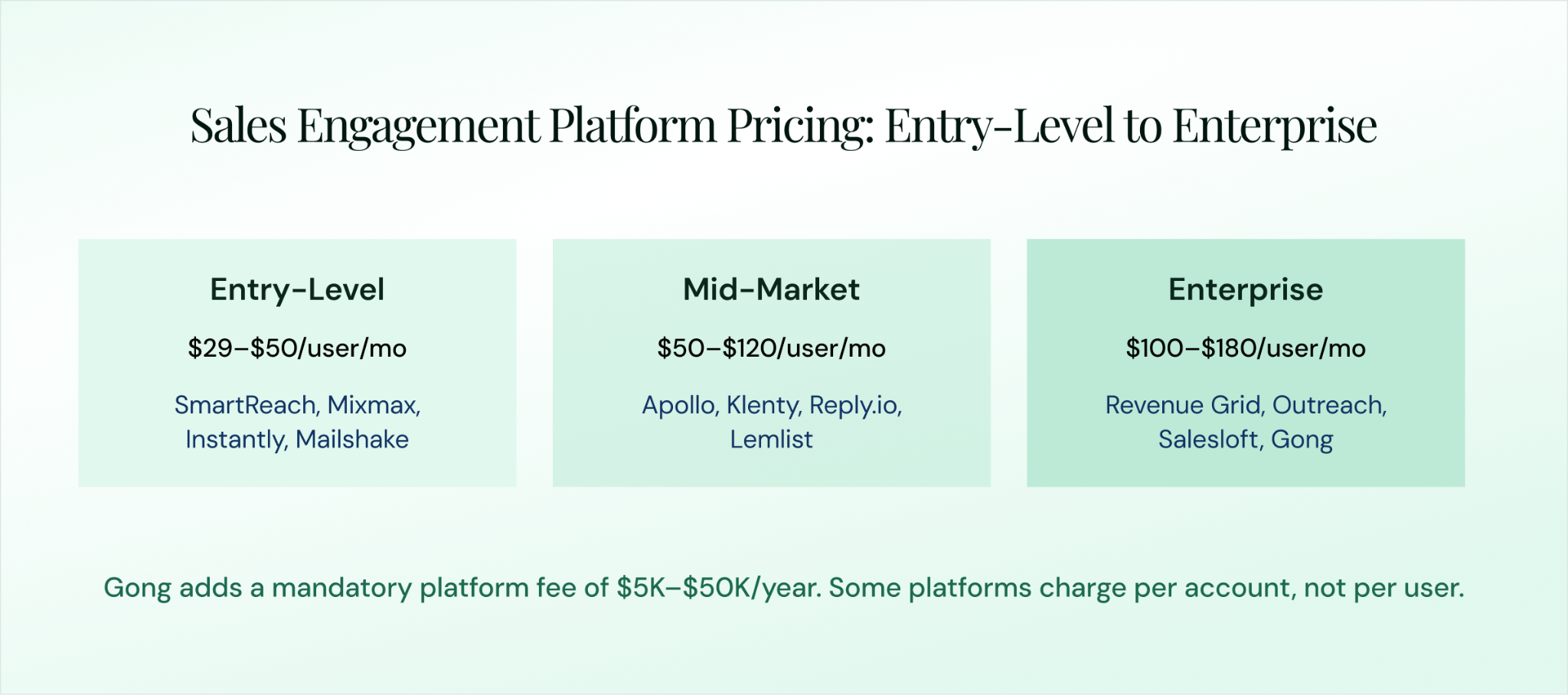
Enterprise platforms (Revenue Grid, Outreach, Salesloft, Gong) range from $100-$180/user/month. Mid-market options start at $29/user/month with trade-offs in AI depth and CRM integration.
6. HubSpot Sales Hub
The native engagement option for HubSpot CRM users. No additional vendor required.
HubSpot Sales Hub bundles Sequences, deal pipeline management, reporting dashboards, and the Breeze AI suite directly into the HubSpot CRM. Outcome-based pricing launched in April 2026.
Pricing: Professional $100/seat/month + $1,500 onboarding, Enterprise $150/seat/month + $3,500 onboarding.
Best for: Teams running HubSpot CRM that want engagement built into their existing platform.
Notable limitation: Sequences only available in Professional and Enterprise tiers. Not designed for Salesforce-native organizations.
7. Reply.io
Multichannel sequences with an AI SDR agent. Strong mid-market option for outbound prospecting.
Reply.io covers email, LinkedIn, calls, SMS, and WhatsApp. Jason AI offers a choice of underlying LLM (Claude, Gemini, Mistral, OpenAI), supports 50+ languages, and includes an Evergreen autopilot mode.
Pricing: Email Volume from $49/user/month, Multichannel $89/user/month, Jason AI SDR ~$259-$800+/month.
Best for: Mid-market outbound teams running multichannel prospecting sequences who want an AI agent handling initial outreach.
Notable limitation: CRM integration is sync-based, not native. No pipeline or forecast capabilities. Published pricing varies across sources.
8. Instantly
High-volume cold email infrastructure with unlimited sending accounts and built-in deliverability.
Instantly is built for cold email volume. Every plan includes unlimited mailboxes and unlimited warm-up. The 450M+ contact SuperSearch database is available as a paid add-on.
Pricing: Growth $37/month, Hypergrowth $97/month, Light Speed $358/month. Account-based pricing, not per user.
Best for: High-volume cold email teams and agencies that need unlimited sending accounts at a flat monthly fee.
Notable limitation: Email-only. No phone, LinkedIn, or SMS automation. Basic CRM integration. Not designed for complex deal cycles.
9. Klenty
Intent-driven multichannel engagement at mid-market pricing.
Klenty adjusts outreach based on prospect engagement signals. The multi-mode native dialer (Power, Parallel at 5-line ~350 calls/hour, Focus, CRM Dialer) is a standout feature. CRM integrations include Salesforce, HubSpot, Pipedrive, Zoho, and Microsoft Dynamics.
Pricing: Growth ~$70/user/month, Pro ~$99/user/month, Ultimate by quote.
Best for: Mid-market teams wanting intent-driven engagement without enterprise pricing, especially on non-Salesforce CRMs.
Notable limitation: Smaller vendor with less ecosystem support. AI capabilities are Tier 2, not Tier 3.
10. Mixmax
Lightweight engagement copilot for Gmail-first teams. Easy to deploy, easy to use.
Mixmax operates exclusively as a Chrome extension for Gmail. Modular copilots: Inbox Copilot ($29/seat), Meeting Copilot ($29/seat), and Engagement Copilot ($49/seat) with AI sequence builder.
Pricing: Free (limited), Inbox or Meeting $29/seat/month, Engagement Copilot $49/seat/month, Suite $89/seat/month.
Best for: Gmail-first teams wanting lightweight engagement without heavy enterprise overhead.
Notable limitation: The 1,500 sequence recipients/month cap is workspace-shared. Gmail and Chrome only. Salesforce sync requires Suite tier.
11. Lemlist
Creative personalization specialist. AI-generated images, videos, and dynamic landing pages in outbound sequences.
Lemlist’s differentiator is creative personalization embedded in outbound sequences. Multichannel outreach covers email, LinkedIn (including voice notes), cold calling, and WhatsApp. Lemwarm handles deliverability.
Pricing: Email Pro $79/user/month ($63 annual), Multichannel Expert $109/user/month ($87 annual), Enterprise custom.
Best for: Teams that prioritize creative personalization in outbound sequences.
Notable limitation: Creative personalization is the differentiator. Without it, the platform is comparable to other mid-market tools. Pricing increased ~$10/seat in February 2025.
12. SmartReach.io
Budget-friendly multichannel engagement with solid channel coverage.
SmartReach uses prospect-volume-based pricing rather than per-seat pricing. Email, LinkedIn, WhatsApp, calls, and SMS are all supported. Unlimited sending mailboxes included. SOC 2 Type II certified.
Pricing: Basic $29/month (1,000 prospects), Plus ~$89, Pro $199, Scale $499.
Best for: Cost-conscious mid-market teams running multichannel sequences without enterprise pricing.
Notable limitation: AI capabilities are Tier 1-2. CRM integration is a paid add-on on Basic. HubSpot integration is a recurring complaint.
13. Regie.ai
AI content generation layer for existing engagement platforms. Enhances Outreach and Salesloft without replacing them.
Regie.ai closed a $30M Series B in February 2025 and now offers RegieOne, a standalone SEP. Auto-Pilot Agents handle autonomous list-building, enrichment, prioritization, email writing, sequence execution, and CRM logging.
Pricing: AI Agents start at ~$35,000/year, RegieOne included with annual contract.
Best for: Enterprise teams that want an AI content generation and prospecting layer.
Notable limitation: Pricing floor is prohibitive for small teams. One SEP integration per workspace at a time.
14. Mailshake
Simple email-first engagement for small teams and agencies.
Mailshake is built for simplicity. SHAKEspeare AI generates three cold-email variants in under a minute. Native Salesforce, HubSpot, and Pipedrive integrations available.
Pricing: Starter $29/user/month, Email Outreach $49-$59/user/month, Sales Engagement $99/user/month.
Best for: Small sales teams (5-20 reps) and agencies running email-first outbound campaigns.
Notable limitation: Limited AI depth (Tier 1). No conversation intelligence. Product velocity has slowed.
15. VanillaSoft
Queue-based lead routing and auto-dialing for call-heavy inside sales teams.
VanillaSoft’s Intellective Routing auto-pushes the next-best record to each rep, eliminating cherry-picking. TCPA-compliant VoIP dialer supports multiple modes. SmartCaller Trust registers numbers with 850+ carriers. Users average 23 calls/hour versus an industry average of 8.
Pricing: Not published. Estimates: Core ~$49/user/month, Advantage ~$79, Enterprise by quote.
Best for: Inside sales teams and call-heavy organizations (insurance, financial services, mortgage, fundraising).
Notable limitation: Designed for call-heavy workflows. Less competitive for email-first or LinkedIn-first engagement. AI capabilities are limited and the interface feels dated.
How to Choose the Right Platform for Your Team
Fifteen platforms is a lot to evaluate. The right choice among these best AI sales tools depends on four variables: your team’s primary sales motion, your CRM environment, your budget, and whether you need engagement as a standalone tool or as part of a broader revenue intelligence stack.

Platform recommendations mapped to four team profiles. Enterprise Salesforce-native teams have the narrowest viable shortlist; high-volume SDR teams have the broadest.
For High-Volume Outbound SDR Teams
Apollo, Instantly, Reply.io, and Lemlist are the strongest options. These teams need volume: unlimited sending accounts, large prospecting databases, and deliverability infrastructure at a price that scales with large SDR headcounts. CRM integration depth and pipeline visibility are less critical here; outbound volume and response rates are the primary metrics.
For Enterprise AE Teams Running Complex Deals
Revenue Grid, Outreach, Salesloft/Clari, and Gong are the platforms built for this use case. Enterprise AE teams running complex, multi-stakeholder deals need engagement platforms that connect to pipeline visibility, conversation intelligence, and forecasting. Revenue Grid’s approach, bundling engagement, capture, pipeline, and forecasting natively inside Salesforce, is purpose-built for this scenario.
For Salesforce-Native Organizations
Revenue Grid, Salesloft/Clari, and Outreach are the primary options. Outreach and Salesloft sync data to Salesforce via API. The approach is functional, but data lives in two places. Revenue Grid is built natively on Salesforce as a managed package. For RevOps teams that need engagement data to appear in standard Salesforce reports, feed Process Builder and Flow, and support the forecast without manual reconciliation, the Salesforce-native architecture is a material differentiator.
For Budget-Conscious Mid-Market Teams
Klenty, SmartReach, Mixmax, and Mailshake offer solid multichannel engagement at $29-$50/user/month, significantly less than enterprise platforms. The trade-offs are real: less advanced AI, shallower CRM integration, no pipeline or forecast capabilities, and smaller vendor ecosystems.
Why CRM Data Quality Should Drive Your Platform Decision
The sales engagement platform you choose is fundamentally a data quality decision.
Engagement activity (emails sent, calls made, meetings held, replies received) is the raw material for pipeline visibility and forecast accuracy. If that activity data doesn’t flow cleanly into the CRM, pipeline reports are incomplete, deal health scores are unreliable, and forecasts are built on guesswork. Gartner reports that only 47% of sales leaders believe their organization has high-quality data.
Most standalone engagement platforms store data in their own system. Reps run sequences in the engagement tool, and the activity only partially syncs to Salesforce, often on a delay, often missing context, and rarely against custom objects. RevOps then builds workaround dashboards to compensate, creating fragile infrastructure that breaks when the engagement tool changes its API.
Platforms that capture activity natively in the CRM operate differently. Every email, call, and meeting lands as a native Salesforce record, available to standard reports, the API, Process Builder, and Flow. No workarounds. No reconciliation. No stale data.

Three CRM integration architectures produce fundamentally different data quality outcomes. CRM-native platforms eliminate the reconciliation layer between engagement activity and pipeline reporting.
Source: Custom infographic, Revenue Grid Blog (2026)
When you evaluate ai powered sales platforms for sales engagement, ask one question first: where does the engagement data live? If the answer is “in our CRM, as native records, in real time,” you’re building a pipeline and forecast on solid ground. If the answer is “in the vendor’s system, synced to CRM on a schedule,” you’re building on a foundation that requires constant maintenance.
Picking the Right AI Sales Engagement Platform
Multichannel sequencing is table stakes. Every platform on this list offers it. The differentiators are CRM integration depth, AI capabilities that connect engagement to pipeline outcomes, compliance posture, and total cost of ownership. The right ai-powered platform for sales engagement depends on team size, sales motion, CRM environment, and whether the buyer needs engagement as a standalone tool or as part of a broader revenue intelligence stack.
For RevOps teams running Salesforce that need engagement data to feed pipeline and forecast reports, Revenue Grid connects sales sequences, automatic activity capture, pipeline visibility, and AI-driven forecasting in one Salesforce-native sales engagement platform.
What is an AI-powered sales engagement platform?
An AI-powered sales engagement platform automates multichannel sales outreach (email, phone, SMS, LinkedIn) using artificial intelligence. It goes beyond scheduled sends to include AI-generated email content, conversation intelligence, deal risk prediction, and autonomous prospecting agents. The category spans lightweight email automation tools to unified revenue platforms that connect engagement data to pipeline forecasting.
How much do AI sales engagement platforms cost?
AI sales engagement platforms range from $29-$50/user/month for entry-level tools (SmartReach, Mixmax, Instantly) to $100-$180/user/month for enterprise platforms (Outreach, Salesloft, Revenue Grid). Gong adds a mandatory $5,000-$50,000/year platform fee on top of per-user costs. Annual commitments and separate implementation fees ranging from $0 to $65,000 are common at the enterprise tier. Account-based pricing is an alternative at lower tiers.
Can AI sales engagement platforms replace human sales reps?
No. AI sales engagement platforms augment reps, not replace them. AI automates repetitive tasks like email drafting, CRM updates, prospect research, and meeting scheduling so reps focus on relationship-building and deal strategy. AI agents handle initial outreach autonomously, though complex B2B deals still require human judgment for discovery, negotiation, and closing.
What is the difference between a sales engagement platform and a CRM?
A CRM (Salesforce, HubSpot) is the system of record that stores customer data, deals, and activity history. A sales engagement platform automates the outreach workflows that create that activity data. The CRM is the database; the engagement platform is the execution layer. Some platforms like Revenue Grid and HubSpot Sales Hub are built natively on the CRM.
How do AI sales engagement platforms integrate with Salesforce?
Three integration models exist. Batch API sync sends data on a schedule, keeping CRM data 12-24 hours stale. Bidirectional real-time sync flows data between both systems instantly, though two data stores remain. CRM-native architecture builds directly on Salesforce, and engagement data lands as native records accessible to standard reports, APIs, and Flows.
What AI features should I look for in a sales engagement platform?
Prioritize three tiers when evaluating. Must-have: AI email generation, AI-powered sequence optimization, and automated activity capture to CRM. High-value: conversation intelligence, AI prospecting agents, and deal risk prediction from engagement patterns. Differentiating: AI-powered forecasting connecting engagement to pipeline outcomes, and autonomous agents executing multi-step workflows without human intervention. Tier 3 platforms deliver the strongest long-term ROI.
How long does it take to implement an AI sales engagement platform?
Lightweight tools (Mixmax, Mailshake, Instantly) take hours to set up and start sequencing. Mid-market platforms (Apollo, Klenty, Reply.io) take one to two weeks for full CRM integration and team rollout. Enterprise platforms (Outreach, Salesloft, Revenue Grid, Gong) take two to six weeks depending on CRM complexity, security reviews, and team size.