

Key Takeaway
- Sales reps spend roughly 60% of their time on non-selling activities. The right sales team productivity tools eliminate that admin work and return hours to actual selling.
- More tools do not fix productivity. The average team juggles 8+, and 42% of reps feel overwhelmed. Consolidation and adoption matter more than feature lists.
- AI is delivering measurable results. Sellers who use AI are 3.7x more likely to meet quota (Gartner).
- The best sales productivity software in 2026 solves three problems at once: it captures activity automatically, surfaces deal intelligence in real time, and integrates natively with Salesforce.
- Revenue Grid is the only platform that unifies activity capture, revenue signals, forecasting, and coaching inside Salesforce, with zero behavior change required from reps.
- Before evaluating any tool, ask one honest question: Is your CRM data accurate enough to trust? If not, activity capture is your first priority.
Quick Comparison: Best Sales Team Productivity Tools for 2026
Sales team productivity tools are sales productivity software platforms that automate manual tasks, streamline the sales process, and help sales reps spend more time closing deals. The best sales productivity tools in 2026 integrate with your customer relationship management system, use AI for automatic data capture, and deliver real-time insights that improve sales performance across the entire sales pipeline.
| Tool | Best For | Starting Price | SF-Native | G2 |
| Revenue Grid | Unified activity capture + forecasting + deal guidance inside Salesforce | $30/user/mo | Yes | 4.5/5 |
| Gong | Conversation intelligence and call coaching | ~$150-250/user/mo | No | 4.8/5 |
| Salesloft | Multi-channel sales engagement sequences | Custom | No | 4.5/5 |
| Clari | AI-powered revenue forecasting | Custom | No | 4.6/5 |
| Outreach | Outbound sales automation at scale | Custom | No | 4.3/5 |
| Apollo.io | Prospecting and lead database | Free-$99/user/mo | No | 4.8/5 |
| Mindtickle | Sales readiness and coaching | Custom | No | 4.7/5 |
| People.ai | Enterprise activity capture | Custom | No | 4.4/5 |
| Calendly | Meeting scheduling automation | Free-$16/user/mo | No | 4.7/5 |
| PandaDoc | Proposal and document automation | $35/user/mo | No | 4.7/5 |
*Pricing reflects publicly available data as of March 2026.
The Productivity Problem No One Budgeted For
According to Salesforce’s State of Sales report, only 28% of reps hit their annual quota in 2024-25. That is the lowest figure in six years. Which raises an obvious question: where is all the time going?
The same report has an answer. Reps dedicate roughly 60% of their workweek to non-selling activities: CRM updates, internal meetings, data entry, content searches, toggling between tools. These are the silent hours that never appear on a pipeline report.
Meanwhile, 57% of sales professionals say their sales cycles are getting longer. Fewer hours selling, longer timelines to close. That math does not work in anyone’s favor.
This guide walks you through the best sales team productivity tools for 2026, with honest trade-offs, real adoption data, and a framework for building a stack that drives revenue instead of draining it.
Three Forces That Changed How Sales Teams Choose Their Tools

Sales reps spend the majority of their time on non-selling tasks, leaving limited capacity for actual revenue-generating activities.
The efficiency mandate reached the boardroom
Post-ZIRP economics reshaped board-level expectations. CAC payback, Magic Number, and Net Revenue Retention replaced top-line growth as the headline metrics. Sales operations leaders now face a direct mandate: more pipeline, smaller teams, tighter budgets.
Every hour a rep spends on admin carries a measurable cost. A 10-person team losing 5.5 hours per week to CRM data entry burns approximately $214,500 per year in direct labor alone. Factor in missed follow-ups, longer sales cycles, and deal slippage from stale data, and the real figure is significantly higher.
AI moved from hype to measurable impact
TechCrunch called 2026 the year AI “gets practical.” Eighty-one percent of sales teams have now implemented or are experimenting with AI, per Salesforce. The teams seeing returns are applying it to specific problems: automatic activity logging, deal risk scoring, and forecast accuracy.
Gartner found sellers who partner with AI are 3.7x more likely to meet quota. The condition: AI only works when it runs on clean, complete CRM data.
Tool overload became its own productivity problem
The average sales team now uses 8+ tools to close deals (Salesforce, 2026 State of Sales). Forty-two percent of reps feel overwhelmed. Gartner found overwhelmed sellers are 45% less likely to hit quota.
The tools designed to boost productivity are, in many sales operations, the reason it is declining. That is why evaluation criteria for sales team productivity software tools shifted. The question is no longer what a tool does. It is: will your reps actually use it, and will it make your CRM trustworthy? The best sales productivity software in 2026 answers both.
How to Evaluate Sales Team Productivity Tools Before Comparing Vendors
Most comparison articles skip straight to product lists. That wastes your time if you have not first defined what productivity means for your team.
A more useful starting point: map your evaluation to three layers. Each one determines whether a tool delivers ROI or collects dust.
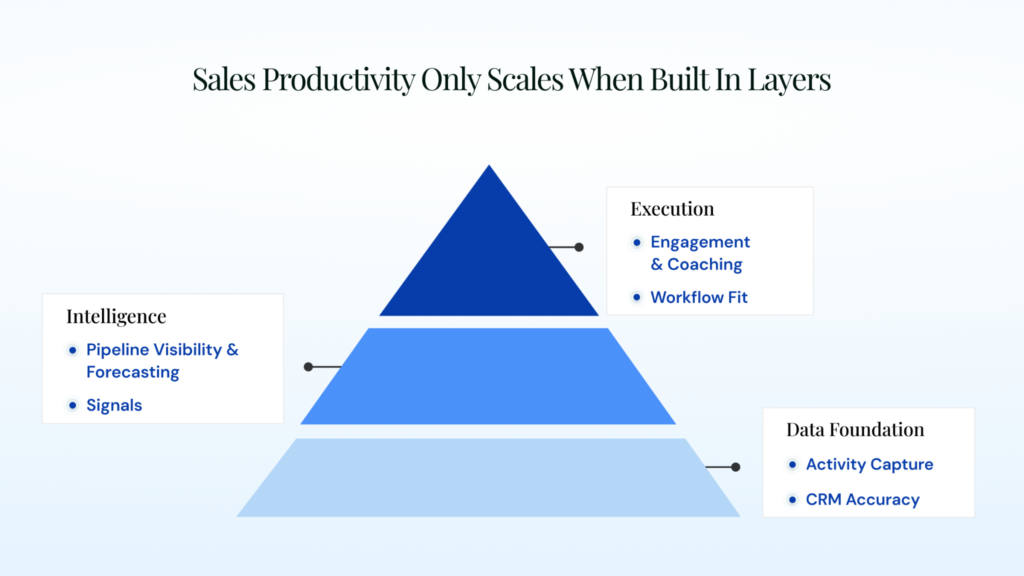
Sales productivity only scales when built in layers: starting with clean data, then adding intelligence, and finally enabling execution.
Layer 1: Data foundation
Everything downstream depends on one question: does your CRM reflect reality? Forecasting, coaching, pipeline reviews, deal management, sales performance management. None of it holds up when the underlying data is partial or stale.
This is why automatic activity capture is the foundational layer. When emails, meetings, calls, and contacts flow into Salesforce without rep effort, data quality improves, rep time opens up, and every tool built on top becomes accurate instead of aspirational.
Layer 2: Intelligence
Clean data is the starting line, not the finish. The next layer turns it into actionable insight: sales pipeline visibility showing which deals are progressing or at risk, revenue signals that alert managers before problems become losses, and forecasting grounded in real sales process behavior.
Layer 3: Execution
Average seller adoption for sales tech sits at 30% (Outreach). Companies waste an estimated $313,000 over two years on tools that never get fully adopted. Seventy-six percent say poor adoption is the main reason sellers miss quotas.
The fix is choosing tools that eliminate steps instead of adding them. Platforms that operate inside the CRM, require no extra logins, and capture data automatically achieve structurally higher adoption. There is nothing to “adopt” when the tool works invisibly.
This framework sharpens every vendor conversation that follows. You know what each layer needs to deliver.
Best AI Tools for Sales Team Productivity in 2026
Each platform below is assessed on core strength, Salesforce integration depth, adoption ease, and the trade-offs you will not find on pricing pages.
Revenue Grid
- Best for: Salesforce-centric teams that need activity capture, forecasting, deal guidance, and coaching in one platform.
- Pricing: Activity Capture 360 ($30/user/mo) | Knowledge Capture ($49/user/mo) | Revenue Grid Ultimate ($149/user/mo).
- G2: 4.5/5 | Support score: 9.1/10
Revenue Grid solves a problem most teams do not realize they have: their CRM data is incomplete, and every tool on top of it works with a partial picture.
The platform is fully native to Salesforce. Not API-connected, not scheduled-sync. It operates inside Salesforce as part of the system. Emails, meetings, calls, and contacts flow in automatically through Activity Capture 360. No rep input. No sync delays. No storage inflation.
That data foundation changes everything above it. True Pipeline shows managers which deals advanced, stalled, or lost engagement based on real activity. Revenue Signals deliver role-based alerts when deals go quiet or stages stall. Revenue Grid Mentor, the AI assistant powered by its RG Brain engine, summarizes meetings, drafts emails, and coaches reps within the CRM sidebar. Beta users saw 40% less admin time and 27% better forecast accuracy.
One G2 reviewer put it plainly: “We don’t have to worry about reps taking time to update key records in Salesforce. It is really seamless.” Implementation takes 2-3 weeks, compared to 6-12 weeks for competitors.
Trade-offs: Analytics are streamlined compared to standalone BI tools. Teams needing deep ad-hoc analysis outside Salesforce may find native reporting lean for heavy customization. Built exclusively for Salesforce organizations.
Why it stands out: The only platform in this guide covering activity capture, engagement, pipeline intelligence, forecasting, and AI coaching in one Salesforce-native product. Vapotherm saved 761 working days in a single year. Morgan & Morgan increased caseload 15-20%.
Compare Revenue Grid to competitors | Book a demo
Gong
- Best for: Teams where call analysis and conversation-driven coaching are the primary productivity levers.
- Pricing: Custom, typically $150-250/user/month plus $50K+ platform fee.
- G2: 4.8/5
Gong set the standard for conversation intelligence. Its AI analyzes every sales call, surfacing talk-to-listen ratios, competitor mentions, and objection patterns with real granularity. For managers coaching large SDR or AE teams, the ability to pinpoint what separates top performers from the rest is genuinely useful.
The platform expanded into deal intelligence and forecasting, though these remain add-on modules rather than core strengths. Its searchable transcript library creates institutional memory that proves especially valuable during onboarding and competitive deals.
Trade-offs: Gong’s value concentrates around the call. Deals move in the space between calls: missed follow-ups, shifting stakeholders, incomplete CRM activity. Those elements are outside Gong’s focus. Pricing friction is the most common G2 complaint. Renewal quotes frequently land 30-50% above initial contracts. One Salesforce admin reported 25MB of data per day flowing into Salesforce, creating unexpected storage costs.
Best fit: Teams with clean CRM data already in place who want conversation intelligence layered on top. If your CRM data is incomplete, Gong amplifies the gap rather than closing it.
Salesloft
- Best for: Teams running structured outbound cadences across email, phone, and social.
- Pricing: Custom, typically annual contracts.
- G2: 4.5/5
Salesloft turns outbound motions into repeatable, measurable workflows. Its cadence engine automates multi-step sequences, prioritizes tasks, and delivers engagement analytics that help managers optimize messaging and timing. For high-volume outbound teams, the workflow automation reduces the cognitive load of managing hundreds of prospect touchpoints.
Clari acquired Salesloft in December 2025, adding forecasting and pipeline capabilities to the engagement foundation. The combined roadmap promises tighter integration between engagement data and revenue intelligence, though full product integration remains in progress. For existing users, the merger introduces both opportunity and uncertainty around long-term product direction.
Trade-offs: Pipeline visibility and forecasting are newer additions. G2 reviewers cite “Missing Features” as a recurring theme (107 mentions), especially around reporting depth compared to Outreach. Chrome extension reliability is a common daily-use complaint.
Best fit: SDR and BDR-heavy organizations where outbound velocity is the primary lever. Related: Sales Engagement Platform
Clari
- Best for: Enterprise revenue teams where forecast accuracy and pipeline governance are non-negotiable.
- Pricing: Custom, typically higher due to separately priced modules.
- G2: 4.6/5
Clari built its reputation on making revenue forecasts trustworthy. Its AI analyzes CRM data, email activity, meeting patterns, and deal behavior to generate forecasts that typically land within 3-4% accuracy for mature deployments. For CROs presenting to boards, that precision is career-defining.
The platform structures commit, upside, and risk categories into a unified rollup. Regional, segment, and global forecasts align in one view, reducing the fragmentation that slows weekly pipeline reviews across distributed teams.
Trade-offs: Clari serves leaders and RevOps, not individual reps. One Reddit thread captures it well: “Clari is a tool for sales leaders. It adds no value to reps.” Pricing scales quickly because forecasting, analytics, and Copilot (CI module) sit in separate line items. Despite marketing Salesforce alignment, Clari runs outside the CRM via API syncs.
Best fit: Organizations where forecast accuracy is the most important metric and RevOps has bandwidth for a complex implementation.
Outreach
- Best for: Large sales organizations running complex multi-channel outbound with deep analytics requirements.
- Pricing: Custom, contracts typically annual with 2-year commitments.
- G2: 4.3/5
Outreach is the enterprise-grade workhorse of sales engagement. Its sequencing engine handles email, phone, LinkedIn, and SMS workflows with sophisticated branching logic that adapts to prospect behavior. The analytics layer shows managers which sequences, templates, and timing patterns drive the highest conversion rates.
The platform also includes meeting intelligence, deal management, and forecasting features that extend its reach beyond pure engagement. For large operations with established sales ops teams, this breadth can consolidate several narrower tools.
Trade-offs: Power comes with complexity. New SDRs typically need 2-4 weeks to become productive, and the platform often requires a dedicated admin. Pricing is opaque. Several G2 reviewers describe pressure toward multi-year contracts. For teams under 20 reps, setup overhead often outweighs the engagement gains.
Best fit: Organizations with 50+ reps and dedicated sales ops support. Smaller teams will find equivalent value with lighter tools at lower cost.
Apollo.io
- Best for: SMB and mid-market teams needing affordable prospecting with a large contact database.
- Pricing: Free plan available. Paid plans $49-$99/user/month.
- G2: 4.8/5
Apollo.io became the default Reddit recommendation for teams needing prospecting, enrichment, and basic engagement at a transparent price. Its 275M+ contact database, built-in email sequencing, and Chrome extension give smaller teams enterprise-level capabilities without the enterprise bill. Setup takes hours, not weeks.
The platform also includes intent signals and a job-change tracker, which help reps identify warm prospects before first outreach. For founders and early-stage teams running lean, Apollo often replaces three separate tools: a data provider, an email platform, and a basic CRM.
Trade-offs: Apollo is prospecting-first. Pipeline management, forecasting, revenue intelligence, and deal coaching sit outside its scope. Data accuracy varies in niche industries, with some users reporting outdated contacts. Salesforce integration exists but lacks native depth.
Best fit: Teams under 30 reps focused on building pipeline. Once deal management and forecasting become priorities, pair it with Revenue Grid for the complete stack.
Mindtickle
- Best for: Organizations where rep skill development and onboarding acceleration drive productivity.
- Pricing: Custom.
- G2: 4.7/5
Mindtickle approaches productivity from a different angle. Instead of automating tasks, it accelerates how quickly reps become effective. Training modules, role-play simulations, and AI-powered coaching form a readiness framework that attacks the gap between hiring and quota attainment.
Its conversation intelligence module analyzes real sales calls and maps them against ideal behaviors, creating a feedback loop between training content and field performance. Managers can track which skills improve over time and which consistently lag, making coaching interventions more targeted.
Trade-offs: Mindtickle is an enablement platform, not a daily workflow tool. It does not automate CRM data entry, manage pipelines, or deliver deal intelligence. The ROI shows up in ramp time reduction and skill improvement rather than immediate time savings. If reps know how to sell but spend too much time on admin, activity capture tools solve that more directly.
Best fit: Organizations with 50+ reps and dedicated enablement staff. Related: Sales Coaching Software
People.ai
- Best for: Large organizations needing exhaustive activity capture across email, meetings, calls, and contacts.
- Pricing: Custom. Cost scales with activity volume.
- G2: 4.4/5
People.ai captures every email, meeting, call, and contact interaction, then maps them to the correct accounts and opportunities in Salesforce. For enterprise RevOps teams managing multi-stakeholder deals, this thoroughness creates the data foundation that pipeline analytics and forecasting depend on.
Its predictive scoring engine highlights patterns reps typically miss: declining contact frequency, missing decision-makers, accounts where engagement dropped without explanation. These signals help managers surface risk earlier, particularly in long sales cycles where quiet disengagement can derail a deal.
Trade-offs: People.ai runs outside Salesforce via API, which means ongoing oversight of storage usage, field mappings, and sync queues. Reps toggle between systems, creating friction. Cost scales with activity volume, making it expensive for the large, high-activity organizations it was designed for.
Best fit: Enterprise organizations (500+ reps) with dedicated RevOps teams. For mid-market teams, Revenue Grid’s Activity Capture 360 delivers similar capture with significantly less operational overhead.
Calendly
- Best for: Any team looking to eliminate scheduling friction.
- Pricing: Free plan available. Teams plan at $16/user/month.
- G2: 4.7/5
Calendly solves one problem well: the 3-4 email exchange that precedes a discovery call. “Book Me” links in email signatures, outbound sequences, and landing pages let prospects self-schedule. Round-robin routing distributes meetings evenly, and buffer management prevents back-to-back booking fatigue.
For SDR teams running high-volume outbound, the time savings compound. Minutes per meeting add up to hours per week across a team. Calendly also integrates with Zoom, Google Meet, and Teams for automatic meeting links, removing one more manual step from the booking process.
Trade-offs: Single-function tool. It does not touch CRM data quality, pipeline visibility, deal intelligence, or coaching. The Salesforce integration logs meetings but does not capture the broader activity picture. For teams using a platform with built-in scheduling (like Revenue Grid), adding Calendly creates redundancy.
Best fit: Any team without scheduling automation in their current stack. At $16/user/month, the ROI is nearly immediate.
PandaDoc
- Best for: Teams where proposal creation and e-signatures bottleneck the close process.
- Pricing: From $35/user/month.
- G2: 4.7/5
PandaDoc automates the last mile between “verbal yes” and “signed contract.” Templated proposals, dynamic pricing tables, built-in e-signatures, and real-time document tracking compress the window that often stalls deals at the finish line.
The content library and approval workflows help maintain brand consistency and pricing accuracy across large teams. Managers can see which proposals are opened, how long prospects spend on each section, and where engagement drops. That visibility turns the proposal stage from a black box into a measurable step in the sales process.
Trade-offs: Document and proposal tool only. It does not address upstream productivity around CRM data, pipeline management, or deal intelligence. Salesforce integration is limited for most workflows. If close-stage conversion is lower than expected, evaluate PandaDoc before assuming the problem sits earlier in the funnel.
Best fit: Teams where proposal creation takes more than 30 minutes per deal. Related: Sales Enablement Platform
Each tool above addresses a specific slice of the productivity problem. The harder question is how to make them work together without creating the complexity they were supposed to eliminate.
Sales Growth Coach Tools for Team Productivity
Most AI tools for improving sales team productivity focus on automation: doing things faster. Coaching takes a different angle. It improves sales performance by helping reps do things better.
Traditional coaching depended on pulling recordings, scheduling reviews, and delivering feedback days after the interaction. By then the deal moved, and the coaching moment passed. G2 data shows organizations with sales enablement strategies achieve 49% higher win rates on forecasted deals. The data is clear. The challenge is embedding coaching into the daily sales process, not bolting it on afterward.
The 2026 generation works in real time. Revenue Grid’s Sales Coaching embeds coaching signals directly inside Salesforce: missed follow-ups, weak multithreading, stalled stages. These surface as they happen, not in next week’s review meeting.
Mindtickle approaches from readiness: structured programs and simulations that build competence before reps enter live deals. Gong coaches from the conversation layer, tracking talk-to-listen ratios and objection quality.
The distinction that matters: coaching built on complete activity data covers the full deal motion. Coaching built on call data alone covers one interaction in a multi-touch sales cycle. For complex B2B deals running 30+ days, that gap is significant.
Building Your Sales Productivity Stack in Layers
The worst way to build a sales tech stack is tool-by-tool, reacting to each pain point with a new purchase. Eighteen months later you are managing 10+ subscriptions, three admin-heavy integrations, and a CRM nobody trusts. A reactive sales strategy never produces a cohesive stack.
The best sales productivity tools work when layered intentionally.
Layer 1: CRM + Activity Capture. Non-negotiable. Revenue Grid’s Activity Capture 360 ensures every email, meeting, and contact syncs without rep effort. Skip this, and everything above it runs on incomplete data.
Layer 2: Engagement + Scheduling. Salesloft or Outreach for sequences. Calendly for scheduling. Revenue Grid’s built-in sales sequences cover this layer within the same platform, cutting tool count by one.
Layer 3: Intelligence + Forecasting. Revenue Grid’s True Pipeline and forecasting delivers pipeline visibility, deal health scoring, and AI forecasting inside Salesforce. Clari is the alternative for standalone forecasting.
Layer 4: Conversation Intelligence + Coaching. Revenue Grid’s coaching signals or Mindtickle for structured programs. This layer improves effectiveness over time.
Layer 5: Proposals. PandaDoc compresses last-mile bottlenecks. Only add if proposal turnaround is a documented conversion drag.
The principle: each layer reinforces the one below it. Adding conversation intelligence before fixing data quality produces brilliant call insights next to an unreliable pipeline. More confusion, not less.
Revenue Grid simplifies this architecture by covering Layers 1 through 4 in one Salesforce-native platform. Fewer syncs, less admin overhead, and less context-switching every day.
The Uncomfortable Truth About Sales Tool Sprawl
Eighty-four percent of sales teams without an all-in-one platform plan to consolidate their technology (Salesforce). Companies waste $313,000 over two years on tools that never get adopted. Employees switch between 9.5 apps per day, spending up to 1.25 hours just navigating between them.
A real example: one 120-person sales org was paying for 14 tools at $387K per year. Including integration maintenance, context-switching costs, and onboarding ramp, the true cost exceeded $600K. After consolidating to six tools, revenue per rep rose 22% and annual savings hit $210K.
The lesson is not fewer tools. It is the right tools that actually work together.
When your sales productivity software lives inside your CRM, there is no sync to manage, no second login, no data discrepancy to reconcile. Revenue Grid was built on this principle. Here’s how:
Why Revenue Grid Fits the Salesforce Sales Team
- Salesforce-native from day one. Activity capture, revenue signals, pipeline visibility, forecasting, deal guidance, and AI coaching operate as part of Salesforce. No sync delays, no storage inflation, no admin overhead.
- Zero behavior change. The Outlook and Gmail sidebar lets reps manage Salesforce from their inbox. Activity capture runs in the background. Reps do not learn a new tool. Their existing tools work better.
- Enterprise proof. Vapotherm: 761 working days saved. Morgan & Morgan: 15-20% caseload increase. Mentor beta: 40% less admin, 27% better forecasts.
- Transparent pricing. Starting at $30/user/month. No hidden platform fees.
- G2 recognition. Best Software Award for Sales, two consecutive years. #1 Easiest Setup.
For sales team tracking software that delivers, Revenue Grid is worth a serious look.
What are sales team productivity tools?
Software platforms that help reps spend more time selling by automating admin, streamlining workflows, and providing intelligence that improves decisions. The best tools in 2026 integrate with Salesforce and use AI for automatic data capture, deal insights, and next-best-action guidance.
How do AI tools improve sales team productivity?
AI automates repetitive tasks (data entry, meeting summaries, follow-up drafts), surfaces deal intelligence humans miss, and improves forecast accuracy. Gartner found sellers using AI are 3.7x more likely to meet quota, provided the AI operates on clean data.
How do I choose the right sales productivity tool?
Start with CRM data quality. If reps log activities manually, fix that first with automatic activity capture. Then layer on intelligence, engagement, and coaching. Evaluate on Salesforce integration depth, adoption ease, and total cost of ownership. Run a 30-45 day proof of concept with real reps.
What features matter most in 2026?
Automatic CRM activity capture, Salesforce-native architecture, AI-powered deal intelligence, integrated forecasting, coaching workflows, and transparent pricing.
How should teams integrate multiple productivity tools?
Build in layers: CRM foundation, then activity capture, engagement, intelligence, coaching, close acceleration. Each layer should reinforce the one below. Choose platforms consolidating multiple layers to reduce integration complexity.
What is the ROI of sales productivity tools?
CRM delivers $8.71 per $1 spent (Nucleus Research). Automation makes teams 14.5% more productive. AI saves reps an estimated 2 hours 15 minutes daily. Highest ROI comes from activity capture because it makes every other tool more accurate.
What are the benefits of sales growth coach tools?
Coaching tools accelerate ramp time, improve win rates, and build consistent selling behaviors. Organizations with enablement strategies achieve 49% higher win rates on forecasted deals (G2). The most effective tools coach in real time.
How many tools does the average sales team use?
As per Salesforce’s 2026 report, an average sales team uses 8+ tools, which results in 42% of reps feeling overwhelmed.
Can AI replace sales reps?
No. Sixty-seven percent of B2B buyers prefer rep-free experiences for transactional purchases (Gartner, March 2026), but complex B2B sales still need human judgment and relationships. AI augments by handling admin and surfacing intelligence.