

Key Takeaway
- Account-based selling (ABS) is a strategic approach that targets specific high-value accounts with personalised campaigns, requiring collaboration between sales and marketing teams
- Relationship selling focuses on building trust and rapport before closing, acting as a consultant rather than a traditional salesperson
- Both strategies depend on connected systems like CRMs, sales engagement platforms, and AI-powered tools to deliver personalised experiences at scale
- Revenue Grid's AI-powered platform uniquely enables B2B sales teams to orchestrate account-based strategies at scale, delivering actionable insights that generic CRMs can't match
For B2B sales leaders in SaaS, finance, and enterprise technology, the pressure to accelerate deal cycles and personalise every engagement has never been higher. That’s why understanding the nuances of account-based and relationship selling—and leveraging platforms like Revenue Grid—is essential for predictable growth.
What is Account-Based Selling?
Account-based selling (ABS) is a strategic sales approach that focuses on targeting specific high-value accounts with highly personalised campaigns and coordinated efforts between sales and marketing teams. Unlike traditional sales methods that cast a wide net, ABS treats individual accounts as markets of one, developing customised strategies for each target organisation.
This approach requires deep research into target accounts, understanding their business challenges, decision-making processes, and key stakeholders. Sales and marketing teams work together to create tailored content, messaging, and engagement strategies that resonate with each account’s specific needs and pain points.
Benefits of Account-Based Selling
Account-based selling delivers significant advantages for organisations targeting high-value prospects. Organisations implementing account-based selling strategies experience revenue increases averaging 208 percent, with 97 percent of marketers reporting that account-based selling delivers higher return on investment compared to traditional marketing and sales approaches.
Key benefits include:
- Higher ROI: Focused resources on high-value accounts generate better returns than broad-based approaches
- Shorter Sales Cycles: Personalised engagement accelerates decision-making processes
- Stronger Customer Relationships: Deep account knowledge builds trust and long-term partnerships
- Improved Sales and Marketing Alignment: Collaborative approach ensures consistent messaging and strategy
Larger Deal Sizes: Comprehensive understanding enables identification of additional opportunities within accounts
Account-Based Selling vs. Traditional Sales
Understanding the differences between account-based selling and traditional sales approaches helps you determine which strategy best fits your organisation’s needs and target market.
| Aspect | Account-Based Selling | Traditional Sales |
|---|---|---|
| Target Approach | Narrow focus on specific high-value accounts | Broad targeting across large prospect pools |
| Personalisation | Highly customised messaging and content | Generic messaging with basic segmentation |
| Team Collaboration | Integrated sales and marketing efforts | Separate sales and marketing functions |
| Resource Allocation | Concentrated investment in fewer accounts | Distributed resources across many prospects |
| Success Metrics | Account penetration, deal size, relationship depth | Lead volume, conversion rates, activity metrics |
Account-based selling and relationship-based selling are hot topics these days. But—what do these terms actually mean for sales reps?
In reality, tailoring your offer to your audience is not new—successful selling has always been rooted in building strategic relationships, especially in today’s data-driven landscape.
So, why is it that we’ve suddenly recommitted to relationships?
Well, for one, relationship selling and account-based selling are more than trending topics. They’re a response to changing buyer expectations and increased access to big data and AI.
67% of the buyer’s journey now takes place online and a whopping 90% of buyers say they don’t respond to cold calls. The sales rep is now part educator, part customer journey guide.
In other words, account-based selling and relationship selling have resurfaced, this time with a high-tech makeover that includes things like advanced CRM solutions and chatbots. Read on to learn more about the two terms and why they matter.
Customers crave long-term relationships.
According to the State of Sales report, selling to today’s customer is more difficult than ever, reporting that over half of the reps they surveyed don’t expect to meet their quotas. And while 72% of reps said that their organisation does use data to set quotas, their sales reports don’t always include customer engagement metrics.
Organisations understand that customer-centric strategies mean more sales and lasting relationships, but on the whole, the workplace culture doesn’t always give reps much time to focus on making connections.
Many salespeople find themselves spending more time answering emails and performing administrative tasks than talking to people or prospecting. Here’s a list of how reps view their task breakdown:
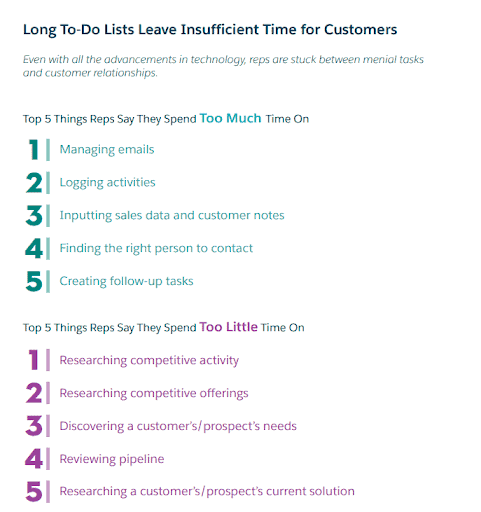
Long to-do lists and building relationships with customers seem to exclude each other out.
Businesses are learning that personalisation is a huge driver for success. Improving the customer experience is known to boost retention rates and encourage repeat purchases. Meaning, more money long-term.
Customers have thousands of vendors to choose from, and as a result, brands must deliver a personalised experience that delights and drives value at every touchpoint.
That’s a significant challenge for one rep to handle.
To off-set the pressure of delivering a near-perfect customer experience, sales teams are turning toward collaborative selling methods like account-based marketing and embracing strategies like data-driven forecasting.
Technology is driving personalisation.
In 2014, research from VoloMetrix found top salespeople spent 33% more time talking to clients each week yet were focused on 40% fewer accounts. They also found that these high performers spent more time working with sales managers and had larger internal networks.
Sales reps are adopting traits like personalisation and collaboration across all industries and territories, in companies big and small. Thanks to rapid improvements in sales and marketing technology, reps are realising that the days of the old “spray and pray” approach are long gone.
Instead, new metrics like customer satisfaction scores (CSAT) and net promoter scores (NPS) are measured alongside old standbys like sales velocity and quota attainment.
Technology is driving personalization. – Revenue Grid
Level of penetration of technology in measuring old and new Sales KPIs is quite high and promises to grow even more.
Here’s a quick rundown on the sophisticated tools that make ABS and relationship-
centric strategies possible:
CRMs
CRMs are, of course, the driving force behind today’s high-tech sales teams. The CRM functions as a cloud-based central hub containing a record of contacts, interactions, sales goals, and performance reports.
But good CRMs are more than glorified phonebooks. They’re productivity tools that connect ALL sales activities, as well as help teams manage tasks and review data from multiple sources.
Per Copper CRM, here’s a look at all the channels that sales reps use to keep up with their relationships.
All channels used by sales reps to maintain and develop their relationships with customers. – Revenue Grid
Lots of channels, lots of relationships.
Chatbots
As a species, chatbots have come a long way from their early attempts at customer service. Nowadays chatbots are a sales support secret weapon, powered by AI or rule-based sequences and built to automate low-level customer interactions.
Today, they’re a powerful sales tool changing the lead gen game by collecting data gathered from leads and prospects and funnelling the details for qualified leads to the correct person.
Tools like Intercom and Drift are using chat to shorten the sales cycle, score leads, and connect prospects to reps.
Bottom line, chatbots help sales teams spend less time on admin tasks and unqualified leads.
Lead Generation Software
From LinkedIn Sales Navigator to Infusionsoft, Hubspot, and the whole Google Suite, there’s a wide range of lead gen tools designed to help reps identify, connect with, and close new sales opportunities.
While each has a slightly different use case (think Facebook Audience Insights vs. on-site intelligence tools like Clearbit), lead generation software collects leads (and information about those leads) so that you can nurture them through your sales pipeline.
Sales Engagement Platforms (SEPs)
A Sales Engagement Platform allows salespeople to bring efficiency to prospect outreach by automating the nurturing of leads and prospects across multiple communication channels.
Such platforms are fairly easy to use. You can integrate them to CRM tools like Salesforce and email servers, like Exchange or Gmail. SEPs will auto-log engagement-generated data to the CRM, give signals to salespeople about the next action they should take and multiply their capacity to follow up leads.
All that combined automates sales communication and increases return on engagement.
RevenueGrid – an example of Sales Engagement platform that automates communication with leads and prospects, increasing return on engagement. – Revenue Grid
Developing a relationship requires lots of attention from the sales rep – and timely responses and follow-ups via multiple channels.
What is Relationship Selling?
Relationship selling is a sales strategy built around establishing rapport and trust before going in for the close. It’s a move away from the transactional model of yesteryear—the one responsible for the sleazy car salesman stereotype.
Relationship selling, by contrast, depends on learning as much about a prospect as possible. What are their (business-related) hopes and dreams? What roadblocks stand in the way?
Relationship selling is closely linked to another term, value-based selling.
Value-based selling is all about making your product seem irresistible to your prospect. It’s not about performing some act of trickery, rather approaching the sales process as a consultant or go-to expert.
Here, we’ll go over a few ways to make sure you’re delivering value throughout the sales process.
Become an active listener
Marketing expert, Lee Ann Obringer describes relationship selling as being “all about building a friendship or relationship with your prospects and listening to their needs.”
A big part of relationship-building is asking the right questions. Your customers expect great products and services. So, you’ll need to make a point of asking questions that allow you to deliver the best possible solution.
To start, you might ask a series of questions like these:
- Tell me a bit more about what you do?
- What are your team’s goals this year?
- How did you hear about us?
- What made you reach out?
- Can you tell me about the solution you’re using now? Why is it not working?
- What other solutions are you currently reviewing?
While these may seem a bit “basic,” consider these examples of foundational questions you can build on as the relationship progresses. Use answers to set mutual goals, develop an action plan, and anticipate potential roadblocks. Just make sure you store this data in your CRM for later reference.
Get on-board with social selling
Social selling is relationship-based selling on social media. Pretty self-explanatory, to be sure. According to Accenture’s State of B2B Procurement Survey, 94% of buyers do some research online before making a purchase.
And IDC research found that 91% of B2B buyers are active social media users, while 84% of senior executives use social media to help make purchasing decisions.
Yet, only 49% of teams have developed any formal social selling program. According to Sales for Life, top sales reps see social tools as a way to close more deals and create more relationships, as you can see in the graphic below:
Social tools methodologies may help sales reps to establish better rapport with potential customers. – Revenue Grid
Social selling as a major factor of establishing closer relationships with potential customers.
Act as a guide for the buyer’s journey
Traditional selling methods often focus on the seller and their outcomes. How can they close faster, upsell, cross-sell, and just maybe meet their quota this month?
Value-based selling is all about shifting that frame of reference so that the focal point falls on the buyer’s needs instead. This seems obvious—why would a prospect care whether you close this deal, anyway? What’s in it for them?
Look, this all seems obvious, but as humans, putting yourself in someone else’s shoes isn’t always the default response.
Adjust your strategy by becoming a tour guide of sorts, building your sales pipeline around key milestones in the buyer’s journey.
This means educating customers every step of the way—a strategy companies like MailChimp, Salesforce, HubSpot, and other SaaS legends have whole-heartedly embraced.
These brands start off as resources and build trust in their niche markets, running blogs that even non-customers read on the regular.
At the rep-level, the takeaway is, how can you move from pitching to consulting or educating? Which case studies or resources answer questions or address objections? And, how do these resources fit in with the journey?
How Does the Account-Based Selling Model Work?
Like the idea that selling is based on relationships, Account-Based Selling (ABS) isn’t exactly new. These days, just about everyone is clued into the fact that targeted campaigns are an effective sales strategy. And, ABS has targeted sales on steroids.
These two triangles actually do a nice job explaining the difference between traditional marketing and account-based marketing.
Account-Based Selling – Revenue Grid
ABM – here we go again.
Yes—we did say marketing, but account-based marketing and account-based sales are intertwined every step of the way. In traditional selling, marketers work to attract leads and there’s some sort of hand-off further down the funnel.
The account-based approach is a collaborative effort. Marketing and sales set aside their differences to develop content and campaigns together at each stage, based on data.
Thanks to AI-powered CRMs and data analytics platforms, sales and marketing teams can get really granular insights about target accounts, including the following:
- Technologies used
- Location
- Industry
- Purchase history
- Number of employees
- Revenue
Taking personal relationships to the next level, ABS goes beyond nurturing prospects one-by-one. Instead, this complex strategy brings multiple teams into the sales process to engage with several decision-makers within one company.
As you might imagine, ABS can quickly turn into a “too many cooks” situation if efforts aren’t coordinated properly. Done right, however, account-based selling can result in a more predictable revenue stream, a shorter sales cycle, and more revenue per deal.
Pardot’s 2018 State of Account-Based Marketing survey found that 25% of respondents said the biggest challenge to adopting this strategy is that they lack the ability to execute. That same report found that those same companies were just getting started with the strategy.
Level of adoption of Account-based marketing strategy. – Revenue Grid
Level of maturity of ABM in companies: despite the publicity, most companies are still just getting started.
Step-by-Step Guide to Implementing Account-Based Selling
Successfully implementing account-based selling requires a systematic approach that aligns your sales and marketing teams around target accounts. Here’s a practical roadmap to get you started:
- Identify Target Accounts: Develop your Ideal Customer Profile (ICP) and create a list of high-value accounts that match your criteria. Focus on accounts with significant revenue potential and strategic importance.
- Research and Map Stakeholders: Conduct deep research into each target account’s organisational structure, decision-making process, and key stakeholders. Identify champions, influencers, and decision-makers.
- Develop Account-Specific Strategies: Create customised messaging, content, and engagement plans for each account based on their unique challenges and business objectives.
- Align Sales and Marketing Teams: Ensure both teams understand the account strategy and their respective roles in executing the plan. Establish clear communication channels and shared goals.
- Execute Multi-Channel Outreach: Launch coordinated campaigns across multiple touchpoints including email, social media, direct mail, and events. Maintain consistent messaging across all channels.
Track and Measure Results: Monitor account engagement, pipeline progression, and revenue outcomes. Use data to refine your approach and optimise future campaigns.
Who Should Use Account-Based Selling?
Account-based selling is most effective for organisations with specific characteristics and target markets. Understanding whether ABS aligns with your business model is crucial for successful implementation.
Is Account-Based Selling right for your organisation?
Gartner predicts ABS will become the default selling method for tech vendors bringing in $5 million or more in annual revenue. For B2B sales leaders in SaaS, finance, and enterprise technology, this strategy offers particular value when targeting complex, high-value accounts.
ABS requires a unified approach and alignment between sales and marketing teams to work.
This strategy is best served for complex sales cycles involving significant sums of money, multiple decision-makers, and an obvious opportunity for long-term customer relationships.
Companies that chase after big fish clients and have the technology and labour force to support ABS stand to benefit big time.
Beyond being able to front the costs for this strategy, you also need to figure out if ABS even makes sense for your prospects. For companies that sell to end-consumers or SMBs, applying that level of resources and manpower to smaller deals just seems ridiculous.
Consider how bringing an entire ABS team might look to a prospect navigating this deal on their own—probably overwhelming and frankly, pretty weird.
That said, you could apply a scaled down version of ABS to mid-sized accounts, just make sure that the number of people working each deal is proportional to the number of decision-makers on the prospect side.
A few questions you should be able to answer before implementing an account-based strategy:
Who Are Your Customers?
Account-based selling depends on this idea of an Ideal Customer Profile (ICP). More than developing personas, ICP profiles are all about identifying your top customers, so you can identify similar accounts likely to buy.
How Well Do You Know Your Customers?
ABS is all about precision. If you don’t have a deep understanding of who your customers are or what they need from you, your organisation might not be ready to implement this strategy.
What Do You Sell?
High-value subscription-based services tend to see the highest ROI from ABS.
Beyond these basics, organisations need to have a plan for organising sales data, ensuring it’s always accessible, actionable, and secure. They’ll also need to come up with a process for selecting target accounts, and creating personalised content for those targets, among other strategic efforts.
Key Metrics for Measuring Account-Based Selling Success
Measuring the effectiveness of your account-based selling efforts requires tracking specific metrics that reflect the unique nature of this strategic approach. Ninety-three percent of companies report that mature account-based selling programs attribute 79 percent of total sales opportunities to account-based selling efforts, underscoring the strategy’s dominance in opportunity generation.
Essential ABS metrics include:
- Account Engagement Score: Measures the level of interaction and engagement across all touchpoints within target accounts
- Pipeline Velocity: Tracks how quickly accounts move through your sales pipeline compared to traditional approaches
- Account Penetration: Measures the number of stakeholders and departments engaged within each target account
- Deal Size: Compares average deal values from ABS accounts versus traditional sales approaches
- Customer Lifetime Value (CLV): Tracks the long-term revenue potential from accounts acquired through ABS
Sales and Marketing Alignment Score: Measures the effectiveness of cross-team collaboration on account strategies
Relationship selling and Account-based selling both depend on connected systems
Account-based selling and relationship selling may be buzzwords, but they certainly aren’t trends.
New technologies are changing the game for the world’s oldest profession. Selling has always been about human relationships, but today’s tools from chatbots to CRMs and AI enable us to do more.
Revenue Grid’s AI-powered platform uniquely enables B2B sales teams to orchestrate account-based strategies at scale, delivering actionable insights and automations that generic CRMs can’t match. For example, Vapotherm saved 761 working days in one year by switching to Revenue Grid.
Ready to accelerate deal cycles for your SaaS sales team? See how Revenue Grid can shorten your sales cycle—Book your personalised demo to start driving higher sales performance at every stage in the sales cycle.
Why Revenue Grid?
Revenue Grid empowers teams with AI-driven insights, automated workflows, and deep CRM integration—so you can win more deals, faster.
Strengthen your account relationship
Streamline your sales process with Revenue Grid
How does account-based selling work?
Account-based selling works by treating individual high-value accounts as markets of one. You identify target accounts, research their specific needs and stakeholders, then create highly personalised campaigns and content. Sales and marketing teams collaborate to engage multiple decision-makers within each account through coordinated, multi-channel outreach designed to address the account’s unique challenges and business objectives.
What is the difference between account-based selling and traditional sales?
Traditional sales casts a wide net across many prospects with generic messaging, whilst account-based selling focuses intensively on specific high-value accounts with highly personalised approaches. ABS requires integrated sales and marketing efforts, concentrated resource investment, and measures success through account penetration and relationship depth rather than just lead volume and conversion rates.
What are the key benefits of account-based selling?
Account-based selling delivers higher ROI, shorter sales cycles, larger deal sizes, and stronger customer relationships. You’ll see improved sales and marketing alignment, better resource utilisation, and increased account penetration. The personalised approach builds trust faster and creates opportunities for long-term strategic partnerships with your most valuable prospects.
What is an account-based selling strategy?
An account-based selling strategy is a comprehensive plan that includes identifying your Ideal Customer Profile, selecting target accounts, researching stakeholders and business challenges, developing account-specific messaging and content, coordinating sales and marketing efforts, executing multi-channel campaigns, and measuring success through account-focused metrics rather than traditional lead-based metrics.