Win Percentage Calculator.

Use our free Win Percentage Calculator to quickly determine your sales team's success rate. Track your closing efficiency, identify performance trends, and make data-driven decisions to improve your sales results.

$10,000 $1,000,000
$10,000 $1,000,000

Your Forecast Accuracy

How to Use the Win Percentage Calculator

Follow these simple steps to calculate your sales team's win percentage:

 – Revenue Grid

Enter your total number of won opportunities

Include all deals your team has successfully closed within your desired time period.

 – Revenue Grid

Enter your total number of opportunities

Include all deals that were either won or lost (closed opportunities only).

 – Revenue Grid

Click "Calculate"

The calculator will instantly display your win percentage.

 – Revenue Grid

Analyze your results

Compare your current win rate against historical performance or industry benchmarks to gauge effectiveness.

For the most accurate assessment, ensure you're using data from the same time period (e.g., monthly, quarterly, or annually).

Win Percentage Formula

The win percentage formula is: (Number of Wins ÷ Total Opportunities) × 100

This simple calculation provides a clear metric of your sales team's closing efficiency, expressed as a percentage.
  • Number of Wins: The total count of successfully closed deals within a specific time period.
  • Total Opportunities: The combined total of all closed deals, both won and lost, within the same time period.
By dividing wins by total opportunities and multiplying by 100, you get a percentage that represents your team's success rate.

Understanding Your Results

Your win percentage is a critical indicator of sales effectiveness. Here's how to interpret your results:

High Win
Percentage (Above 40%):

A win rate above 40% typically indicates strong sales performance. Your team is effectively qualifying leads, addressing customer needs, and overcoming objections.

Average Win
Percentage (20-40%):

This range is considered average for most B2B sales organizations. There's room for improvement, but your team is performing at an industry-standard level.

Low Win
Percentage (Below 20%):

A win rate below 20% suggests potential issues in your sales process. You may need to improve lead qualification, sales training, or value proposition clarity.

Remember that win percentages vary significantly by industry, deal size, and sales cycle length. Enterprise sales with longer cycles typically have lower win rates than transactional sales with shorter cycles.

Tracking Changes: Monitor your win percentage over time to identify trends. An upward trend indicates improving sales effectiveness, while a downward trend may signal problems requiring attention.

Example Calculation:

Scenario: A sales team closed 45 deals successfully out of 150 total opportunities last quarter.

Calculation:

  • Number of Wins: 45
  • Total Opportunities: 150
  • Win Percentage: (45 ÷ 150) × 100 = 30%

Analysis: This 30% win rate falls within the average range for B2B sales organizations. The team is converting nearly one-third of all opportunities, which is respectable but leaves room for improvement.

Improvement Strategy: To improve this win percentage, the team could:

  • Analyze the 105 lost opportunities to identify common objections
  • Refine their qualification process to focus on higher-quality leads
  • Implement targeted sales training based on successful deal patterns

About RevenueGrid

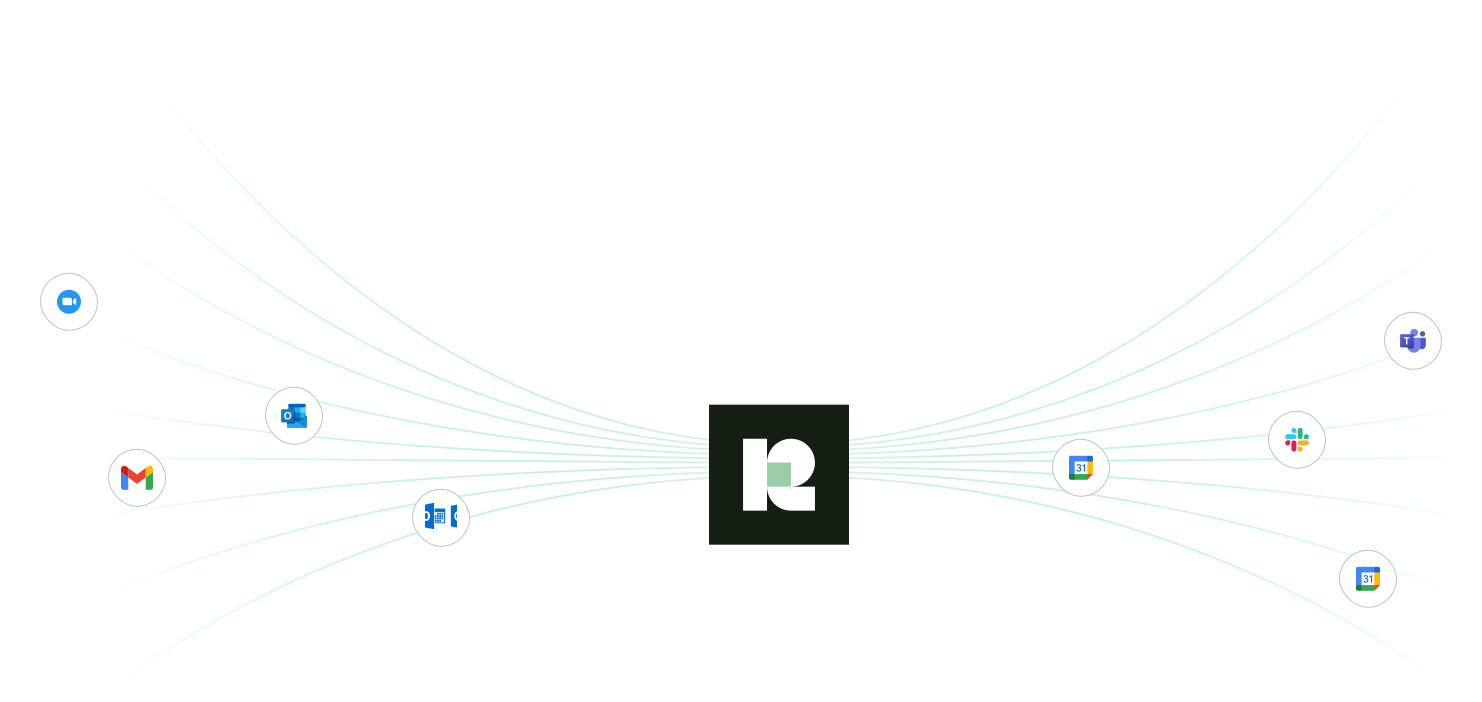
RevenueGrid is an AI-powered revenue intelligence platform that brings clarity and guidance to every stage of your sales process. By analyzing customer interactions, deal progression, and sales activities, RevenueGrid provides actionable insights that help teams close more deals and accelerate revenue growth.

Our platform seamlessly integrates with Salesforce to capture sales data, eliminate manual entry, and deliver predictive analytics that transform how sales teams operate.

Trusted by 900,000 sales professionals globally

Hear it straight from our customers

User Image
User Image

Revenue Grid allows us to work much more efficiently by capturing all our Outlook contacts, correspondence, and meetings and updating Salesforce automatically.

Tasha. K
RevOps Manager

Ready to Maximize Your Revenue Growth?

RevenueGrid helps businesses automate their sales processes and accelerate revenue growth. Join thousands of companies achieving exceptional results.

Frequently Asked Questions

How can this calculator help improve my sales performance? s arrow
This calculator provides an objective measure of your sales team's closing efficiency. By tracking your win percentage over time, you can quantify the impact of process changes, training initiatives, or new sales strategies. It helps you move beyond anecdotal evidence to data-driven decision making, allowing you to identify which approaches actually increase your success rate and which don't deliver results.
What metrics are included in RevenueGrid's analytics? arrow
RevenueGrid's comprehensive analytics include win rate analysis, conversion rates at each pipeline stage, average deal size, sales cycle length, forecast accuracy, activity metrics (calls, emails, meetings), engagement scores, and revenue attribution. These metrics are presented through customizable dashboards that allow sales leaders to focus on the KPIs most relevant to their specific business goals.
Can I compare win rates across multiple sales teams or time periods? arrow
With this basic calculator, you'll need to calculate different scenarios separately. However, RevenueGrid's full platform provides advanced comparative analytics that allow you to segment win rates by team, territory, product line, or any custom parameter. You can also analyze trends over customizable time periods to identify seasonal patterns or measure the impact of specific initiatives on your win percentage.
What's a good win percentage for B2B sales? arrow
Win percentages vary significantly across industries and sales models, but general B2B benchmarks are:
  • Enterprise sales (complex, long cycle): 15-25%
  • Mid-market sales: 20-40%
  • SMB/transactional sales: 40-60%
Your ideal win rate depends on your specific business context, including factors like deal qualification criteria, sales cycle length, and average deal size. Generally, it's more important to focus on improving your win rate over time rather than comparing to broad industry averages.
How often should I analyze my win percentage? arrow
For most B2B organizations, monthly and quarterly analysis provides the right balance between timely insights and sufficient data volume. Short sales cycles might benefit from weekly analysis, while enterprise sales with longer cycles may find quarterly or even semi-annual reviews more meaningful. The key is consistency—establish a regular cadence for win rate analysis that aligns with your sales cycle and stick to it to identify meaningful trends.
close
expand_less