




Financial firms have long assigned clear responsibility for who does the work, who owns the decision, and who reviews it.
AI introduces a new challenge because the person accountable for an outcome may not have produced all the analysis or information behind it. A single piece of client advice can now involve several systems working in sequence. One tool summarizes the client’s history, another recommends the next action, an advisor reviews the recommendation, and a compliance system screens the communication.
This is already how large firms work. At Morgan Stanley Wealth Management, 98% of financial advisors actively use the firm’s AI assistant, and its Debrief tool summarizes client meetings and turns advisor notes into follow-up emails and next steps, which advisors must validate before anything reaches a client.
So if no single person or system produced the outcome end to end, what exactly should the manager be supervising?
The work no longer belongs to one person
Financial firms have long assigned supervisory responsibility to people, even when work involves multiple teams and systems. Advisors remain responsible for their recommendations, while managers oversee their activities through established review and approval processes.
FINRA Rule 3110 reflects this approach. It requires firms to establish supervisory systems suited to their business, including designated supervisors and procedures for reviewing activities and communications.
These responsibilities remain in place when firms use AI. In its 2024 Regulatory Notice 24-09, FINRA confirmed that its rules apply to generative AI just as they do to other technologies.
Its 2026 Annual Regulatory Oversight Report goes further, discussing how AI affects supervision, communications, recordkeeping and third-party oversight. It also highlights practices firms may consider, such as retaining AI prompts and outputs, tracking model versions and determining where human review is needed.
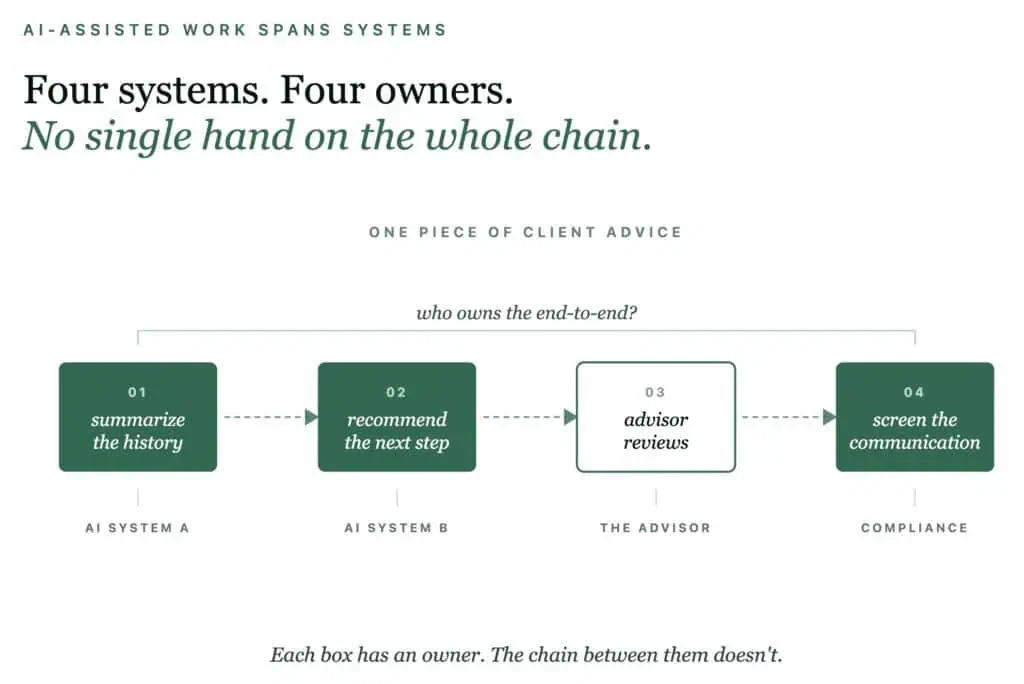
The challenge is that AI systems can now interpret client information, generate analysis and pass their outputs to other tools before an advisor sees the result.
The question for firms is whether their existing supervisory controls adequately cover the AI-assisted work taking place before an advisor makes a decision.
The risk lies in what happens between systems
Each system in an AI-assisted workflow may be working exactly as intended. Yet the overall process can still produce a recommendation that doesn’t fit the client.
The problem is that approving individual tools does not guarantee that the entire workflow produces a suitable outcome.
Information can get lost when a long client history is reduced to a summary. An assumption made early in the process can be carried forward as fact. And a reviewer checking the final communication may have no way of knowing whether important information was missing from the analysis behind it.

These risks become harder to manage when different systems have different owners, vendors and controls. Each team may be responsible for making its part work correctly, without anyone checking how information moves through the entire process.
Human review remains important, but it has limits. An advisor can assess whether a recommendation makes sense based on the information presented. They may be less able to spot something that was omitted earlier in the process, especially if they have no reason to question the summary.
This is why firms need controls at the points where information moves between systems and people. They need to decide what information must be verified, where checks should happen and who is responsible for them.
The supervisory challenge is to identify where problems can enter the workflow and make sure there is a reasonable way to catch them before they affect a client outcome.
Five questions managers should ask about AI-assisted work
To supervise AI-assisted work effectively, firms need to understand where important decisions are made, what information those decisions depend on and where errors could be caught.
Five questions can help managers evaluate their controls.
| Question | What it helps establish |
| What information was available to the AI? | Whether the system had access to relevant client context |
| How was that information summarized or changed? | Whether important details could have been lost or misrepresented |
| Which AI outputs influenced the final decision? | How AI contributed to the client outcome |
| Where was human review required? | Whether appropriate checks were built into the process |
| What records exist of the handoffs? | Whether the firm can investigate problems across systems |
Answering these questions requires reliable records of both the client relationship and how information moves through the workflow.
The quality of the underlying client information matters. If important conversations, preferences or commitments are missing from the client record, AI systems and human reviewers may be working from incomplete context.
This is where Revenue Grid can help. It captures client interactions across email, meetings and calendar and maintains relationship history over time. That gives teams a more complete record to draw from when preparing recommendations and reviewing client work.
Firms still need controls to track how AI systems use that information, what they pass along and where human verification is required.
For managers, this means looking beyond the finished recommendation to examine the steps that shaped it. The aim is to identify where important information could be lost, where checks are needed and who is responsible for carrying them out.
Who owns the controls between AI systems?
FINRA’s guidance makes clear that firms remain responsible for supervision when they use AI. But within a firm, responsibility for checking AI-assisted work needs to be clearly assigned.
If an AI-generated summary leaves out important client information, who should have caught it? The team managing the AI system, the team responsible for the underlying data or the advisor using the output?
The answer may depend on where the error occurred and how the workflow was designed. Firms need to establish who checks the information at each critical stage, who monitors the systems and who investigates problems when they arise.
Does human approval mean meaningful review?
Even when responsibilities are clear, firms still need to know whether human review is working as intended.
An advisor might carefully review an AI-generated recommendation and agree with it. Another might approve the same recommendation after only a quick glance. Both actions could leave an identical approval record.
As AI-generated work becomes more reliable and familiar, advisors may become more inclined to accept it without close examination.
Research already points this way. A 2025 study by Microsoft Research and Carnegie Mellon University of 319 knowledge workers, covering 936 real tasks, found that people with more confidence in generative AI applied less critical thinking to its outputs, while those more confident in their own expertise were more likely to check and question them. Over time, a required review could become a routine approval, even though the firm’s procedures have not changed.

For financial firms, this raises a question about how much assurance a human sign-off really provides. A supervisor can confirm that an advisor approved a recommendation, but that record alone cannot establish whether the advisor checked the underlying information, questioned the AI’s reasoning or considered what might be missing.
The challenge is to make human review meaningful enough to catch errors, without requiring advisors to redo every step of the AI’s work.
That requires firms to be specific about what advisors should verify, which decisions deserve closer scrutiny and what evidence of those checks should be retained. As AI becomes more involved in client work, the effectiveness of supervision will depend in part on whether those review practices hold up in everyday use.