
Advisors work in a business where clients hand over sensitive information and entrust someone with decisions that can affect decades of accumulated wealth. That makes AI a difficult subject to raise.
Advisor360 found that only 21% of advisors proactively discuss their AI and automation policies with clients. Another 49% will talk about them when asked, while 30% avoid the subject entirely.
Yet the clients themselves may be more open to AI than advisors assume.
Matt Reiner’s AI in Wealth 2026 research, which studies affluent Americans with at least $100,000 in investable assets excluding their homes found that:
- • 68% had a somewhat or very positive view of AI.
- • Among people already working with an advisor, 76% were comfortable with their advisor using AI
- • Having a trusted advisor increased comfort with AI by an average of 27 percentage points.
So why the hesitation to disclose the use of AI?
It’s partly because “Disclosing AI use” sounds much simpler than it is. The real problem is figuring out what clients need to know about AI’s role, who owns the outcome, and how can an advisor confidently make any claims about responsible use of AI.
A generic AI disclosure tells clients very little
Clients are unlikely to care about the mere presence of AI as much as what it was allowed to do.
A tool that schedules a meeting is operating at the edge of the relationship. A system that reads financial information, models a retirement scenario or influences an investment recommendation is much closer to the advice that can be life changing. And a system that can take action on a client’s behalf crosses another line altogether.
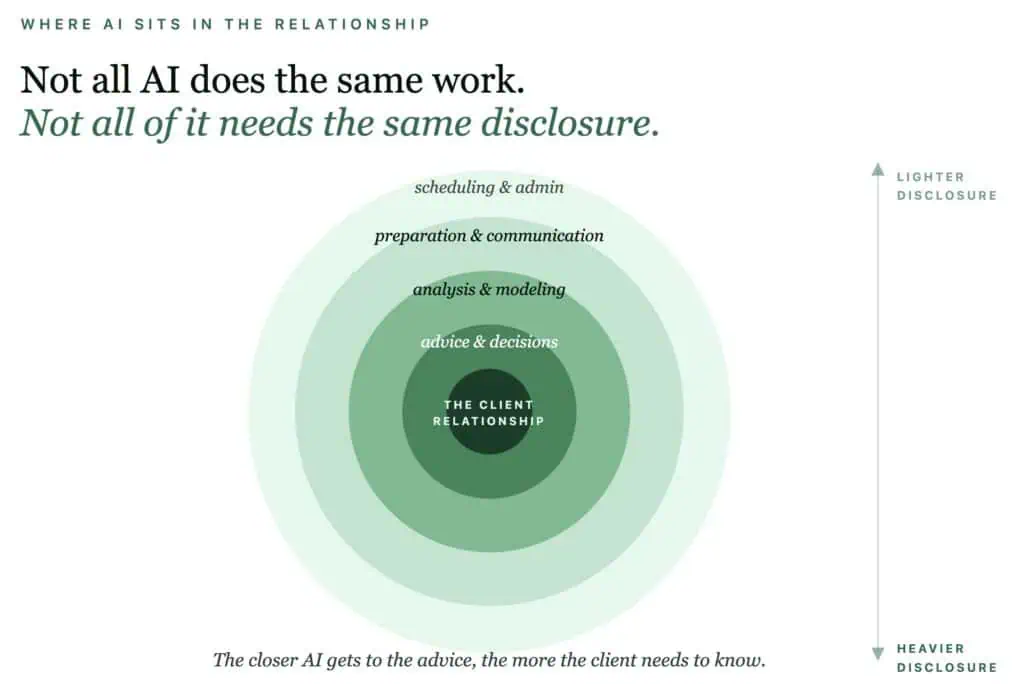
A generic disclosure collapses all of those distinctions into one statement. That forces the client to fill in the gaps themselves, often without knowing how the technology actually fits into the advisory process.
Clients are not really deciding whether they approve of “AI” in the abstract. They are deciding whether they are comfortable with the role it is playing in their financial relationship.
Clients want to understand the chain of responsibility
Clients do not need a lesson in large language models. They need enough information to understand how a piece of advice was produced and who owns the result.
The trust built with the advisor can extend to the technology the advisor chooses to use.
Which is why CFP Board found that only 31% of investors were comfortable acting on financial advice generated by AI without outside verification. But that rose to 52% when a financial planner had reviewed the advice.
Wealth management firms should be able to answer five practical questions:
- • Where was AI involved? Was it used for preparation, administration, analysis, communication or advice?
- • What decision remained with the advisor? If AI generated an analysis or suggestion, who decided whether it should influence the client?
- • Was the output reviewed? What happened between the AI producing something and the client seeing or acting on it?
- • What information could the AI access? Did it work from public information, anonymized data or the client’s personal financial information?
- • Who is responsible if it is wrong? The client should know where accountability ultimately sits.
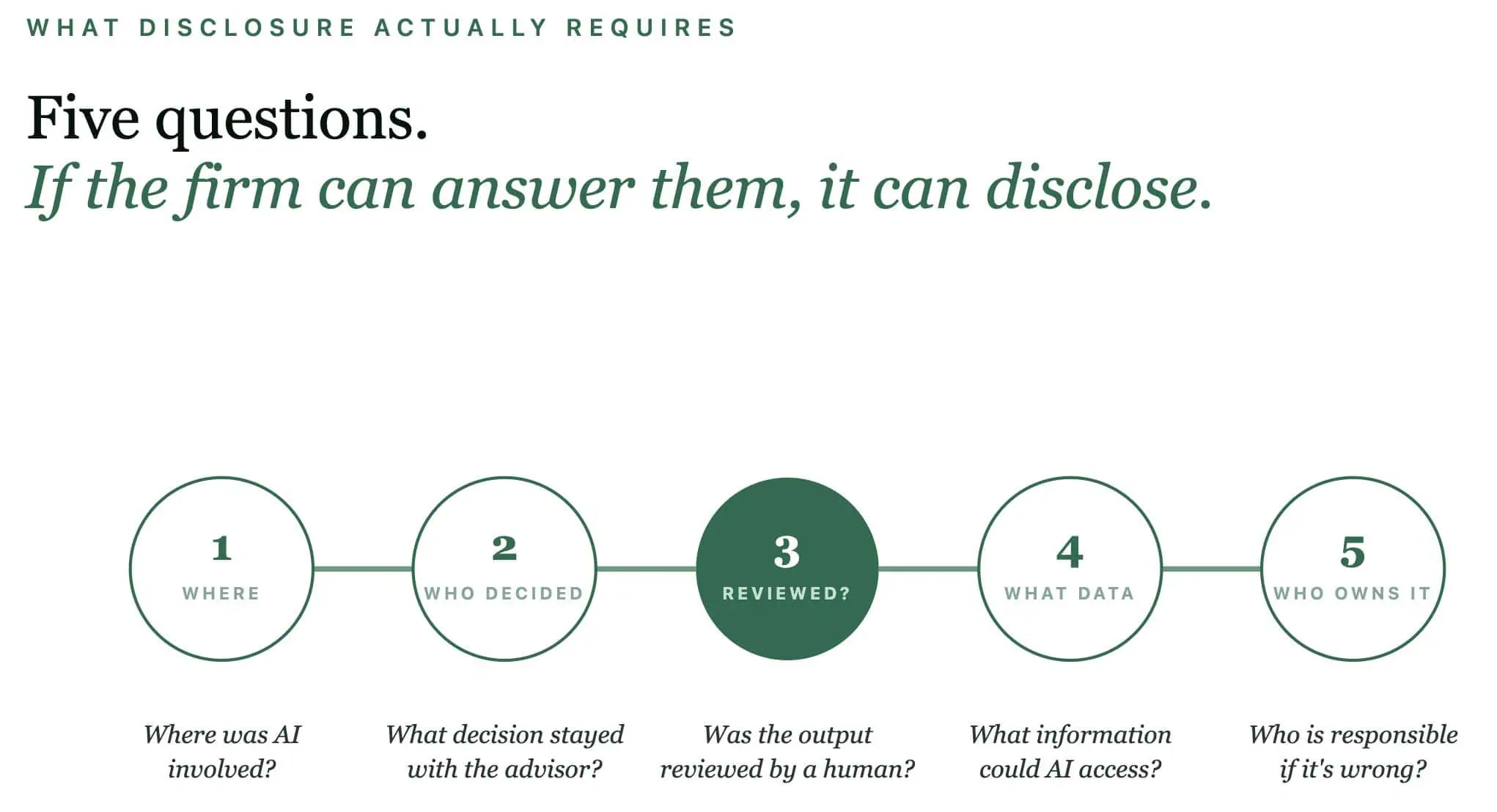
If the firm has not set rules around AI use, tracked how systems are being used and defined where review and accountability sit, the advisor may not actually know the answers. So those are not communication questions. They are a governance question.
Governability makes confident disclosure possible
Governance is the rulebook. Governability is whether the firm can actually enforce it.
A firm may have a policy saying AI cannot make an investment decision without human review. Governability means the system is set up so that AI genuinely cannot cross that line unnoticed.
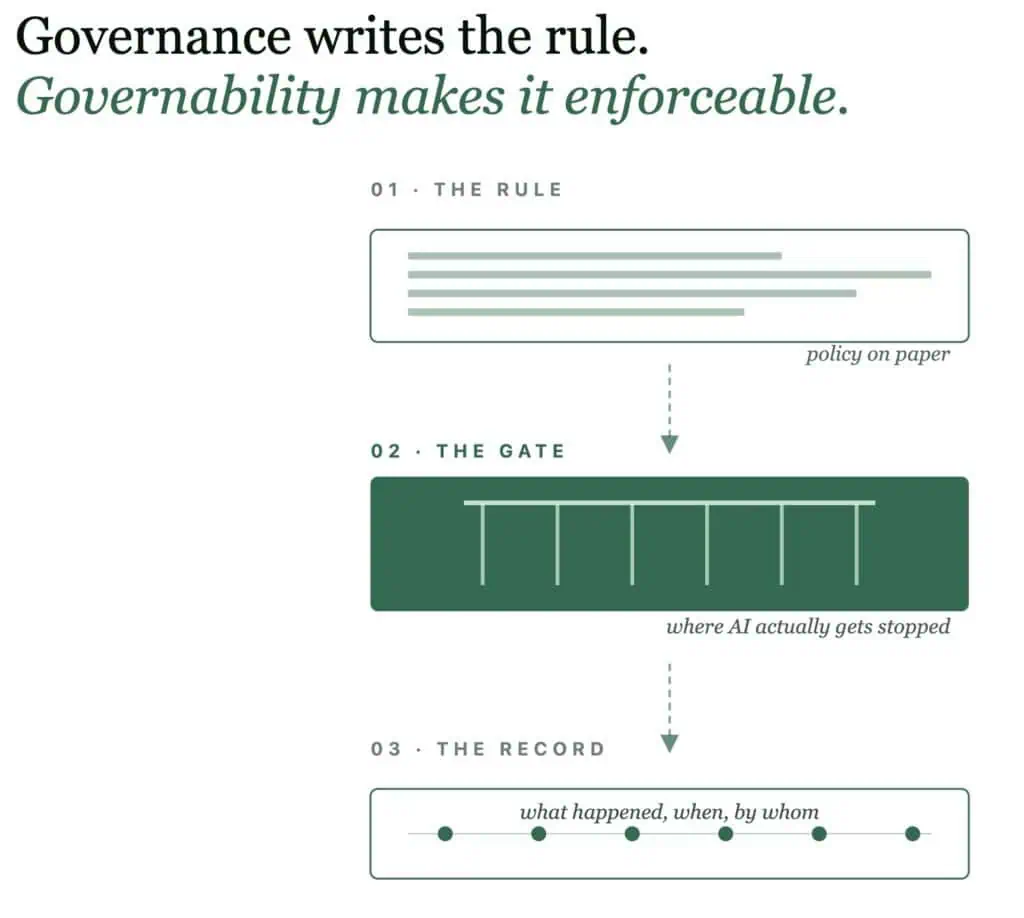
Governability means:
- Having clear rules for what AI systems can access
- What they are allowed to do
- Where human review is required
- Who remains accountable for the outcome.
- Keeping enough of a record to show that those controls were actually followed.
An advisor cannot credibly tell a client, “this was reviewed by a human” or “your data was only used for this purpose” unless the firm has systems and policies that make those statements true and verifiable.
That is very different from simply having an AI policy on paper.
It also explains why governability matters to disclosure. If a client asks how AI contributed to a recommendation, the advisor should not have to rely on a general statement about responsible use. The firm should be able to reconstruct what happened and explain it accurately.
Without that capability, transparency becomes difficult because the firm may not know enough about its own process to give the client a precise answer.
Governability is really the operational layer underneath disclosure. It gives the advisor something concrete to stand behind.
Explainable AI use is a competitive advantage
AI does not automatically make professional advice feel less valuable. Janus Henderson tested whether an advisor’s use of AI changed what affluent and high-net-worth investors were willing to pay for advice.
It found no meaningful penalty simply for using the technology. Investors appeared to care more about how AI was framed, governed and connected to the delivery of advice than about its presence alone.
That gives firms another way to think about transparency.
A clear explanation can show the client what the technology is contributing while making the advisor’s role easier to see: where judgment entered the process, where an output was challenged or reviewed, and who ultimately stands behind the recommendation.
This will become harder to do with vague assurances such as “we use AI responsibly.” Clients who understand these tools will increasingly be able to ask more specific questions. Firms that can answer them from an actual record of how the work was done will be in a stronger position.
They will also have more room to use AI ambitiously, because every new use does not create a new trust problem the firm is unable to explain.
That is where platforms such as Revenue Grid become relevant.
Revenue Grid captures client interactions across email, meetings and calendars within firm-controlled workflows, giving firms a more complete record for advisors and AI systems to work from. That underlying record also makes it easier to reconstruct the context behind an AI-assisted decision when a client or compliance team later asks how it was reached.
Explainability is becoming part of the service itself. The firm giving the client a reason to trust the process behind the advice, and not simply asking them to trust the technology will win.